

Ownmates Post

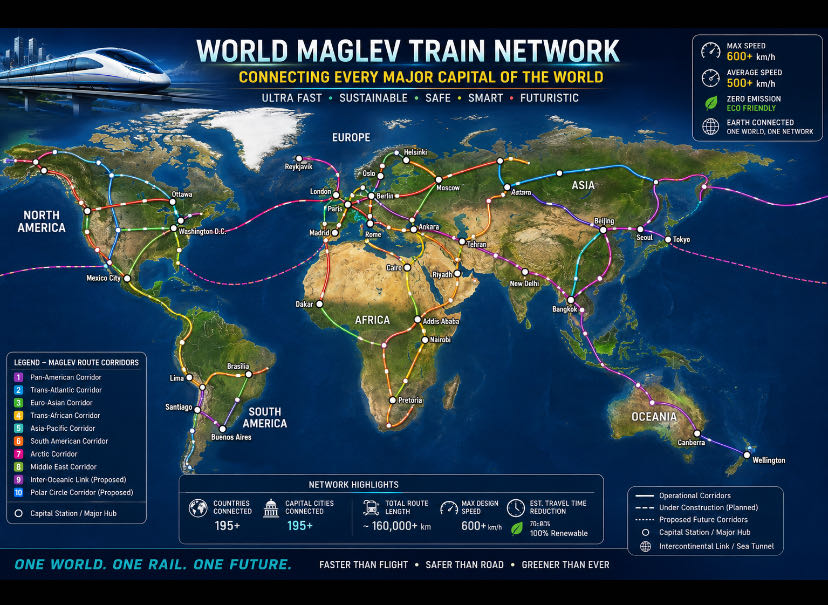
🌍 World Maglev Train Network: One Rail, One World, One Future 🚄
Imagine a world where the capitals and major cities of different countries are connected by a vast Maglev (Magnetic Levitation) Train Network. Trains would travel without physically touching the tracks, using magnetic forces to move at hundreds of kilometers per hour, potentially connecting people across continents faster than ever before.
This would not simply be a transportation system—it could become a vision for bringing the world closer together.
🚄 A Network Connecting Continents
The proposed network would connect major cities and national capitals through large regional and intercontinental Maglev corridors. Europe, Asia, Africa, North America, South America, and Australia could be connected through a combination of regional and international routes.
For example:
Delhi → Tehran → Ankara → Rome → Paris → London
Another potential corridor could connect:
Beijing → Seoul → Tokyo
A broader Asia–Europe corridor could be:
New Delhi → Beijing → Moscow → Berlin → Paris → London
Similarly, Africa could have corridors such as:
Cairo → Addis Ababa → Nairobi → Pretoria
And the Americas could be connected through routes such as:
Washington, D.C. → Mexico City → Lima → Santiago → Buenos Aires
🌐 Connecting Across Oceans
The greatest challenge would be the oceans separating continents. In the distant future, advanced undersea tunnels, bridges, or other intercontinental transportation technologies could potentially make some Maglev connections possible.
For example, a future Trans-Atlantic Maglev Corridor could theoretically connect Europe and North America. Similar concepts could be explored between Asia and North America and between Asia and Australia.
However, these are currently future concepts, and such projects would require enormous technical, economic, environmental, and geopolitical studies.
⚡ Why Is Maglev Technology Important?
Unlike conventional trains, Maglev trains do not rely on direct contact between wheels and rails. Magnetic systems can lift the train above the guideway and propel it forward.
Because there is very little mechanical friction between the train and guideway, Maglev technology has the potential to achieve extremely high speeds.
Real-world Maglev systems already exist, but a global Maglev network connecting the world’s capitals does not currently exist.
🌱 Fast, Smart, and Potentially Sustainable Transportation
If such a system were powered increasingly by clean energy, it could play an important role in long-distance transportation.
Electric transportation could potentially be integrated with solar, wind, hydroelectric, and other low-carbon energy sources, helping reduce dependence on conventional road and some air travel.
🏙️ Impact on Cities and Economies
A worldwide Maglev network would not only transport passengers from one place to another. It could also encourage international trade, tourism, education, employment, and cultural exchange.
If travel times between major cities were dramatically reduced, international business and tourism could become significantly more convenient.
💰 The Biggest Challenge: Cost
Building such a network would be extraordinarily difficult and expensive.
Thousands—or potentially hundreds of thousands—of kilometers of high-speed guideways, tunnels, bridges, stations, power systems, and safety infrastructure would require enormous investment.
In addition, countries would need to coordinate on land acquisition, border controls, security standards, engineering standards, environmental regulations, and international agreements.
Therefore, such a network could never realistically be the project of a single country. It would require large-scale international cooperation.
🤝 The Need for a Global Transportation Framework
If the world ever wants to develop a global Maglev network, countries would need to establish common technical standards, safety regulations, ticketing systems, cross-border passenger procedures, and interoperable energy and communication systems.
An international organization or multinational transportation alliance could potentially coordinate these standards and manage cooperation among participating countries.
🌍 “One World, One Rail, One Future”
The World Maglev Train Network is currently a future-oriented concept, but it raises an important question:
What if future generations measure the distance between countries not only in kilometers, but also in travel time?
A network connecting cities such as Delhi and London, Beijing and Paris, Cairo and Nairobi, or Washington, D.C. and Mexico City through an advanced high-speed rail system could represent a major transformation in the history of transportation.
It would not simply be a vision of faster trains.
It would be a vision of a world where national borders still exist, but the distance between people, cities, economies, and cultures becomes smaller.
🌐 ONE WORLD. ONE RAIL. ONE FUTURE.
One World • One Rail Network • One Shared Future


Comments
No comments yet.