

Ownmates Post

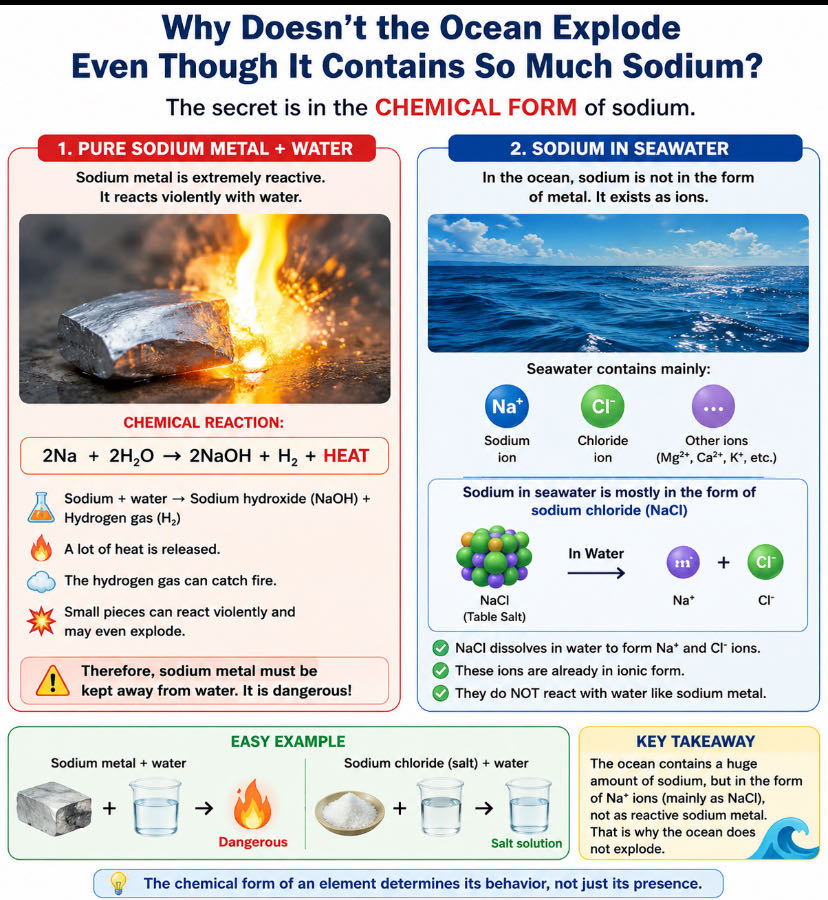
🌊 Why Doesn’t the Ocean Explode Even Though It Contains So Much Sodium?
At first, this seems like a strange question. We know that pure sodium metal reacts very rapidly with water and can produce fire or even an explosive effect. But seawater contains a large amount of sodium. So why doesn’t the ocean constantly explode?
The answer lies in the chemical form of sodium.
⚠️ What happens when pure sodium meets water?
Pure sodium is a highly reactive metal. When it comes into contact with water, a chemical reaction occurs:
2Na 2H₂O → 2NaOH H₂ heat
This reaction produces:
* Sodium hydroxide (NaOH)
* Hydrogen gas (H₂)
* A significant amount of heat
The heat can ignite the hydrogen gas, and under suitable conditions, this can produce an explosion-like reaction.
That is why pure sodium metal must be kept away from water.
⸻
🧂 But sodium in the ocean is not sodium metal
This is the most important point.
The sodium in seawater is not present as pieces of pure sodium metal (Na).
Instead, it is mainly present as sodium ions (Na⁺) dissolved in the water. Large amounts of chloride ions (Cl⁻) are also present.
Together, these are associated with sodium chloride (NaCl)—the main component of ordinary table salt.
When sodium chloride dissolves in water:
NaCl → Na⁺ Cl⁻
The sodium is now in an ionic form, not as reactive sodium metal.
⸻
🌊 So why doesn’t the ocean explode?
Think of it this way:
Pure sodium metal water → very rapid reaction 🔥
But:
Sodium chloride water → salt solution 🧂🌊
The sodium in seawater is already in a chemically different form. Na⁺ does not behave like metallic sodium (Na).
Therefore, the enormous amount of sodium dissolved in the ocean does not cause the ocean to catch fire or explode.
🔬 The key lesson
The presence of an element is not enough to determine how it behaves. Its chemical form matters enormously.
Sodium metal (Na) and sodium ion (Na⁺) are chemically very different.
So it is correct to say:
The ocean contains a huge amount of sodium, but it is mainly present as dissolved ions rather than reactive sodium metal. Therefore, it does not react with seawater like pure sodium metal does.
That is why the ocean can contain enormous amounts of sodium without exploding. 🌊


Comments
nacl to hai.