

Ownmates Post

Why Are Some Planets Rocky While Others Are Made of Gas?
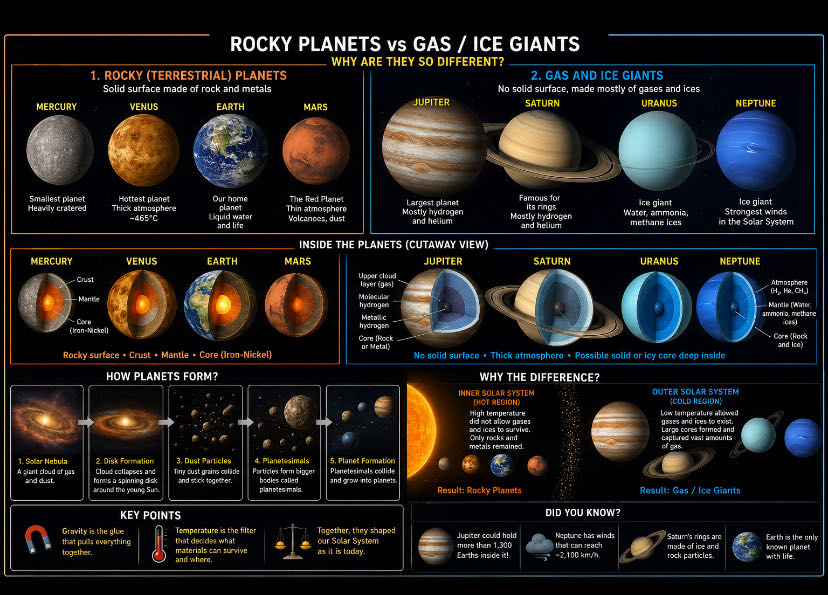
The Solar System is a fascinating place filled with planets that are very different from one another. Some planets, like Earth and Mars, have solid rocky surfaces. Others, such as Jupiter and Saturn, are enormous worlds made mostly of gas. This naturally raises an interesting question: Why did some planets become rocky while others became gas giants?
The answer lies in how the Solar System formed about 4.6 billion years ago.
The Birth of the Solar System
Everything began with a giant cloud of gas and dust known as the solar nebula. Under the force of gravity, this cloud started collapsing. Most of the material gathered at the center, where it eventually became the Sun. The remaining gas and dust formed a spinning disk around the young Sun, called the protoplanetary disk. It was from this disk that all the planets were born.
Why the Inner Planets Became Rocky
The region close to the young Sun was extremely hot. Temperatures were so high that light materials such as hydrogen, helium, water vapor, methane, and ammonia could not condense into solids. These substances either remained gases or were pushed away by intense solar radiation and the young Sun’s powerful solar wind.
However, heavier materials like iron, nickel, and silicate minerals could survive these high temperatures. They condensed into tiny solid grains that collided and stuck together over millions of years, gradually forming larger bodies known as planetesimals. These planetesimals merged into the rocky planets we know today:
* Mercury
* Venus
* Earth
* Mars
These are called terrestrial (rocky) planets because they have solid surfaces made primarily of rock and metal.
Why the Outer Planets Became Gas Giants
Farther from the Sun, temperatures were much lower. In these cold regions, not only rocks and metals but also water, ammonia, and methane could freeze into solid ice particles.
As these icy and rocky materials accumulated, they formed massive planetary cores. Once these cores became large enough, their gravity attracted enormous amounts of surrounding hydrogen and helium gas from the solar nebula. This process created the giant outer planets:
* Jupiter
* Saturn
* Uranus
* Neptune
Jupiter and Saturn are known as gas giants, while Uranus and Neptune are called ice giants because they contain larger amounts of water, ammonia, and methane ices.
Did the Sun Pull Heavy Metals More Strongly?
A common misconception is that the Sun attracted heavy elements like iron and nickel more strongly than gases.
In reality, gravity does not distinguish between different materials. If two objects have the same mass, the Sun exerts the same gravitational force on both, whether they are made of iron, hydrogen, or rock.
The real difference came from temperature.
Near the Sun:
* Only rocks and metals could remain solid.
* Light gases escaped or stayed gaseous.
Far from the Sun:
* Rocks, metals, and icy materials all survived.
* Massive planetary cores formed and captured vast amounts of gas.
Why Didn’t Everything Fall Into the Sun?
Although the Sun’s gravity pulled on all the material in the disk, the particles were already moving around the Sun at high speeds. Their orbital motion prevented them from falling directly into the Sun. Instead, they continued orbiting while colliding and gradually combining into larger objects, eventually becoming planets.
Do Gas Giants Have Solid Cores?
Although Jupiter and Saturn appear to be made entirely of gas, scientists believe they likely contain dense cores deep inside, composed of rock, metal, or a mixture of heavy elements. These cores are buried beneath thousands of kilometers of extremely dense gas and fluid, making it impossible to stand on them.
Similarly, Uranus and Neptune are thought to contain rocky cores surrounded by thick layers of superheated water, ammonia, and methane under enormous pressure.
Conclusion
The planets of our Solar System formed from the same cloud of gas and dust, yet they evolved into two very different families. The intense heat near the Sun allowed only rocks and metals to survive, leading to the formation of the four rocky planets. Farther away, the colder environment enabled gases and icy materials to accumulate, producing the giant planets.
In simple terms:
* Gravity acted like the glue that pulled material together.
* Temperature acted like the filter that determined which materials could remain and form planets.
Together, these two factors shaped the Solar System into the remarkable collection of worlds we see today.


Comments
No comments yet.