

Ownmates Post

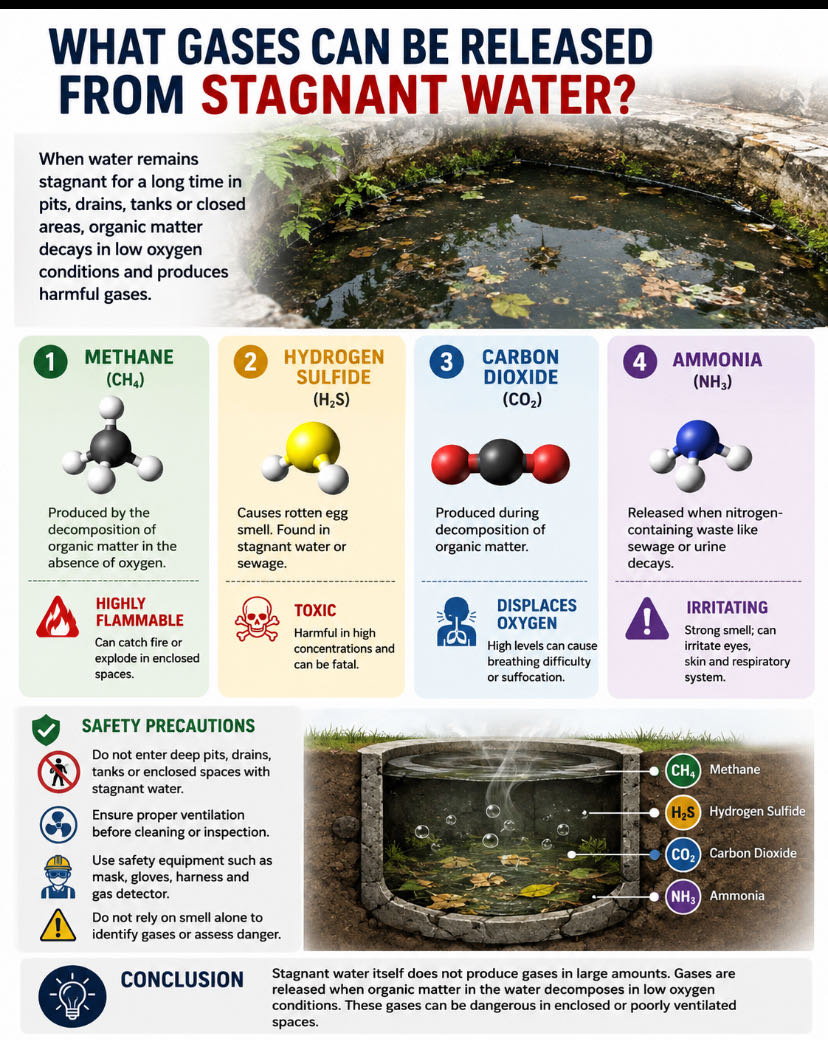
What Gases Can Be Released from Water That Has Been Standing for a Long Time?
If water remains stagnant for a long time in an empty plot, pit, drain, or enclosed area, leaves, garbage, sewage, and other organic materials may begin to decompose. When oxygen levels become low, this decomposition can produce several gases.
1. Methane (CH₄)
Methane can be produced when organic matter decomposes in an oxygen-free environment. It is a highly flammable gas and can become dangerous if it accumulates in an enclosed space.
2. Hydrogen Sulfide (H₂S)
If stagnant water or sludge has a rotten-egg-like smell, hydrogen sulfide may be present. At high concentrations, H₂S is toxic and can pose a serious health hazard.
3. Carbon Dioxide (CO₂)
Decomposition of organic matter can also produce carbon dioxide. In enclosed or deep spaces, CO₂ can accumulate and displace oxygen, potentially causing breathing difficulties and a risk of suffocation.
4. Ammonia (NH₃)
If the stagnant water contains sewage, urine, or other nitrogen-containing materials, ammonia may be released during decomposition. Its strong odor can irritate the eyes and respiratory system.
What Precautions Should Be Taken?
Do not enter a deep pit, drain, tank, or enclosed space containing stagnant water without proper safety measures. Smell alone cannot reliably identify a dangerous gas or determine its concentration. Cleaning or inspecting such areas should be done with adequate ventilation and appropriate safety equipment.
Conclusion
Stagnant water itself does not normally produce large amounts of gas. Instead, gases can be generated when organic matter present in the water or sludge decomposes, particularly under oxygen-poor conditions. These gases may include methane, hydrogen sulfide, carbon dioxide, and sometimes ammonia.


Comments
No comments yet.