

Ownmates Post

Understanding Latitude and Longitude on Earth
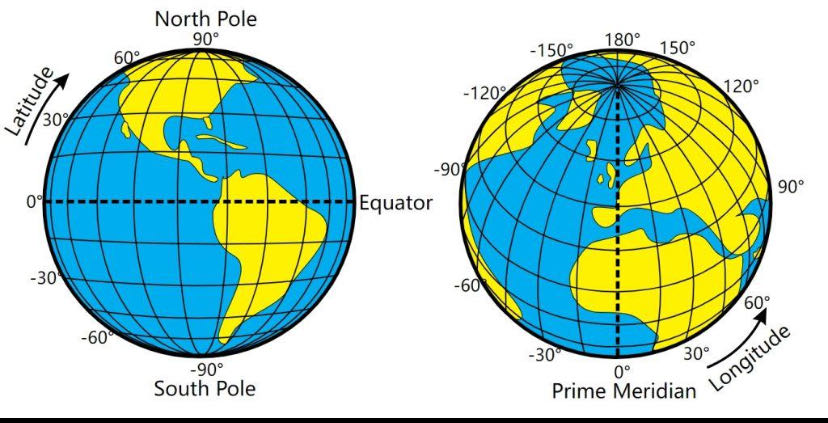
The easiest way to understand latitude and longitude is to imagine the Earth as a giant globe.
1. What is Latitude?
Latitude lines are horizontal (east–west) imaginary lines that circle the Earth.
* 0° Latitude = Equator
* 90° North (90°N) = North Pole
* 90° South (90°S) = South Pole
These lines are parallel to each other, so the distance between each degree is nearly the same everywhere on Earth.
Why is 1° of Latitude about 111 km?
The Earth’s circumference from pole to pole (along a meridian) is approximately 40,008 km.
Since a circle has 360 degrees:
40,008 ÷ 360 ≈ 111.1 km
Therefore:
* 0° to 1° Latitude ≈ 111 km
* 25° to 26° Latitude ≈ 111 km
* 60° to 61° Latitude ≈ 111 km
No matter where you are, 1° of latitude is approximately 111 kilometers.
⸻
2. What is Longitude?
Longitude lines are vertical (north–south) imaginary lines called meridians.
They run from the North Pole to the South Pole.
* 0° Longitude = Prime Meridian (Greenwich, England)
* 180° Longitude ≈ International Date Line
Unlike latitude, longitude lines are not parallel.
⸻
3. Why does the distance of 1° Longitude change?
This is the key difference.
Longitude lines:
* Are widest apart at the Equator.
* Move closer together as they approach the poles.
* Meet at a single point at both the North Pole and South Pole.
Because of this, the distance represented by 1° of longitude decreases as you move away from the Equator.
⸻
4. Distance of 1° Longitude at Different Latitudes
Latitude Distance of 1° Longitude
0° (Equator) 111.32 km
10° 109.6 km
20° 104.6 km
30° 96.5 km
40° 85.3 km
45° 78.7 km
50° 71.7 km
60° 55.8 km
70° 38.2 km
80° 19.4 km
90° (Pole) 0 km
⸻
5. Why does this happen?
Imagine an orange.
Draw several lines from the top to the bottom.
* Around the middle (the Equator), the lines are far apart.
* As they move toward the top or bottom, they get closer together.
* At the very top, they all meet at one point.
Longitude lines on Earth behave exactly the same way.
⸻
6. Easy Rule to Remember
Latitude
* ✅ Horizontal lines
* ✅ Always parallel
* ✅ 1° ≈ 111 km almost everywhere on Earth
Longitude
* ✅ Vertical lines
* ✅ Meet at both poles
* ✅ 1° ≈ 111 km only at the Equator
* ✅ The distance becomes smaller toward the poles
* ✅ At the poles, 1° Longitude = 0 km
Summary
* Latitude measures north–south position and has an almost constant spacing of 111 km per degree.
* Longitude measures east–west position, but its spacing depends on latitude because all longitude lines converge at the poles.
* At the Equator, 1° of longitude is about 111.32 km, while at the North Pole or South Pole, it is 0 km.


Comments
No comments yet.