

Ownmates Post

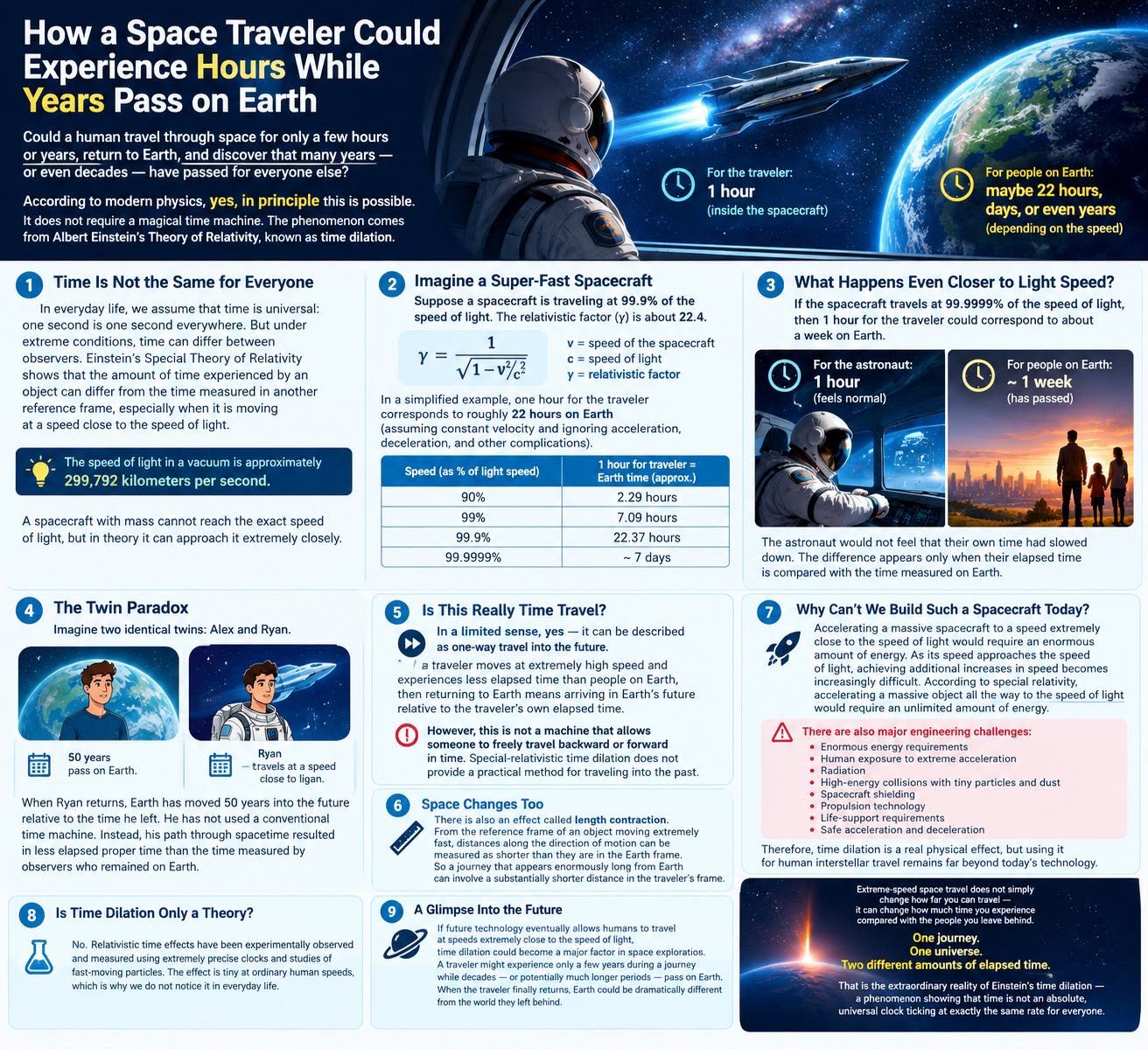
⏳ TIME DILATION: The Universe Where Time Can Slow Down
What if you could travel into the future without pressing a time machine button?
It sounds like science fiction—but according to Einstein’s theory of relativity, nature itself allows something remarkably similar.
Time does not necessarily pass at the same rate for everyone.
A clock on Earth, a clock moving through space at an enormous speed, and a clock near a powerful gravitational field can all experience different amounts of elapsed time.
🚀 Imagine Traveling Near the Speed of Light
Imagine a spacecraft capable of traveling at 99.9% of the speed of light.
You leave Earth and travel through space while your family and friends remain behind.
From your perspective, your own clock behaves normally. Your heartbeat feels normal. Your thoughts feel normal. Nothing seems strange.
But when you eventually return to Earth, something extraordinary has happened:
More time has passed for the people who stayed behind than for you.
You have effectively traveled into Earth’s future.
This is called relativistic time dilation.
🌌 Gravity Can Bend Time Too
The story becomes even more extraordinary near massive objects.
According to Einstein’s General Relativity, gravity affects the passage of time.
The stronger the gravitational field, the slower a clock runs relative to a clock farther away from that gravitational field.
Near an extremely massive object—such as a black hole—the difference can become enormous.
For a distant observer, a clock close to a black hole can appear to run extraordinarily slowly.
🕰️ There Is No Universal Cosmic Clock
This leads to one of the most profound ideas in modern physics:
There is no single master clock governing the entire universe.
Time is intertwined with space, motion, and gravity.
Two people can follow different paths through spacetime and experience different amounts of elapsed time between the same events.
And yet, for each person, their own clock always appears to tick normally.
🛰️ The Effect Exists in the Real World
Time dilation is not merely a thought experiment.
Scientists have measured relativistic effects with extremely precise clocks, and systems such as GPS must account for relativity to maintain accurate positioning.
So the strange behavior of time is not just something that happens in distant galaxies.
It is happening around us—even here on Earth.
🔥 The Ultimate Idea
We cannot simply stop time.
We cannot turn a machine’s dial and choose tomorrow.
But the laws of physics allow something far more fascinating:
By changing your speed or your position in a gravitational field, you can change how much time you experience compared with someone else.
The universe does not simply contain space and time.
Space and time are woven together—and the motion of matter and the presence of gravity can change how that fabric is experienced.
Time is not a universal ticking clock.
It is part of the structure of the universe itself.


Comments
No comments yet.