

Ownmates Post
🌍 The Future of Humanity and Artificial Intelligence: A New Era of Intelligence
Human civilization is standing at the edge of one of its greatest transformations. The rise of Artificial Intelligence (AI) is not just a technological shift—it is a complete redefinition of how humans live, learn, heal, and evolve. To understand this future, we must explore both human life and machine intelligence together.
⸻
🧬 The Human Lifespan: Nature’s Design
Human beings are biological systems shaped by nature over millions of years. The average human lifespan today ranges between 65–75 years, while advancements in healthcare can extend it beyond 100 years in rare cases. The longest verified human lifespan belongs to Jeanne Calment, who lived 122 years.
Human life is influenced by:
• Genetics
• Nutrition and lifestyle
• Environment
• Healthcare systems
• Mental and emotional well-being
Despite all progress, aging remains a natural and unavoidable biological process.
⸻
🤖 Artificial Intelligence: A Non-Biological Revolution
Unlike humans, AI is not alive. It has no birth, aging, or death. AI exists as a system of algorithms running on digital infrastructure powered by companies like Google and Amazon.
AI continues to function as long as:
• Servers are active
• Electricity and networks are available
• Software is maintained and updated
This makes AI potentially indefinite in existence, limited only by human control and technological continuity.
⸻
🧠 Can AI Extend Human Life?
AI cannot make humans immortal, but it is already reshaping medicine and longevity science in powerful ways.
🔬 Medical Revolution
AI helps detect diseases such as cancer, heart disorders, and neurological conditions at early stages. Early detection often means higher survival rates and longer life expectancy.
💊 Drug Discovery
AI accelerates the creation of new medicines by analyzing massive biological data in seconds, a process that once took years.
🧑⚕️ Personalized Healthcare
Modern AI systems can design customized treatment plans based on an individual’s genetic makeup, lifestyle, and medical history.
🧘♂️ Preventive Health
AI-powered applications track sleep, diet, stress, and activity, helping people live healthier and longer lives.
⸻
🌿 Human Life in a Natural Future
Even in a world where humans choose a simple or natural lifestyle, AI can still play a supporting role:
• Supporting farmers with weather predictions
• Helping remote villages access healthcare
• Improving education without traditional classrooms
• Providing early disaster warnings
However, AI remains a tool, not a necessity.
⸻
⚖️ The Balance Between Human and Machine
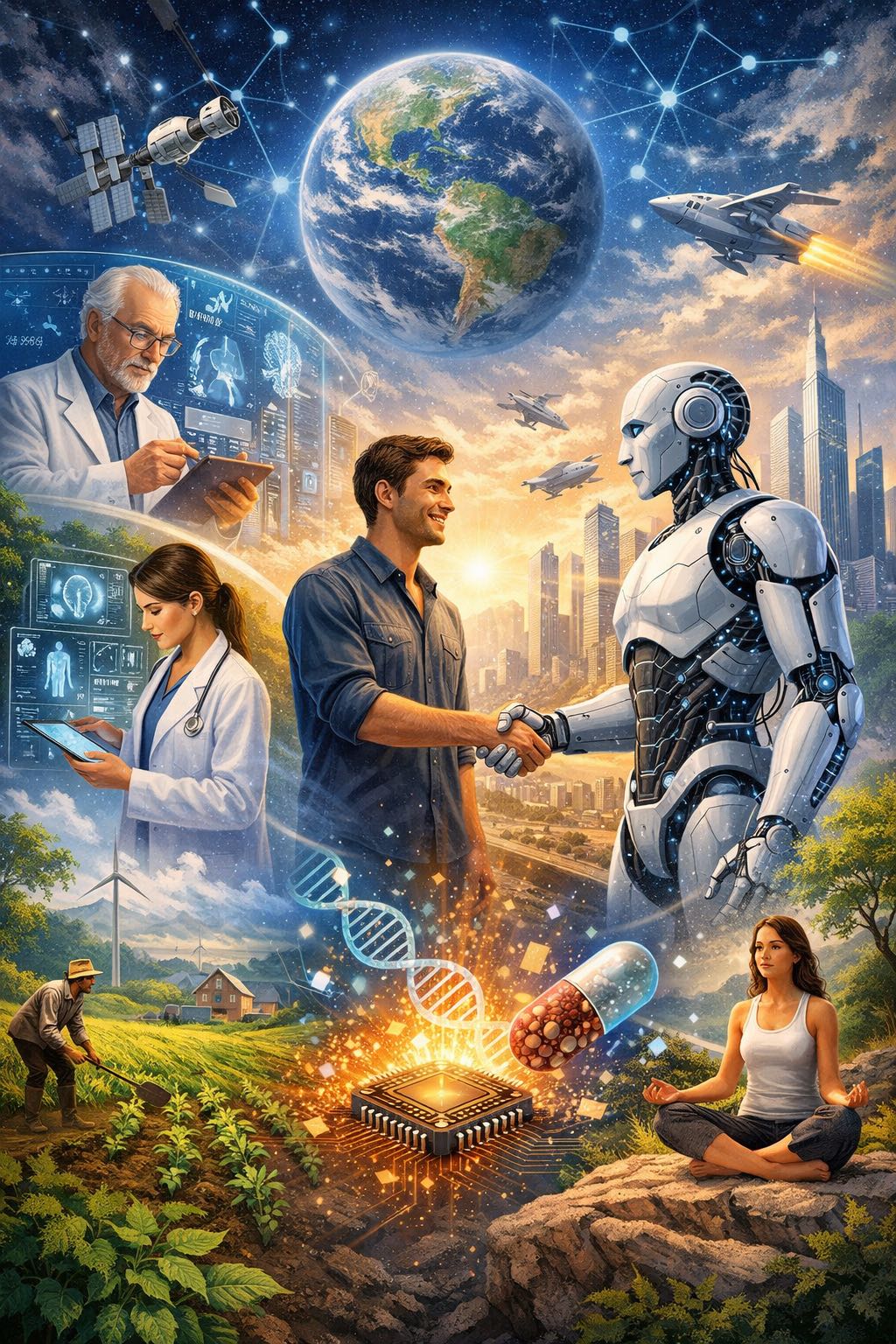
The future is not about AI replacing humans, but about collaboration. Humans provide creativity, emotion, and ethics. AI provides speed, analysis, and precision.
This balance creates a powerful synergy:
• Humans decide what is right
• AI helps determine what is efficient
⸻
🚀 Conclusion: A Shared Future
The relationship between humans and AI defines the next chapter of civilization. Humans have a limited biological lifespan, while AI systems may continue indefinitely through technological evolution.
Yet one truth remains constant:
AI cannot replace humanity—it can only extend and enhance it.
The future belongs not to humans or machines alone, but to both working together in harmony to shape a smarter, healthier, and more connected world.


Comments
No comments yet.