

Ownmates Post

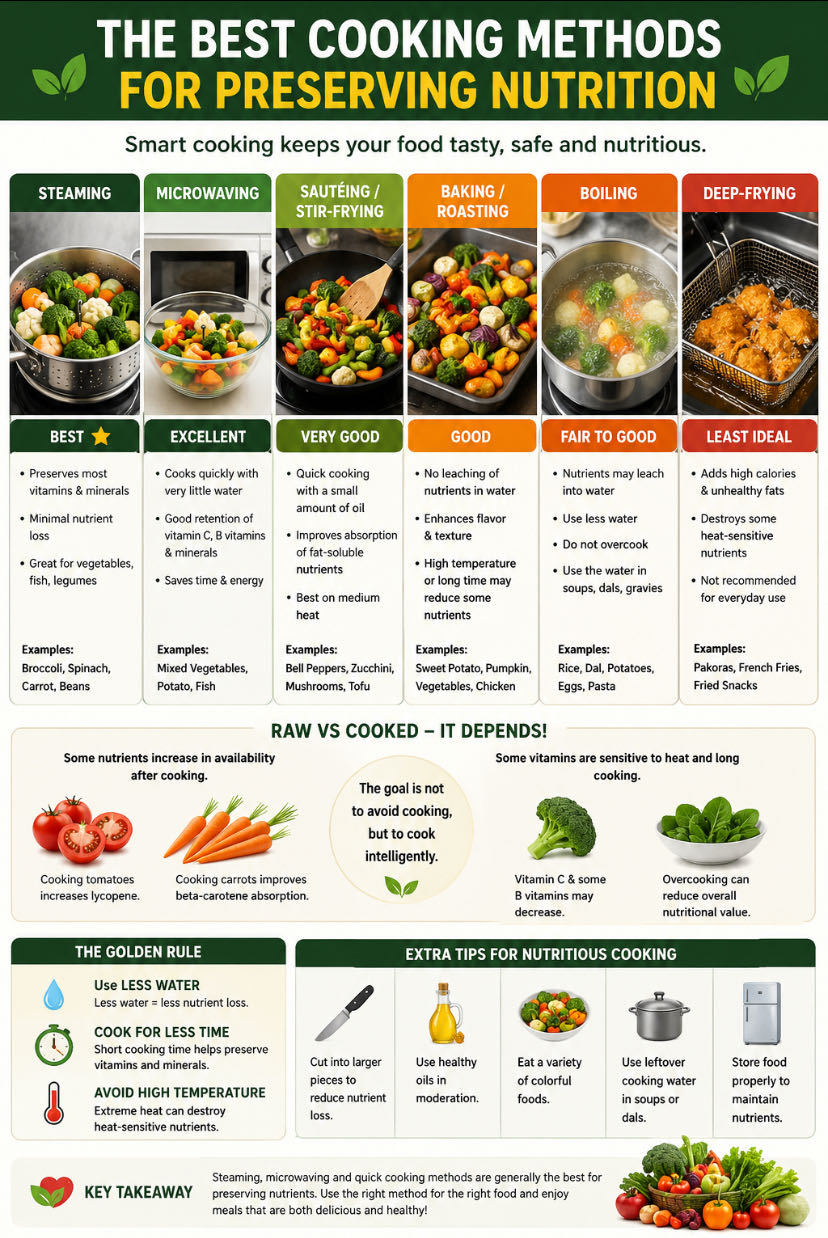
The Best Cooking Methods for Preserving Nutrition
Eating nutritious food is important, but how we cook that food can be just as important. Heat, water, cooking time, and the cooking method can all influence the nutrients that remain in our food. Some nutrients may be lost during cooking, while others can actually become easier for the body to absorb.
There is therefore no single cooking method that is best for every food. However, some methods generally do a better job of preserving nutrients than others.
1. Steaming — One of the Best Methods
Steaming is one of the best ways to cook vegetables while preserving their nutritional value.
Because the food is not immersed in water, fewer water-soluble nutrients such as vitamin C and some B vitamins are likely to leach into the cooking water.
Vegetables such as broccoli, spinach, cauliflower, carrots, green beans, and other vegetables can be lightly steamed until they are tender but still retain their texture.
2. Boiling — Good, But Don’t Throw Away the Water
Boiling is simple and convenient, but it has one major disadvantage: some water-soluble vitamins can move from the food into the cooking water.
This is particularly relevant for vitamin C and certain B vitamins.
A simple solution is to use only the amount of water necessary and, when possible, use the remaining cooking liquid in soups, curries, or gravies rather than throwing it away.
The shorter the cooking time, the better the chance of preserving heat-sensitive nutrients.
3. Light Sautéing and Stir-Frying
Cooking vegetables quickly with a small amount of oil can also be an excellent method.
Some nutrients and plant compounds, particularly carotenoids such as beta-carotene, can become more bioavailable after cooking. A small amount of dietary fat can also help the body absorb fat-soluble compounds.
The key is to avoid excessive heat and prolonged cooking.
4. Baking and Roasting
Baking and roasting have an advantage because food is not submerged in water. This reduces the loss of water-soluble nutrients into cooking water.
However, very high temperatures and prolonged cooking can reduce some heat-sensitive nutrients, including vitamin C and folate.
At the same time, cooking can make certain plant compounds easier for the body to absorb. Therefore, roasting is not necessarily harmful to nutrition—it depends on the food, temperature, and cooking time.
5. Microwave Cooking
Microwave cooking is sometimes misunderstood as being unhealthy, but the cooking method itself does not automatically make food less nutritious.
Because microwaving can cook food quickly with very little water, it can preserve many nutrients effectively.
In fact, minimizing both cooking time and water exposure can be beneficial for preserving certain vitamins.
6. Raw Food Is Not Always More Nutritious
It is commonly believed that raw vegetables are always healthier than cooked vegetables. This is not entirely true.
Cooking can break down plant cell structures and make certain compounds more accessible to the body. For example, cooking tomatoes can increase the availability of lycopene, while cooking some orange and green vegetables can improve the accessibility of carotenoids.
So the question is not simply, “Is it raw or cooked?” The more important question is which cooking method makes the nutrients most useful to the body?
A Practical Ranking
For many vegetables, a useful general guide is:
Cooking Method General Nutritional Benefit
Steaming Excellent
Microwaving with little water Excellent
Light sautéing/stir-frying Very good
Baking/roasting Good
Boiling Good, especially when cooking water is reused
Deep-frying Less suitable for everyday cooking
This is not an absolute ranking. Different foods respond differently to heat, water, and cooking time.
The Golden Rule of Healthy Cooking
The simplest principle is:
Use less water, cook for less time, and avoid unnecessarily high temperatures.
For vegetables, steaming or quick cooking with a small amount of water is often an excellent choice. If you boil food, consider using the cooking liquid rather than discarding it. Baking, roasting, and light stir-frying can also be nutritious when done properly.
Conclusion
Healthy eating is not only about what we eat—it is also about how we prepare it.
There is no universally perfect cooking method. The best approach is to use a variety of methods according to the food. In general, steaming, quick cooking, and using minimal water are excellent ways to preserve nutrients, while moderate roasting, baking, and sautéing can also provide significant nutritional benefits.
The goal is not to avoid cooking, but to cook intelligently—preserving nutrients while making food safe, digestible, and enjoyable.


Comments
No comments yet.