

Ownmates Post

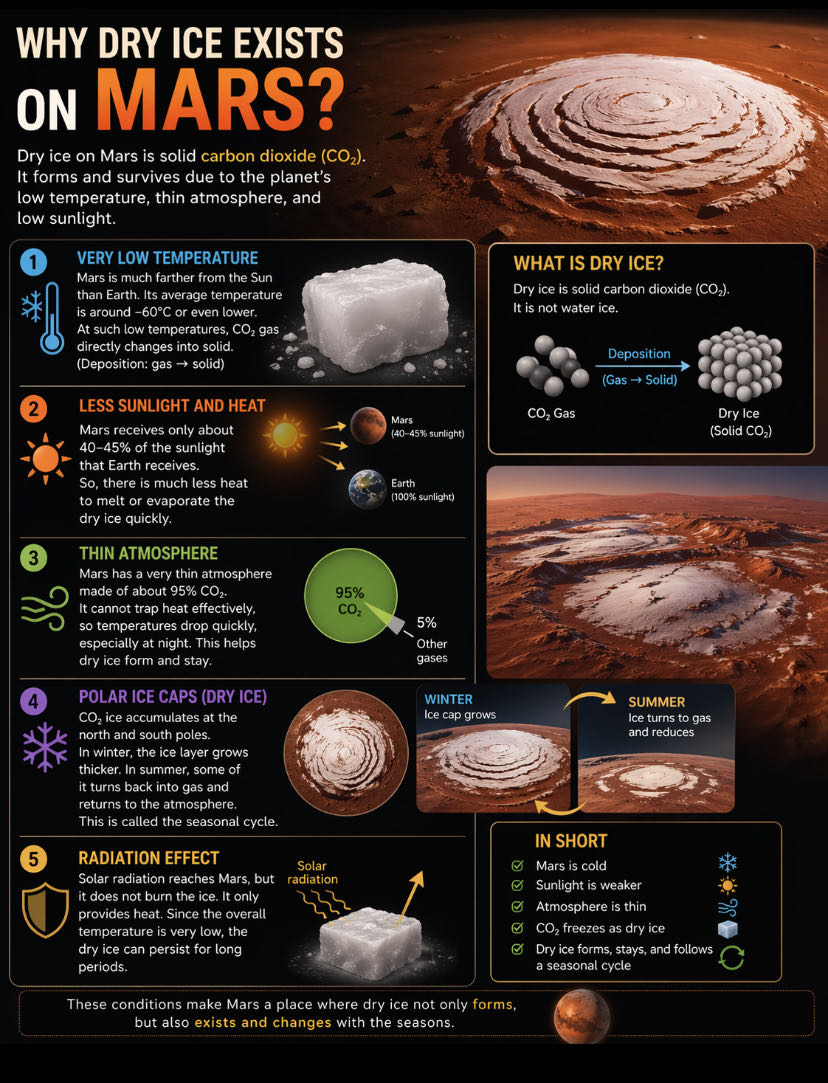
On Mars, the formation of “dry ice” is possible due to its unique environmental conditions. Dry ice is actually solid carbon dioxide (CO₂), which forms when CO₂ gas directly turns into a solid at very low temperatures—a process known as deposition. The average temperature on Mars is around −60°C or even lower, which allows CO₂ to freeze easily into solid form.
Mars also receives only about 40–45% of the sunlight that Earth gets, so there is much less heat available to warm the surface. Because of this reduced solar energy, the dry ice does not quickly disappear. In addition, Mars has a very thin atmosphere composed of about 95% CO₂. This thin atmosphere cannot retain heat effectively, causing temperatures to drop rapidly, especially at night, which further supports the formation of dry ice.
Large amounts of CO₂ ice are found at the north and south polar regions of Mars. During winter, these ice layers grow thicker as more CO₂ freezes, while in summer, some of the ice turns back into gas and returns to the atmosphere. This process is known as a seasonal cycle.
Although solar radiation reaches Mars, it does not destroy the ice directly; it only provides heat. Since the overall temperature remains very low, dry ice can exist and persist on the planet for long periods.


Comments
No comments yet.