

Ownmates Post

🇲🇷 Mauritania: Iron Ore, Gold, and Why It Is Still Not a Rich Country
Mauritania is a resource-rich country in West Africa with large deposits of iron ore, gold, fishing resources, and potential gas reserves. Its ports, especially Nouadhibou, handle continuous mineral exports to global markets. Despite this, the country has not become wealthy even after decades of mining.
The reason is not a lack of resources, but how the economy is structured.
⸻
⛏️ 1) Resource-rich but value-poor economy
Mauritania’s main exports are:
* 🪨 Iron ore (dominant export)
* 🟡 Gold (growing sector)
* 🎣 Fishing products
However, the country mostly exports raw materials, not finished industrial products.
👉 Iron ore is extracted in Mauritania,
but steel and high-value products are produced in Europe and China.
This means:
* Low profit per unit exported
* High value creation happens outside the country
⸻
🚆 2) Nouadhibou railway and export-based system
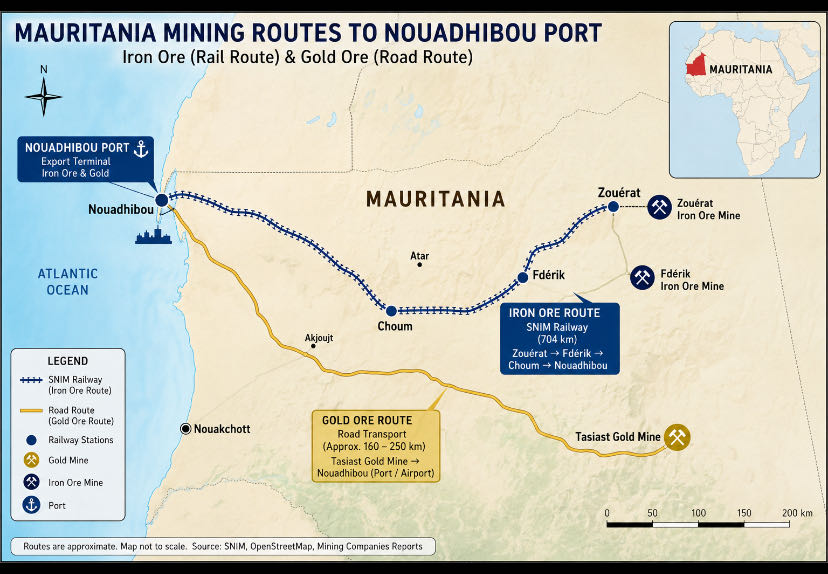
Iron ore is transported from the Zouérat mines to Nouadhibou port via one of the world’s longest heavy freight trains.
This system is efficient but focused on one thing:
👉 extraction and export
It does not support:
* large-scale industrial growth
* massive job creation
* diversified economic development
⸻
🏭 3) Mining generates revenue, but few jobs
Mining is highly capital-intensive:
* heavy machinery 🤖
* automation 🚜
* limited workforce 👷
So:
* Revenue is high
* Employment generation is low
👉 Wealth is created, but not widely distributed through jobs.
⸻
🌍 4) Over-dependence on a few sectors
Mauritania’s economy is heavily dependent on:
* mining (iron ore gold)
* fishing
This creates vulnerability:
👉 If global iron ore prices fall, the entire economy is affected.
This is known as a resource dependency trap.
⸻
🏜️ 5) Geography and desert constraints
A large part of Mauritania is covered by the Sahara Desert:
* agriculture is difficult 🌵
* settlements are scattered
* infrastructure is expensive to build
👉 This limits industrial and agricultural expansion.
⸻
🏗️ 6) Weak industrial base
Mauritania lacks:
* steel production industries
* large manufacturing sector
* strong domestic value chains
So:
👉 it remains a raw material exporter rather than an industrial economy.
⸻
🏛️ 7) Governance and development challenges
Long-term structural issues include:
* historical political instability
* weak institutions
* corruption risks
* slow diversification policies
👉 These factors reduce how effectively resource revenue is converted into development.
⸻
🟡 Gold and Uranium role
* 🟡 Gold (especially Tasiast mine) is a significant second export
* ☢️ Uranium has been discovered but is not yet a major commercial industry
However:
👉 neither has replaced iron ore as the economic backbone.
⸻
⚖️ 8) The key truth
Mauritania’s problem is not lack of resources.
👉 The real issue is:
It exports raw materials but does not build enough value-added industries.
⸻
🇲🇷 Conclusion
Mauritania remains relatively poor because:
* it exports raw resources instead of finished goods
* mining creates limited employment
* the economy depends on a few sectors
* industrial development is weak
* geography makes diversification difficult
* governance and infrastructure challenges slow growth
⸻
🧠 One-line summary
👉 Mauritania is resource-rich but not wealthy because it lacks industrialization, economic diversification, and value-added production within its economy.
🚢 🌍 Shipping Routes from Nouadhibou Port (Mauritania)
Nouadhibou Port mainly handles bulk cargo shipping (especially iron ore) and follows global maritime trade lanes. It does not operate fixed passenger routes; instead, shipping depends on demand and international trade contracts.
⸻
🌍 Main Shipping Routes
🇪🇺 1) Europe (Most Important Market)
* 🇬🇧 Port of Southampton (UK) → steel and industrial cargo
* 🇪🇸 Spain (Canary Islands, Barcelona, Bilbao)
* 🇫🇷 France (Marseille, Le Havre)
👉 Europe is the primary trading partner for Mauritanian exports.
⸻
🌏 2) Asia (Especially China)
* 🇨🇳 China → largest buyer of iron ore
* Long-distance bulk carrier routes via:
* Atlantic Ocean
* Indian Ocean
* South China Sea / Pacific routes
👉 These are the longest and most important global shipping routes.
⸻
🌍 3) West Africa (Regional Trade)
* 🇸🇳 Senegal (Dakar)
* 🇲🇦 Morocco (Casablanca, Tangier)
👉 These routes support regional trade and shorter cargo movements.
⸻
🇧🇷 4) South America (Limited Trade)
* 🇧🇷 Brazil → mining and raw material exchange routes
👉 These are less frequent but still part of global bulk trade networks.
⸻
⚓ Role of Nouadhibou Port
* 🪨 Major iron ore export terminal (from Zouérat mines)
* 🚢 Bulk cargo shipping hub
* 🎣 Fishing industry center
* 🌍 Key Atlantic Ocean trade gateway
⸻
🧭 Simple Flow Idea
Mauritania (Nouadhibou)
→ Europe (UK, Spain, France)
→ Asia (China)
→ West Africa (Senegal, Morocco)
→ Occasional South America routes


Comments
No comments yet.