

Ownmates Post

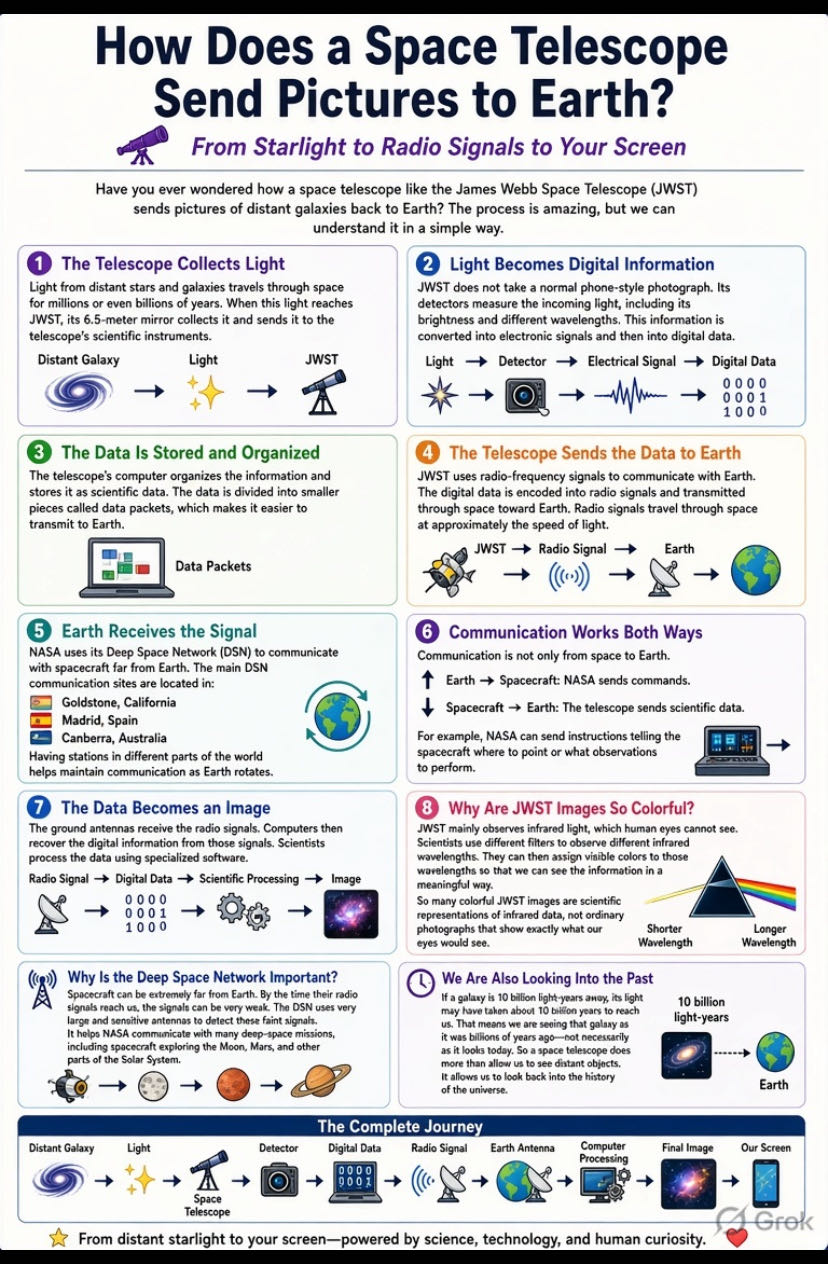
🌌 How Does a Space Telescope Send Pictures to Earth?
🔭 From Starlight to Radio Signals to Your Screen
Have you ever wondered how a space telescope like the James Webb Space Telescope (JWST) sends pictures of distant galaxies back to Earth?
The process is amazing, but we can understand it in a simple way.
🔭 1. The Telescope Collects Light
Light from distant stars and galaxies travels through space for millions or even billions of years.
When this light reaches JWST, its 6.5-meter mirror collects it and sends it to the telescope’s scientific instruments.
Distant Galaxy 🌌 → Light ✨ → JWST 🔭
📷 2. Light Becomes Digital Information
JWST does not take a normal phone-style photograph.
Its detectors measure the incoming light, including its brightness and different wavelengths. This information is converted into electronic signals and then into digital data.
In simple terms:
Light → Detector → Electrical Signal → Digital Data
💻 3. The Data Is Stored and Organized
The telescope’s computer organizes the information and stores it as scientific data.
The data is divided into smaller pieces called data packets, which makes it easier to transmit to Earth.
📡 4. The Telescope Sends the Data to Earth
JWST uses radio-frequency signals to communicate with Earth.
The digital data is encoded into radio signals and transmitted through space toward Earth.
JWST 🛰️ → 📡 Radio Signal → 🌍 Earth
Radio signals travel through space at approximately the speed of light.
🌍 5. Earth Receives the Signal
NASA uses its Deep Space Network (DSN) to communicate with spacecraft far from Earth.
The main DSN communication sites are located in:
🇺🇸 Goldstone, California
🇪🇸 Madrid, Spain
🇦🇺 Canberra, Australia
Having stations in different parts of the world helps maintain communication as Earth rotates.
🔄 6. Communication Works Both Ways
Communication is not only from space to Earth.
Earth → Spacecraft: NASA sends commands.
Spacecraft → Earth: The telescope sends scientific data.
For example, NASA can send instructions telling the spacecraft where to point or what observations to perform.
💻 7. The Data Becomes an Image
The ground antennas receive the radio signals.
Computers then recover the digital information from those signals. Scientists process the data using specialized software.
The basic process is:
Radio Signal → Digital Data → Scientific Processing → Image 🌌
The final image can then be studied by scientists and shared with the public.
🌈 8. Why Are JWST Images So Colorful?
JWST mainly observes infrared light, which human eyes cannot see.
Scientists use different filters to observe different infrared wavelengths.
They can then assign visible colors to those wavelengths so that we can see the information in a meaningful way.
So many colorful JWST images are scientific representations of infrared data, not ordinary photographs that show exactly what our eyes would see.
📡 Why Is the Deep Space Network Important?
Spacecraft can be extremely far from Earth. By the time their radio signals reach us, the signals can be very weak.
The DSN uses very large and sensitive antennas to detect these faint signals.
It helps NASA communicate with many deep-space missions, including spacecraft exploring the Moon, Mars, and other parts of the Solar System.
🌌 The Complete Journey
A space telescope’s image can make an incredible journey:
Distant Galaxy 🌌
↓
Light ✨
↓
Space Telescope 🔭
↓
Detector 📷
↓
Digital Data 💻
↓
Radio Signal 📡
↓
Earth Antenna 🌍
↓
Computer Processing 💻
↓
Final Image 🌈
↓
Our Screen 📱
⏳ We Are Also Looking Into the Past
There is another amazing part.
If a galaxy is 10 billion light-years away, its light may have taken about 10 billion years to reach us.
That means we are seeing that galaxy as it was billions of years ago—not necessarily as it looks today.
So a space telescope does more than allow us to see distant objects.
It allows us to look back into the history of the universe. 🌌🔭


Comments
No comments yet.