

Ownmates Post

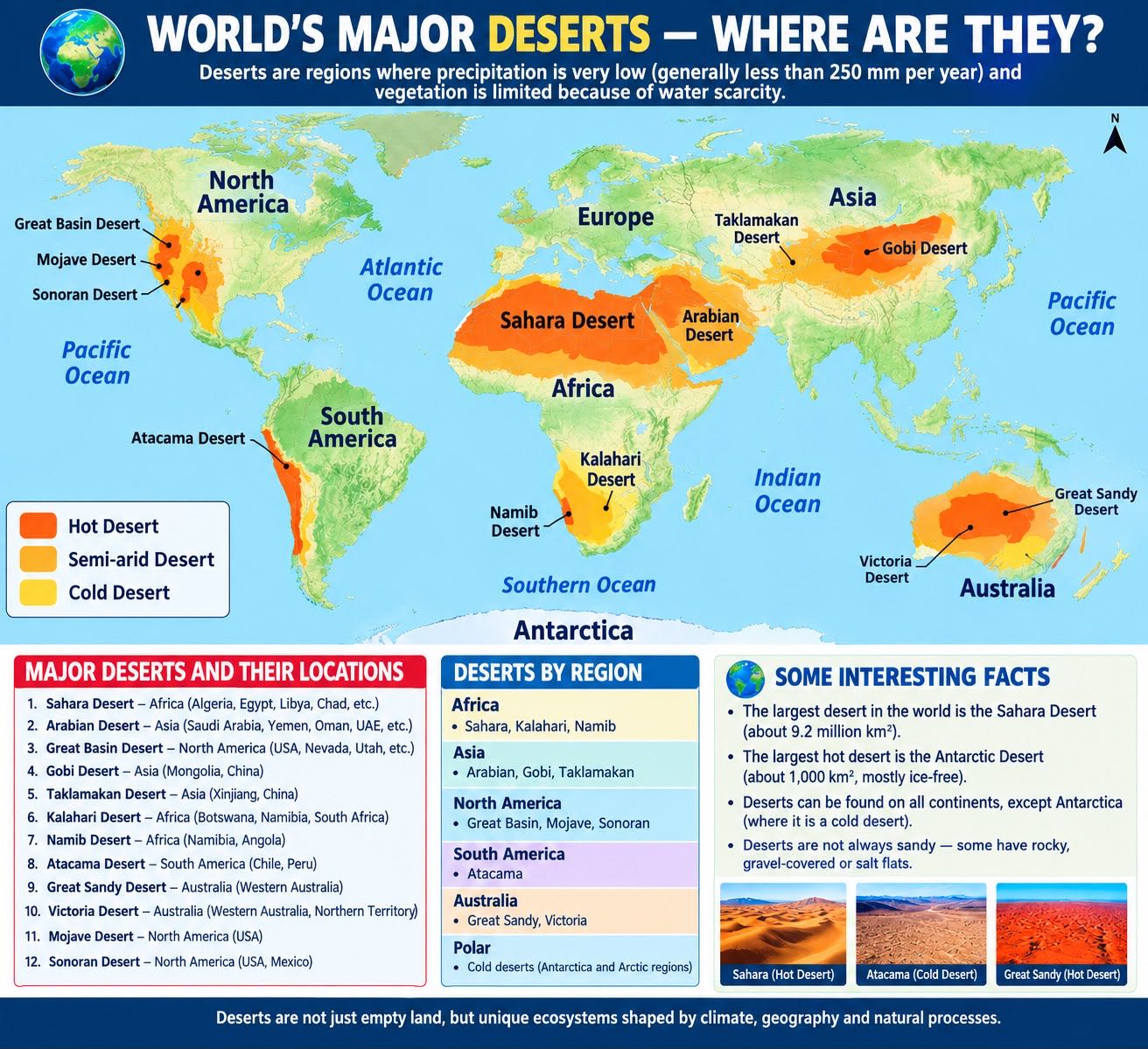
How do deserts form?
A desert forms mainly when an area receives very little precipitation and loses more water through evaporation than it receives from rain or snowfall.
Main causes:
1. ☀️ Subtropical high pressure — Around 20°–30° north and south, descending dry air suppresses rainfall. This helps create deserts such as the Sahara and Arabian Desert.
2. 🏔️ Rain shadow effect — Mountains force moist air to rise and rain on one side. The air becomes much drier on the other side, creating a dry region. This occurs in parts of Central Asia and elsewhere.
3. 🌊 Cold ocean currents — Cold currents can reduce evaporation and rainfall along nearby coasts. The Atacama Desert is strongly influenced by the cold Humboldt Current.
4. 🌍 Distance from the ocean — Inland regions may receive very little moisture from the sea. Parts of the Gobi Desert are extremely dry for this reason.
5. ❄️ Polar conditions — Deserts don’t have to be hot or sandy. Antarctica is the world’s largest desert because it receives extremely little precipitation.
In simple terms:
Low precipitation dry air high evaporation = desert conditions.
And importantly, not all deserts are sandy—many are rocky, gravel-covered, or covered by salt.


Comments
thank you for informing