

Ownmates Post

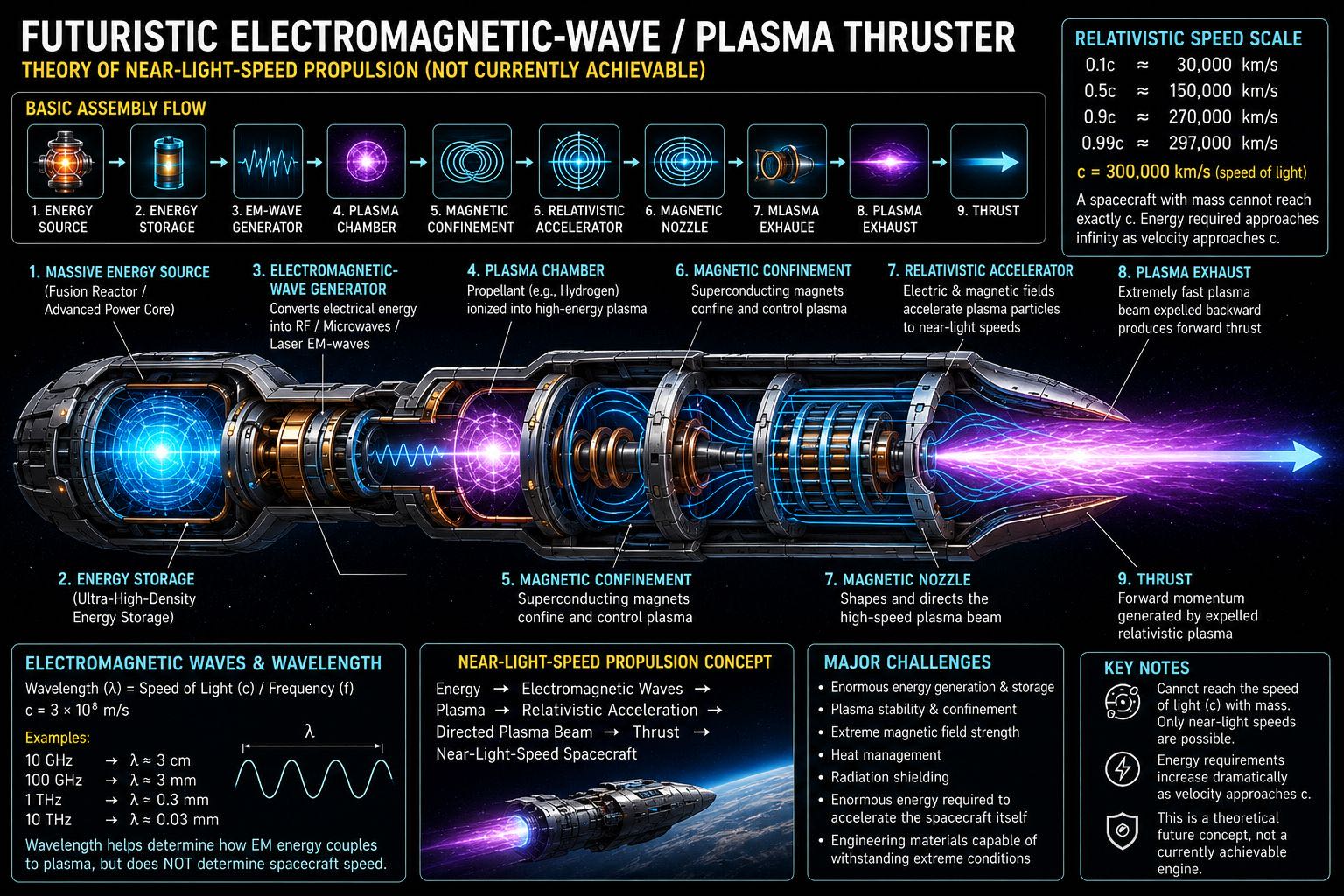
🌌 Futuristic Electromagnetic-Wave / Plasma Thruster
If by 300,000 km/s you mean the speed of light, we can imagine a theoretical relativistic electromagnetic-wave/plasma propulsion system. However, this is a future concept—not a currently achievable engine.
Basic Assembly
Massive Energy Source → Energy Storage → EM-Wave Generator → Plasma Chamber → Magnetic Confinement → Relativistic Accelerator → Magnetic Nozzle → Plasma Exhaust → Thrust
1. ⚡ Massive Energy Source
The system would require an enormous energy supply, potentially from a future fusion reactor or another extremely high-energy technology.
2. 📡 Electromagnetic-Wave Generator
Electrical energy would be converted into RF, microwave, or laser electromagnetic energy.
The wavelength is related to frequency:
For example:
10 GHz → wavelength ≈ 3 cm
The wavelength would help determine how electromagnetic energy couples to the plasma, but wavelength itself does not determine spacecraft speed.
3. 🔥 Plasma Chamber
A propellant such as hydrogen would be ionized into extremely hot plasma.
4. 🧲 Magnetic Confinement
Very strong magnetic fields would control and confine the plasma.
5. 🚀 Relativistic Accelerator
Electric and magnetic fields would accelerate charged particles to a significant fraction of the speed of light.
For example:
0.1c ≈ 30,000 km/s
0.5c ≈ 150,000 km/s
0.9c ≈ 270,000 km/s
0.99c ≈ 297,000 km/s
6. 🧲 Magnetic Nozzle
The accelerated plasma would be directed backward as an extremely fast exhaust beam, producing forward momentum and therefore thrust.
⚠️ Why not exactly 300,000 km/s?
300,000 km/s ≈ speed of light (c).
According to special relativity, a spacecraft with rest mass cannot be accelerated to exactly the speed of light. As its velocity approaches c, the required energy increases enormously and approaches infinity.
Therefore, the scientifically meaningful goal would be near-light-speed propulsion, such as 0.1c, 0.5c, 0.9c, or potentially 0.99c, rather than exactly 1.0c.
The futuristic concept
Energy → Electromagnetic waves → Plasma → Relativistic acceleration → Directed plasma beam → Thrust → Near-light-speed spacecraft
The biggest challenges would be energy generation, energy storage, plasma stability, heat management, magnetic-field strength, radiation, and the enormous energy required to accelerate the spacecraft itself.


Comments
No comments yet.