

Ownmates Post

🌌 From the Sun to Stephenson 2-18: Exploring a Giant Star
Our Sun is not a planet—it is a star. Deep inside its core, nuclear fusion takes place. Hydrogen atoms combine to form helium, releasing enormous amounts of energy. This energy produces the Sun’s light and heat.
In contrast, planets such as Earth and Jupiter do not perform nuclear fusion. They orbit stars and receive energy from them.
⭐ What Is a Massive Star?
A massive star is a star whose mass is much greater than that of our Sun. In astronomy, stars with roughly 8 or more times the Sun’s mass are generally considered massive stars.
1 Solar Mass = the mass of our Sun.
For example:
* ☀️ Sun = 1 Solar Mass
* ⭐ 8 Solar Masses = about 8 times the Sun’s mass
* ⭐ 20 Solar Masses = about 20 times the Sun’s mass
* ⭐ 50 Solar Masses = an extremely massive star
Massive stars undergo nuclear fusion extremely rapidly. During their evolution, they can produce heavier elements such as carbon, oxygen, neon and silicon.
Because they consume their nuclear fuel much faster, massive stars generally have much shorter lives than the Sun.
At the end of their evolution, sufficiently massive stars can undergo core collapse, potentially leaving behind a neutron star or black hole.
⸻
🔴 Stephenson 2-18: An Enormous Red Supergiant
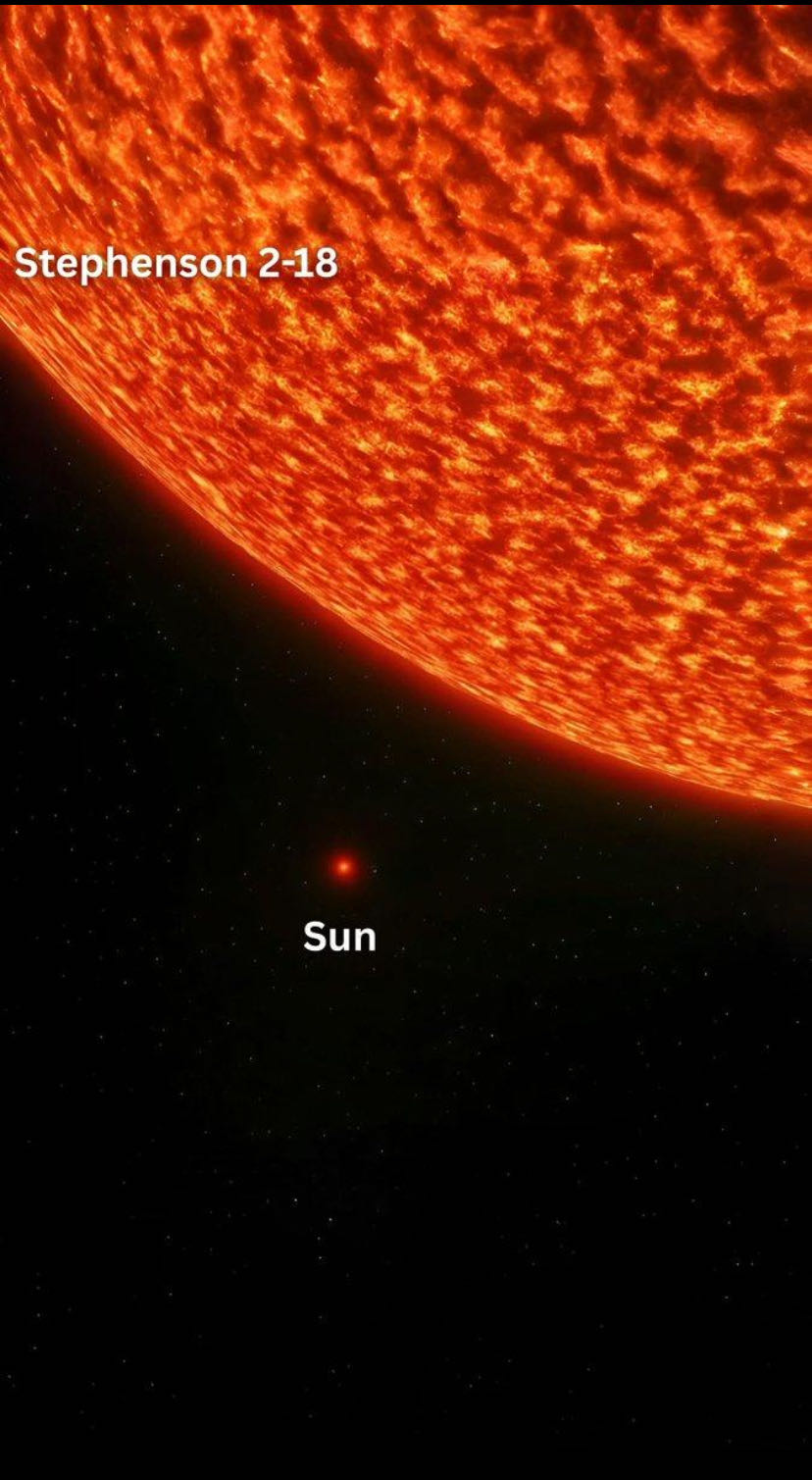
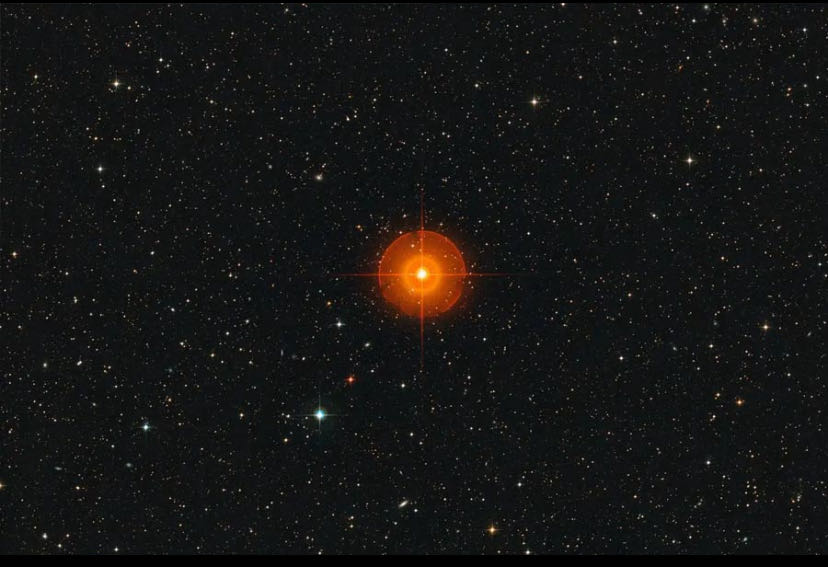
One of the stars frequently mentioned among the largest known stars is Stephenson 2-18. It is considered a red supergiant, and some estimates have placed its radius at roughly 2,000 times the radius of the Sun.
However, its exact size is uncertain because accurately measuring the physical dimensions of such a distant star is extremely difficult.
Size comparison
Star Approximate Radius
☀️ Sun ~696,000 km
🔴 Stephenson 2-18 Up to ~1.4 billion km in some estimates
If Stephenson 2-18 were placed at the center of our Solar System instead of the Sun, its enormous outer layers could extend toward the region of Saturn’s orbit.
⸻
🪐 Does Stephenson 2-18 Have Planets?
At present, no planet has been confirmed orbiting Stephenson 2-18.
That does not necessarily mean there are no planets there. Planets can form around stars, but detecting planets around such a distant and enormous star is extremely difficult.
So the current conclusion is:
Confirmed planets: None known
Could planets exist? Possibly, but there is no confirmed evidence.
⸻
🌌 Which Galaxy Is Stephenson 2-18 In?
Stephenson 2-18 is located in our own Milky Way Galaxy.
It lies in the region of the Stephenson 2 (RSGC2) massive star cluster, in the direction of the Sagittarius constellation.
Its distance is generally estimated at around 18,000–20,000 light-years, although the exact distance is uncertain.
That means the light we see from Stephenson 2-18 today began its journey toward Earth roughly 18,000–20,000 years ago.
🚀 How Far Away Is It?
1 light-year ≈ 9.46 trillion kilometers
Therefore, 18,000–20,000 light-years corresponds to approximately:
1.7–1.9 × 10¹⁷ kilometers
That is roughly 170–190 quadrillion kilometers from the Sun.
⸻
☀️ Sun vs. Stephenson 2-18
The Sun is a relatively ordinary star and is about 4.6 billion years old. Stephenson 2-18, by comparison, is an enormous red supergiant at a much later stage of stellar evolution.
Both are stars, but they differ enormously in size, mass, luminosity, temperature and evolutionary stage.
🌠 Imagine This
If Stephenson 2-18 replaced the Sun at the center of our Solar System, its enormous size could extend across the inner Solar System and potentially toward the Saturn region.
Stephenson 2-18 is a striking example of just how enormous stars can become—and how dramatically different stars can be from our own Sun.


Comments
No comments yet.