

Ownmates Post

Europa: The Icy Moon That May Hide an Ocean of Life
Introduction
Europa, one of Jupiter’s largest moons, is considered one of the most fascinating worlds in our Solar System. Although its surface is covered by a thick shell of ice and experiences temperatures as low as −160°C (−260°F), scientists believe that beneath this frozen exterior lies a vast global ocean of liquid water. Because liquid water is one of the key ingredients for life, Europa has become a major target in the search for extraterrestrial life.
⸻
1. A Global Underground Ocean
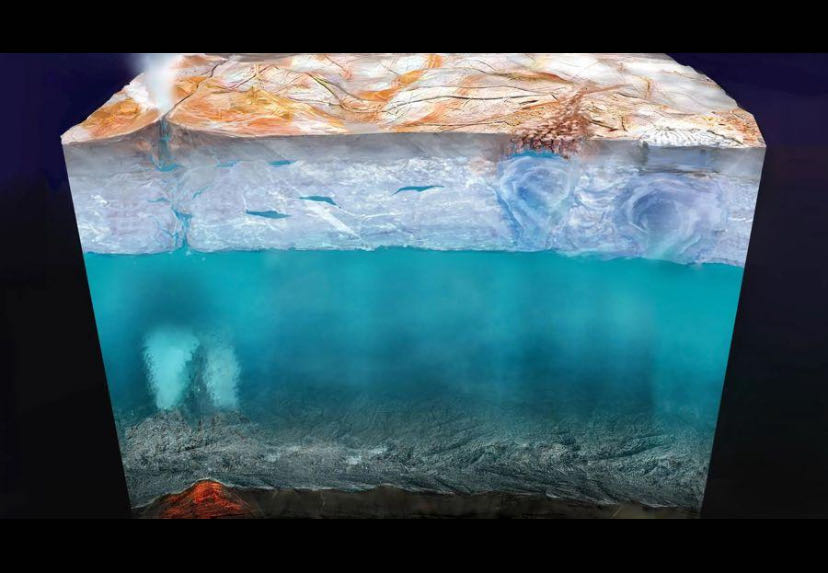
The most significant discovery on Europa is strong evidence for a global subsurface ocean beneath its icy crust.
Scientists reached this conclusion by studying:
* Measurements of Europa’s magnetic field.
* Surface geology showing cracked and shifting ice.
* Gravity data and computer models.
The underground ocean is believed to contain more water than all of Earth’s oceans combined, making Europa one of the wettest worlds in the Solar System.
⸻
2. An Ice Shell Covering the Ocean
Europa’s ocean is hidden beneath a thick layer of water ice.
Current scientific estimates suggest:
* Ice shell thickness may range from 10 to 30 kilometers, although it likely varies from place to place.
* Beneath the ice lies a deep ocean that may extend 100 kilometers or more.
The surface constantly develops cracks and ridges, indicating that the ice is slowly moving over the liquid ocean below.
⸻
3. Water Vapor Plumes
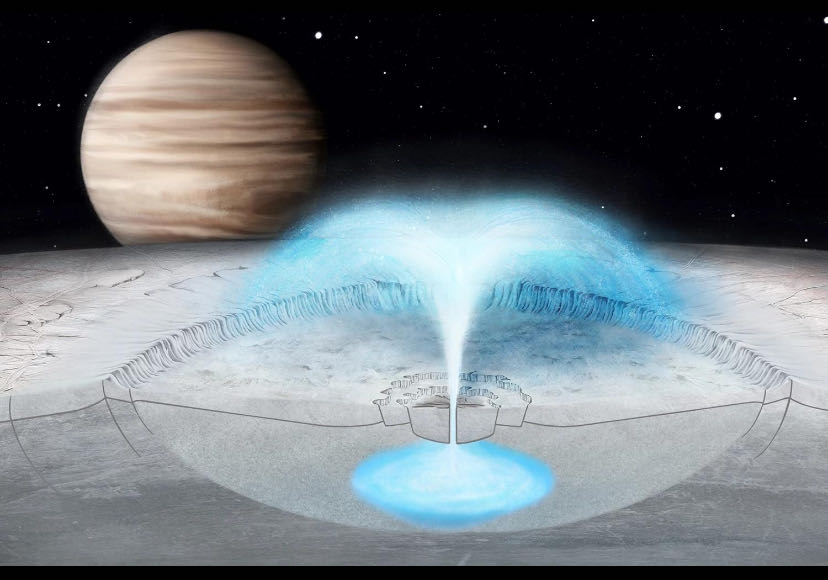
Observations by space telescopes and spacecraft have provided evidence that Europa may occasionally eject water vapor plumes through fractures in its icy surface.
If confirmed, these plumes are extremely valuable because future spacecraft may be able to:
* Fly through them.
* Collect water samples.
* Analyze their chemical composition without drilling through the ice.
⸻
4. Surface Chemistry
Europa’s surface is composed primarily of water ice, but scientists have also detected:
* Salts
* Carbon dioxide
* Sulfur compounds
* Other minerals
These materials may originate from the underground ocean, suggesting that ocean water may occasionally reach the surface through cracks in the ice.
⸻
5. Energy Beneath the Ice
Unlike Earth, Europa receives very little heat from the Sun.
Instead, its internal heat is produced by tidal heating.
Jupiter’s immense gravity continuously stretches and squeezes Europa during its orbit. This repeated flexing generates heat inside the moon, helping keep the underground ocean in a liquid state despite the extremely cold environment.
⸻
6. Could Europa Support Life?
Scientists have not discovered life on Europa.
However, Europa appears to possess three major ingredients considered important for life:
* Liquid water
* Essential chemical elements
* A long-term energy source
If hydrothermal vents exist on Europa’s ocean floor—similar to those on Earth—they could potentially provide environments where microbial life might survive.
For this reason, Europa is considered one of the most promising places beyond Earth to search for life.
⸻
7. Future Exploration
Several major space missions are focused on studying Europa.
NASA’s Europa Clipper
The Europa Clipper spacecraft is designed to:
* Map Europa’s surface in high detail.
* Measure the thickness of its ice shell.
* Investigate the underground ocean.
* Analyze surface chemistry.
* Determine whether Europa has conditions suitable for life.
ESA’s JUICE Mission
The European Space Agency’s Jupiter Icy Moons Explorer (JUICE) mission is studying Jupiter and its icy moons, including Europa, to better understand their geology, oceans, and potential habitability.
⸻
Current Scientific Understanding
Scientists have gathered compelling evidence that Europa contains:
* A vast underground ocean.
* A thick icy crust.
* Surface chemicals linked to the ocean.
* Possible water vapor plumes.
* Internal heating powered by Jupiter’s gravity.
Although no extraterrestrial life has been detected, Europa remains one of the most promising worlds in the Solar System for future discoveries.
⸻
Conclusion
Europa represents one of humanity’s greatest scientific mysteries. Beneath its frozen surface may exist an enormous ocean that has remained liquid for billions of years. Whether that hidden ocean contains life is still unknown, but upcoming missions such as NASA’s Europa Clipper and ESA’s JUICE are expected to provide the most detailed answers yet. If evidence of life is ever found beyond Earth, Europa is widely considered one of the most likely places where that discovery could occur.
If you’d like, I can also create this as a  magazine-style article,  research paper, or  illustrated infographic.


Comments
No comments yet.