

Ownmates Post

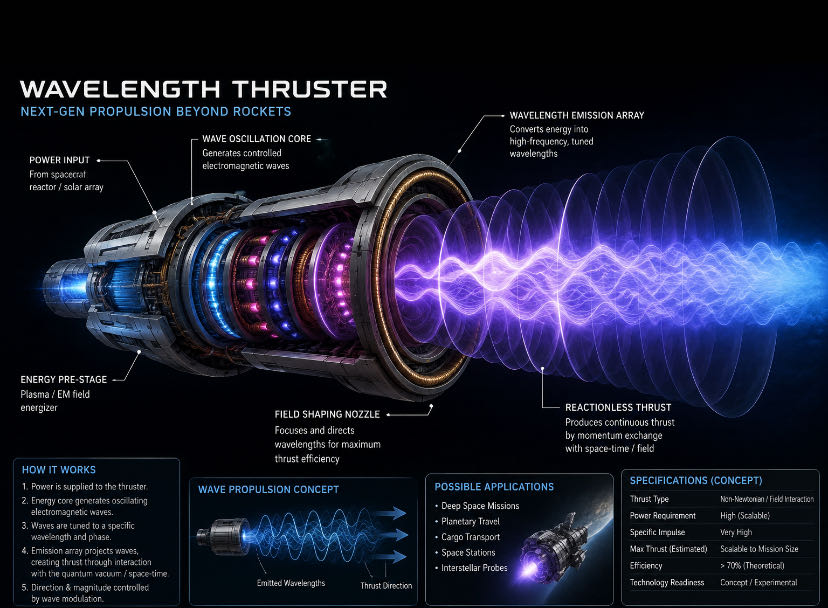
🚀 Electric Propulsion and Wavelength
Electric Propulsion (EP) is a spacecraft propulsion technology that uses electrical energy and electric/magnetic fields to accelerate charged particles, such as ions or plasma, and produce thrust.
There is no single “EP wavelength.” The wavelength depends on the frequency of the electromagnetic wave or field being used.
The relationship is:
λ = c / f
Where:
* λ (lambda) = wavelength
* c = speed of light in vacuum ≈ 300,000 km/s
* f = frequency
Examples
Frequency Wavelength
1 MHz 300 m
10 MHz 30 m
100 MHz 3 m
1 GHz 30 cm
10 GHz 3 cm
100 GHz 3 mm
How EP produces thrust
Electrical energy → Plasma/Ions → Electric or magnetic fields → Particle acceleration → Exhaust → Thrust
For example, an ion thruster uses an electric field to accelerate ions to very high exhaust velocities. The ions are expelled backward, producing thrust in the opposite direction.
Importantly, a shorter wavelength does not automatically mean greater thrust. Thruster performance depends mainly on factors such as electrical power, mass flow rate, exhaust velocity, and efficiency.
For an Earth-to-Mars high-speed propulsion concept, especially one involving extremely high velocities, conventional electric propulsion faces enormous energy and acceleration limitations.


Comments
No comments yet.