

Ownmates Post

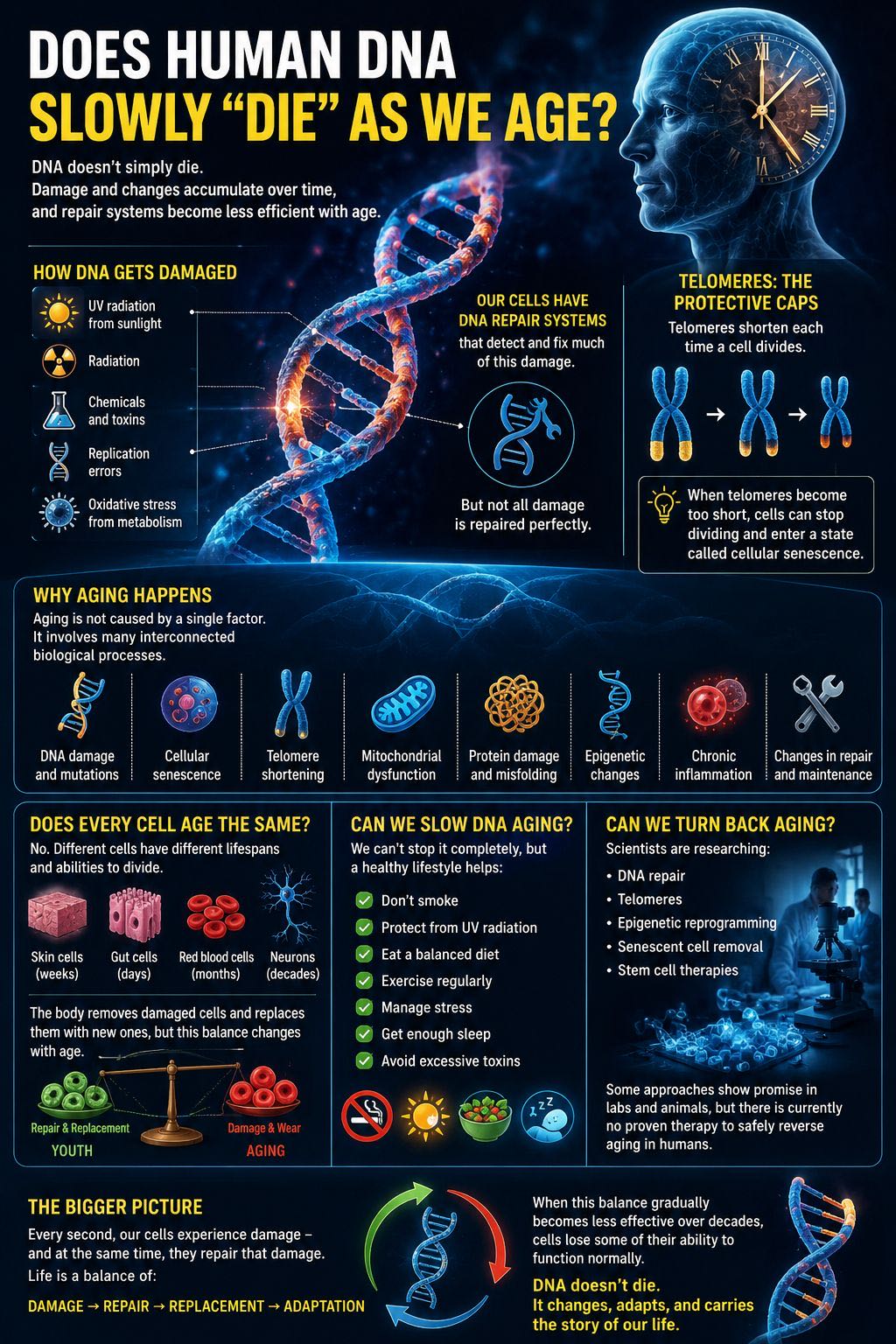
🧬 Does Human DNA Slowly “Die” as We Age?
We often say that humans grow old with time. But what actually happens inside our bodies as we age?
Does our DNA itself slowly “die”?
The answer is more fascinating than it sounds.
DNA does not simply die as we get older. Instead, DNA damage and molecular changes gradually accumulate throughout our lives. Our cells constantly repair this damage, but these repair and maintenance systems can become less efficient with age.
🧬 How Does DNA Become Damaged?
Our cells are constantly producing energy and carrying out thousands of chemical reactions. Some of these processes can generate reactive molecules that may damage DNA.
DNA can also be affected by:
* ☀️ Ultraviolet (UV) radiation from sunlight
* ☢️ Ionizing radiation
* 🧪 Certain chemicals and environmental toxins
* 🔄 Errors that occasionally occur when DNA is copied
* ⚡ Oxidative stress produced during normal cellular metabolism
Fortunately, our cells have sophisticated DNA repair systems that detect and fix much of this damage.
But not every error is repaired perfectly.
Over many decades, some damage and mutations can accumulate.
🔬 Why Does This Become More Important With Age?
When we are young, our cells generally have strong systems for repairing damage, removing defective cells and replacing old cells with new ones.
As we age, however, many of these biological systems change.
Some DNA damage may remain unrepaired, while mutations and other molecular alterations can accumulate.
At the same time, epigenetic changes occur.
Epigenetics refers to changes that affect how genes are switched on or off without necessarily changing the DNA sequence itself.
These changes can alter how cells function over time.
🧬 What Are Telomeres?
At the ends of our chromosomes are protective structures called telomeres.
In many types of cells, telomeres become shorter each time the cell divides.
Think of it like this:
Chromosome = shoelace
Telomere = protective cap at the end of the shoelace
The cap helps protect the chromosome ends.
When telomeres become critically short, some cells can stop dividing and enter a state called cellular senescence.
This is one of several mechanisms associated with biological aging.
⚠️ Does Every Cell’s DNA Age at the Same Rate?
No.
Different cells have very different lifespans and abilities to divide.
Some cells are replaced frequently, while others can survive for decades.
Our body also has systems that identify and remove damaged or senescent cells.
However, as we age, the balance between damage, repair and replacement can gradually change.
🧠 So, Why Do Humans Age?
DNA damage is only one part of the aging process.
Scientists consider aging to involve multiple interconnected biological processes, including:
* 🧬 DNA damage and mutations
* 🧫 Cellular senescence
* 🧬 Telomere shortening
* ⚡ Mitochondrial dysfunction
* 🧪 Protein damage and loss of protein quality control
* 🔄 Epigenetic alterations
* 🔥 Chronic inflammation
* 🛠️ Changes in cellular repair and maintenance
In other words, aging is not caused by one single mechanism.
It is the result of many biological systems gradually changing over time.
🌱 Can We Stop DNA Aging?
Not completely.
There is currently no proven treatment that can prevent all age-related DNA damage.
However, protecting overall cellular health is important. Avoiding smoking, protecting the skin from excessive UV radiation, exercising regularly, maintaining a balanced diet and getting adequate sleep can support normal cellular maintenance and overall health.
🚀 Could We Make Cells Young Again?
This is one of the most exciting areas of modern biological research.
Scientists are studying:
DNA repair • telomeres • epigenetic reprogramming • senescent cells • stem cells
Some experimental approaches have shown that certain aspects of cellular aging can potentially be altered in laboratory models.
But there is currently no scientifically established therapy that can safely turn an entire aging human body back to a young state.
🌌 The Bigger Picture
Every moment, our cells are experiencing molecular damage—and at the same time, they are repairing that damage.
Life is therefore a constant balance between:
Damage → Repair → Replacement → Adaptation
When this balance gradually becomes less effective over decades, cells can lose some of their ability to function normally.
And that is one important part of the biological story of aging.
Human DNA does not simply “die” with age.
It continuously experiences damage, repair and change throughout our lifetime. 🧬


Comments
No comments yet.