

Ownmates Post

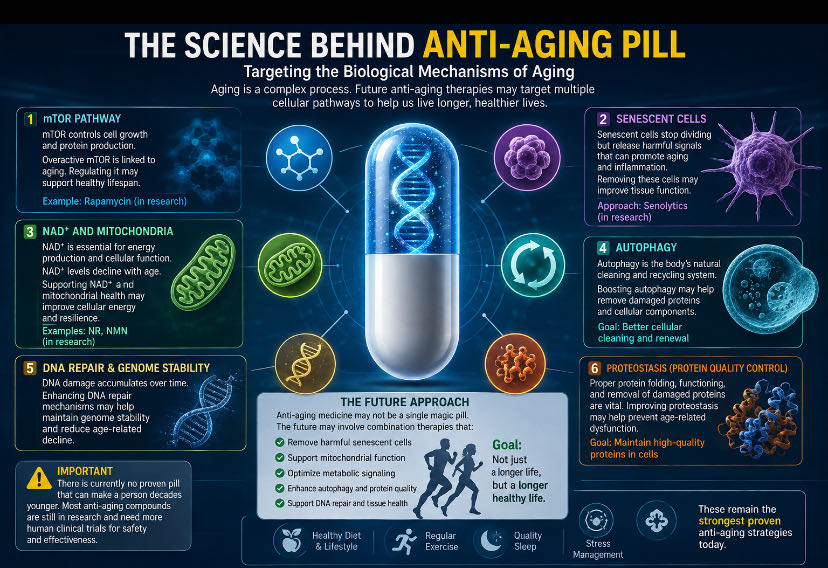
Can an Anti-Aging Pill Really Make Humans Young Again?
Imagine a pill that does more than reduce wrinkles—a medicine that could actually slow down the biological processes that make our cells age.
A pill that could potentially help muscles, the brain, heart, and immune system remain healthier for longer.
Today, this may sound like science fiction. But scientists are already studying the biological mechanisms behind aging and looking for ways to influence them.
Why Do We Age?
Aging is not simply about gray hair or wrinkles.
As we grow older, our cells gradually accumulate DNA damage, damaged proteins, mitochondrial problems, and senescent cells.
That is why future anti-aging medicine may focus not only on making a person look younger, but on controlling biological changes inside cells.
1. mTOR: The Cell’s Growth Switch
mTOR is an important cellular pathway involved in growth and protein production.
Scientists are studying whether regulating mTOR signaling could influence aging and longevity.
Rapamycin is one of the major compounds being studied in this area.
However, this does not mean that rapamycin is a proven anti-aging drug or that people should take it on their own.
2. Senescent Cells: Removing Old, Damaged Cells
Some damaged cells enter a state in which they stop dividing but can continue releasing inflammatory signals.
These are called senescent cells.
One possible future approach is to selectively remove harmful senescent cells. Drugs designed for this purpose are known as senolytics.
This is an active research area, but it is not yet an established anti-aging treatment for healthy people.
3. NAD⁺ and Mitochondria
Our cells depend on mitochondria to produce energy.
NAD⁺ is also involved in cellular energy metabolism and several important cellular processes.
As we age, NAD⁺ metabolism can change. Scientists are therefore studying compounds that influence NAD⁺ pathways.
Compounds such as NR and NMN have been investigated in this field, but there is still no conclusive evidence that they extend human lifespan.
4. Autophagy: The Cell’s Recycling System
Cells have a natural cleaning and recycling process called autophagy.
It helps cells break down and recycle damaged proteins and cellular components.
Because this process can change with age, researchers are investigating whether regulating autophagy could help maintain cellular health.
5. DNA Repair
Our DNA experiences damage every day.
Fortunately, cells have repair mechanisms that correct much of this damage. However, genomic instability can increase as we age.
That makes DNA repair and genome stability important areas of aging research.
But manipulating DNA-repair pathways is extremely complex. Changing cellular growth and repair mechanisms incorrectly could potentially affect risks such as cancer.
6. Protein Quality Control
Cells must produce proteins correctly, maintain their proper structure, and remove damaged proteins.
As we age, this protein quality-control system can become less efficient.
Researchers are therefore studying proteostasis—the maintenance of healthy proteins inside cells—as another possible target for future anti-aging therapies.
Could One Pill Make a 70-Year-Old 20 Years Younger?
Not today.
This is the most important point.
There is currently no proven pill that can make the entire body of a 70- or 80-year-old person biologically 20–30 years younger.
Aging is not caused by one single process. It involves many interconnected systems, including DNA, mitochondria, metabolism, the immune system, protein recycling, cellular senescence, and tissue regeneration.
Therefore, the future of anti-aging medicine may not be a single magic pill.
Instead, it could involve combinations of therapies that target different biological pathways.
What Could the Future Look Like?
Imagine a future where doctors measure a person’s biological age, genetics, biomarkers, and cellular health.
A personalized treatment could then be designed for that individual.
One therapy might target senescent cells. Another could focus on mitochondrial function. A third might regulate metabolic pathways, while another could support tissue repair.
At that point, anti-aging would mean much more than simply removing wrinkles.
The goal could become:
“Not just a longer life—but a longer healthy life.”
However, this future is still being researched.
Until large, well-controlled human clinical trials demonstrate that an anti-aging treatment is both safe and effective, no drug or supplement should simply be assumed to be an “anti-aging pill.”
The real anti-aging revolution may not be a pill that keeps us young forever.
It may be a medicine that helps our cells remain healthy for much longer.


Comments
No comments yet.