

Ownmates Post
Can AI Read the Human Mind?
The Future of Brain-Computer Interfaces
Artificial intelligence is becoming increasingly powerful, but can AI actually read what a person is thinking?
The short answer is not in the way science fiction movies show it. Today’s AI cannot simply look at someone and know their private thoughts. However, scientists are developing technologies that can analyze signals produced by the brain and use AI to make limited predictions about what a person may be trying to say, see, or do.
🧠 How Does It Work?
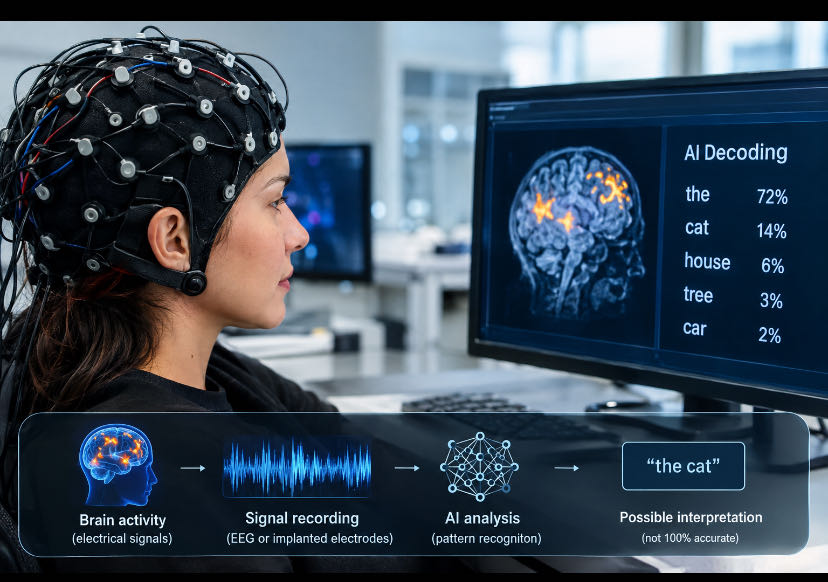
The human brain communicates through electrical and chemical signals. Technologies such as electroencephalography (EEG) and implanted brain electrodes can record some of this brain activity.
AI models can then analyze these signals and identify patterns associated with particular actions or intentions.
For example, researchers have demonstrated systems that can help decode attempted speech from brain activity in people who cannot speak normally. Other experiments have explored reconstructing or identifying aspects of what a person is seeing or imagining.
🤖 AI Is Not Literally Reading Every Thought
It is important to understand the difference between decoding brain signals and reading someone’s mind.
AI does not currently have a universal dictionary that converts every thought directly into words. Brain signals are complex, vary between individuals, and are affected by many factors.
In many experiments, the system must first be trained using data from the particular person. This means that current technology is far from being able to secretly read anyone’s complete thoughts.
🔬 Brain AI Could Change Communication
The combination of brain-computer interfaces and AI could eventually allow people to communicate with computers without using their hands or voice.
A person might one day be able to control a computer cursor, operate a device, or communicate by intentionally generating specific brain signals.
For people who have lost the ability to speak or move, this technology could be particularly valuable.
🔐 The Privacy Question
As brain-decoding technology improves, it also raises an important question:
Who should have access to our brain data?
Brain activity is potentially much more sensitive than ordinary personal information. If future technologies become capable of decoding increasingly complex mental information, society may need new rules to protect mental privacy and cognitive freedom.
🌍 The Future
AI cannot currently read the human mind like a book. But scientists are making progress in translating certain patterns of brain activity into useful information.
The future may therefore not be about AI “reading every thought,” but about creating a new form of communication between the human brain and machines.
The biggest breakthrough may come when technology allows people to communicate with computers simply by thinking about what they want to communicate.
AI may not be able to read our minds today—but the boundary between the human brain and technology is becoming increasingly connected.


Comments
No comments yet.