

Ownmates Post

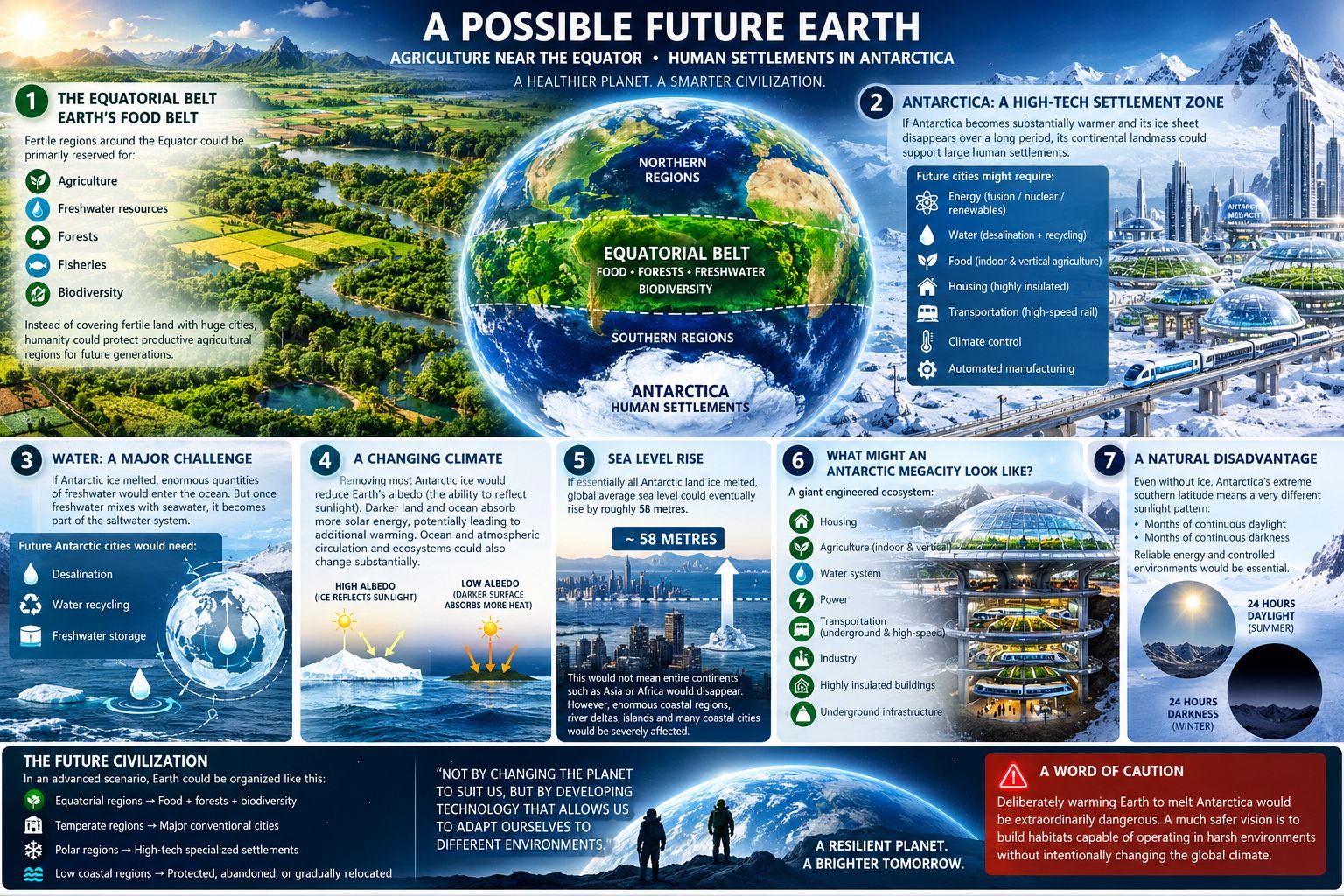
🌍 A Possible Future Earth: Agriculture Near the Equator and Human Settlements in Antarctica
Imagine a distant future in which humanity deliberately protects large regions around the Equator for agriculture, forests, freshwater, and biodiversity, while millions—or even billions—of people live in highly engineered cities in places such as Antarctica.
This would completely transform Earth’s geography, climate strategy, and human civilization.
🌾 1. The Equatorial Belt could become Earth’s Food Belt
The fertile regions around the Equator could be primarily reserved for:
* Agriculture 🌾
* Freshwater resources 💧
* Forests 🌳
* Fisheries 🐟
* Biodiversity 🌱
Instead of covering fertile land with huge cities, humanity could concentrate major urban populations elsewhere and protect productive agricultural regions.
🏙️ 2. Antarctica could become a High-Tech Settlement Zone
If Antarctica became substantially warmer and its ice sheet disappeared over a very long period, its continental landmass could potentially support large human settlements.
Future cities might require:
Energy → Water → Food → Housing → Transportation → Climate control
Possible technologies could include:
* Tokamak reactor plasma energy system
* Nuclear or fusion power
* Large-scale renewable energy
* Desalination
* Almost-complete water recycling
* Indoor and vertical agriculture
* Highly insulated buildings
* Underground infrastructure
* Automated manufacturing
* High-speed rail
💧 3. Water would become one of the biggest challenges
If Antarctic ice melted, enormous quantities of freshwater would eventually enter the ocean. But once freshwater mixes with seawater, it becomes part of the saltwater system.
Therefore, future Antarctic cities would probably need:
Desalination water recycling freshwater storage
rather than simply relying on melting ice.
🌡️ 4. Earth’s climate would change dramatically
Removing most Antarctic ice would reduce Earth’s albedo—the ability of the bright ice surface to reflect sunlight.
Darker land and ocean absorb more solar energy, potentially producing additional warming.
Ocean circulation, atmospheric circulation and ecosystems could also change substantially.
🌊 5. Sea levels would rise enormously
If essentially all Antarctic land ice melted, global average sea level could eventually rise by roughly 58 metres.
This would not mean that entire continents such as Asia or Africa would disappear. Instead, enormous coastal regions, river deltas, islands and many coastal cities would be severely affected.
Human civilization could gradually shift from:
Coastal civilization → Inland and engineered-habitat civilization
🏗️ 6. What might an Antarctic megacity look like?
A future Antarctic city could resemble a giant engineered ecosystem:
☀️ ENERGY
│
▼
┌─────────────────┐
│ ANTARCTIC CITY │
├─────────────────┤
│ 🏙️ Housing │
│ 🌾 Agriculture │
│ 💧 Water system │
│ ⚡ Power │
│ 🚄 Transport │
│ 🏭 Industry │
└─────────────────┘
│
▼
🌍 GLOBAL NETWORK
│
🌾 EQUATORIAL
FOOD BELT
Buildings might be heavily insulated, while much of the transportation, utilities and industrial infrastructure could be underground.
🌞 7. But Antarctica has a major natural disadvantage
Simply melting the ice would not automatically make Antarctica comfortable for humans.
Its extreme southern latitude means that the seasonal sunlight pattern is very different from most populated regions. Near the South Pole, there are months of continuous daylight followed by months of darkness.
Therefore, reliable energy and controlled environments would be essential.
🔮 The possible civilization of the future
In an extremely advanced scenario, Earth could be organized roughly like this:
🌾 Equatorial regions → Food forests biodiversity
🏙️ Temperate regions → Major conventional cities
❄️ Polar regions → High-tech specialized settlements
🌊 Low coastal regions → Protected, abandoned, or gradually relocated
However, deliberately warming Earth to melt Antarctica would be extraordinarily dangerous. A much safer technological vision would be to build habitats capable of operating in harsh environments without deliberately changing the global climate.
The fascinating possibility is that humanity might eventually become capable of living almost anywhere on Earth—not by changing the planet to suit us, but by developing technology that allows us to adapt ourselves to different environments.


Comments
No comments yet.