

Ownmates Post

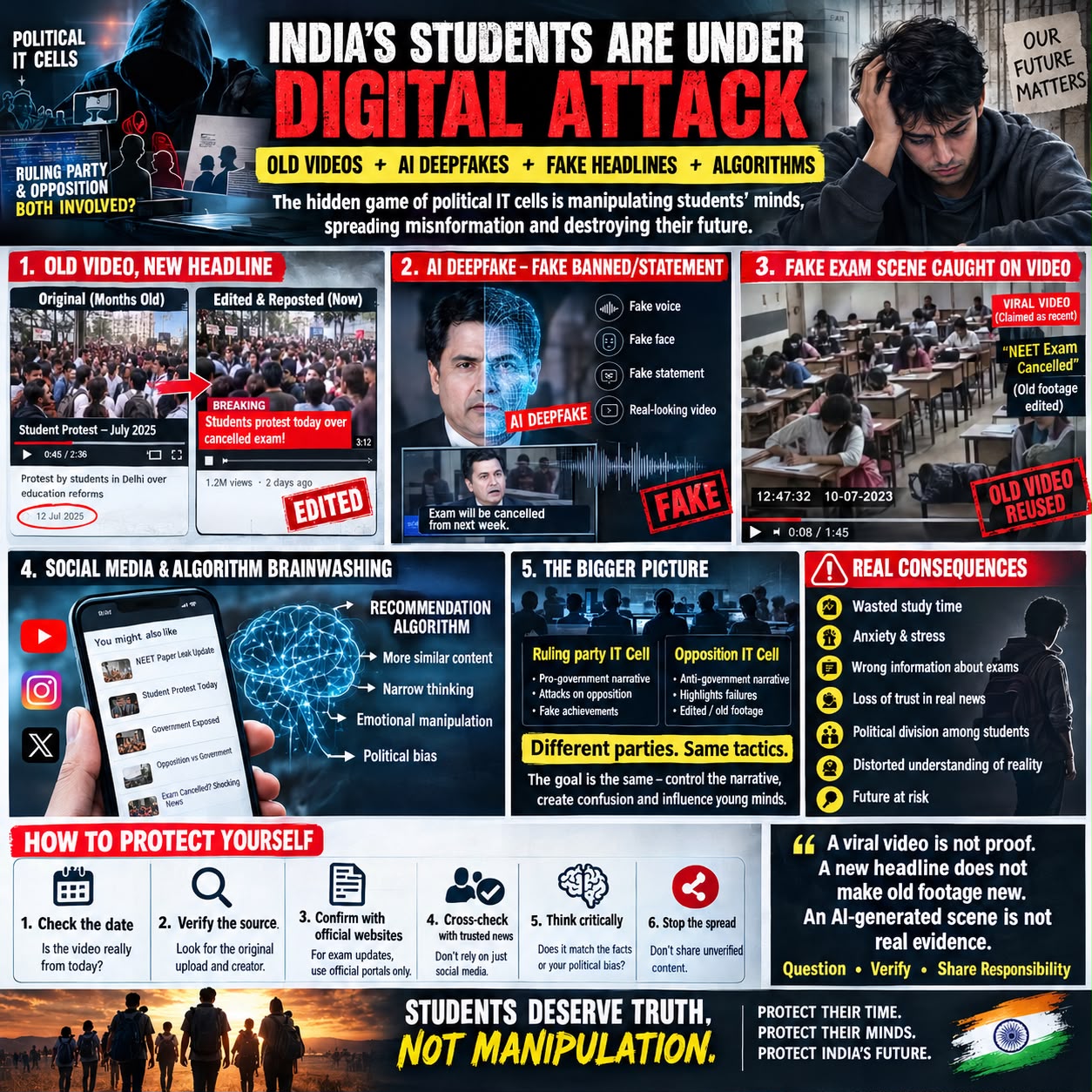
🚨 India’s Students Under Digital Attack: Old Videos, Fake Headlines and AI Deepfakes.Is India’s Students’ Future at Risk?
Old Videos, Fake Examination Footage, AI Deepfakes and Political IT Cells: Is Social Media Manipulating Young Minds?
A video can look real, carry a breaking-news headline, and attract millions of views—and still mislead an entire generation.
India’s students face intense competition, uncertain recruitment processes, examination controversies, unemployment, and pressure to secure their future. At a time when accurate information is essential, misleading social media content can create another serious challenge.
Old videos are sometimes presented as new events. Examination-related footage can be taken out of context. AI-generated videos can imitate real people. Sensational headlines can turn unverified claims into viral stories.
YouTube, Instagram and X provide valuable educational resources, but they can also become channels for spreading misinformation when content is shared without proper verification.
The central question is disturbing: Are India’s students receiving reliable information, or are some of them being influenced by digitally manipulated narratives?
1. Old Videos Presented as New Incidents
One of the simplest methods of digital deception involves taking an old video, editing its presentation and uploading it with a new headline.
For example, footage of a student protest recorded months earlier could be reposted with a headline claiming that students are protesting today over a newly cancelled examination.
The original footage might be genuine, but the new caption could be misleading.
The uploader may remove the original date, crop important details, add dramatic text or combine unrelated clips to create a false impression.
When viewers encounter the video without its original context, they may believe that the event happened exactly as described.
This technique can be particularly misleading during examination controversies, recruitment disputes, political demonstrations and public emergencies.
The footage does not have to be fake for the story to be false. Sometimes, changing the context is enough to mislead thousands of people.
2. Fake Examination Videos and the Suffering of Students
Examinations can determine a student’s educational opportunities, employment prospects and financial future.
When an examination is cancelled, postponed or affected by allegations of irregularities, students urgently seek accurate information.
This creates an environment in which misleading content can spread quickly.
Imagine a video showing students sitting in an examination hall. The footage is several years old, but an uploader presents it as evidence of a recent examination scandal.
Alternatively, a video from one examination centre may be incorrectly described as footage from another examination or state.
Such videos can create false impressions about examination security, cheating, paper leaks or administrative failures.
A fabricated announcement can be even more damaging if students believe that an examination has been cancelled when no such official decision has been made.
The potential consequences include:
* Unnecessary panic among candidates and parents.* Time wasted investigating false claims.* Confusion about examination dates and official announcements.* Unfair damage to the reputations of students, teachers or examination authorities.* Reduced trust in genuine news and authentic evidence.
These consequences depend on the circumstances, but the risk is real enough to demand serious attention.
Students have already invested years of effort in their education. They should not have to fight a constant battle against fabricated examination news.
3. AI Deepfakes: When Fake Evidence Looks Real
Artificial intelligence has made it easier to create realistic-looking synthetic images, voices and videos.
A manipulated video may appear to show a politician making a statement, an official announcing an examination cancellation or a teacher admitting to misconduct.
The person may never have made that statement.
AI-generated content can also be combined with genuine footage, making it more difficult for ordinary viewers to identify manipulation.
The danger becomes particularly serious when fake videos are presented as evidence of corruption, examination fraud, violence or political wrongdoing.
Students who share such content without verification may unintentionally help spread false information.
At the same time, genuine recordings should not automatically be dismissed as fake simply because they are controversial.
The correct response is verification, not blind belief or blind rejection.
4. Political IT Cells and the Digital Propaganda Question
Political parties use digital communication teams to promote policies, respond to criticism and engage with supporters.
Such activity is not inherently deceptive.
However, if individuals or organised networks deliberately edit videos to misrepresent events, circulate fabricated examination claims or coordinate misleading campaigns, their conduct deserves investigation.
This standard must apply equally to ruling-party organisations and opposition-party organisations.
No political group should be permitted to manipulate public understanding without scrutiny simply because the content benefits its preferred side.
But accusations must be supported by evidence.
A misleading video does not, by itself, establish that a particular political IT cell created it. Investigators must examine the original source, upload history, editing evidence, account relationships and any documented coordination.
The issue is not which political party wins an online argument. The issue is whether students are being deliberately misled.
Political loyalty must never become an excuse for spreading misinformation.
5. Social Media Algorithms and the Risk of Political Conditioning
Social media platforms use recommendation systems to select content that users may find relevant or engaging.
These systems can help students discover lectures, science explanations, examination guidance and career opportunities.
However, repeated engagement with sensational political content may expose users to more material with similar themes.
For example, a student who watches several videos attacking a particular political party may receive recommendations for additional content on related topics.
Depending on the platform and the user’s behaviour, this can narrow the range of viewpoints the student encounters.
If the recommended material contains misleading claims, repeated exposure may make those claims seem more familiar or credible.
The same risk can affect supporters of the ruling party and the opposition.
This does not mean that every recommendation is politically motivated or that algorithms inevitably brainwash users. It means that recommendation systems can influence attention and information exposure.
When emotionally charged misinformation enters this environment, its reach may increase.
Digital manipulation does not always require forcing people to believe a lie. Sometimes, repeatedly showing them a misleading narrative can influence what they notice, remember and trust.
6. How Digital Manipulation Can Affect Students’ Minds
Students are not passive or incapable of critical thinking. They can evaluate evidence and challenge misleading claims.
Nevertheless, constant exposure to sensational material can create several risks.
Information overload
Students may spend hours watching and debating viral controversies instead of concentrating on their studies.
Emotional pressure
Repeated exposure to false reports about examination cancellations, violence or recruitment fraud can increase uncertainty and anxiety.
Political polarisation
Edited videos and selective narratives can encourage students to view political opponents as enemies rather than people with different opinions.
Confirmation bias
Students may accept claims that support their existing beliefs while rejecting evidence that challenges them.
Loss of trust
When old footage is repeatedly presented as new, students may struggle to distinguish reliable reporting from manipulation.
Reduced independent judgment
If students rely entirely on viral posts to understand public events, they may overlook original documents, official announcements and independent reporting.
These outcomes are not inevitable, but they demonstrate why digital literacy must become an essential part of modern education.
7. Who Benefits from Fake Viral Videos?
Misleading videos may benefit people seeking attention, advertising revenue, political advantage or reputational damage against an opponent.
However, the person who benefits from a claim is not necessarily the person who created it.
A responsible investigation should ask:
1. When was the original video recorded?2. Who first uploaded it?3. Does the current headline accurately describe the footage?4. Has the original audio or video been altered?5. Are multiple accounts spreading the same misleading claim?6. Is there evidence of coordinated distribution?7. Can independent sources verify the alleged incident?8. Is a political organisation demonstrably connected to the campaign?
These questions help separate evidence from speculation.
Without such checks, people risk responding to misinformation with further misinformation.
8. How Students Can Protect Themselves
Every student can adopt a few simple habits.
Check the date: Search for earlier versions of the video and compare publication dates.
Find the original source: Do not rely exclusively on reposted clips or screenshots.
Verify examination news: Check the relevant examination authority’s official website and authenticated announcements.
Compare independent reports: Look for credible news organisations that independently confirm the event.
Inspect the context: Check whether the location, date and circumstances match the headline.
Be careful with AI content: Realistic faces and voices are not sufficient proof that a video is authentic.
Avoid impulsive sharing: Do not forward a sensational clip before verifying its claims.
Question your own bias: A video supporting your political beliefs still requires evidence.
Report deceptive content: Use the platform’s reporting tools when a post appears to contain manipulated or misleading material.
No single verification technique is perfect. The strongest approach combines source checking, contextual analysis and independent confirmation.
9. What Should Social Media Platforms and Authorities Do?
Social media platforms should enforce their policies against deceptive manipulated media, improve reporting mechanisms and provide appropriate context for recycled footage and synthetic content.
They should also improve transparency around recommendation systems and their responses to coordinated inauthentic behaviour.
Examination authorities should communicate important decisions promptly through official channels, reducing the uncertainty in which rumours can flourish.
Schools, colleges and coaching institutions should teach students how to verify digital information, recognise misleading headlines and evaluate evidence.
Journalists and fact-checkers should distinguish authentic footage from misleading captions and explain the limits of their findings.
Political organisations should establish clear standards for their digital campaigns and investigate credible allegations of deceptive practices within their networks.
Freedom of expression must be protected, but deliberate fabrication should not be confused with legitimate political criticism.
10. India’s Future Depends on an Informed Generation
India’s young people represent an enormous source of scientific, educational, economic and social potential.
Their time should be invested in learning, innovation, employment preparation and the development of independent thought.
Technology can support these goals. YouTube can provide free educational lessons, AI can improve learning, and social media can help students discover opportunities.
But the same technologies can spread misleading information when used irresponsibly.
The solution is not to abandon digital platforms. It is to demand greater accountability, strengthen digital literacy and develop habits of critical thinking.
Students should learn to distinguish a verified announcement from a viral rumour, an authentic recording from a manipulated clip, and a documented fact from a political allegation.
They should be able to question the ruling party without automatically trusting the opposition. They should be able to question the opposition without automatically defending the government.
Their judgment should be guided by evidence rather than political loyalty.
FINAL WARNING: DON’T LET DIGITAL PROPAGANDA STEAL STUDENTS’ FUTURE
An old video can receive a new headline.
A genuine recording can be presented with a false explanation.
An AI-generated scene can imitate reality.
A misleading examination claim can spread across thousands of accounts.
And an algorithm can influence which stories repeatedly appear on a student’s screen.
These risks demand vigilance, investigation and responsible action.
If any political organisation knowingly manipulates evidence to mislead students, it should be held accountable on the basis of verified evidence—regardless of whether it belongs to the ruling party or the opposition.
The same principle applies to influencers, media organisations and social media platforms.
India’s students deserve accurate information, fair opportunities and the freedom to form their own opinions.
Their future should not be shaped by fabricated videos, deceptive headlines or unverified political propaganda.
REMEMBER:
* A viral video is not automatically true.* An old video does not become new because someone changes its headline.* An AI-generated scene is not proof that an event occurred.* A political claim is not a fact simply because your preferred party shares it.* A recommendation algorithm should never replace independent judgment.* Verification is a responsibility, not an inconvenience.
Protect students’ time. Protect their right to accurate information. Protect their freedom to think independently.
India’s future belongs to a generation that questions misinformation, demands evidence and refuses to let digital deception decide what it believes.


Comments
No comments yet.