

Ownmates Post
🌍 Did Human Ancestors Nearly Become Extinct 900,000 Years Ago?
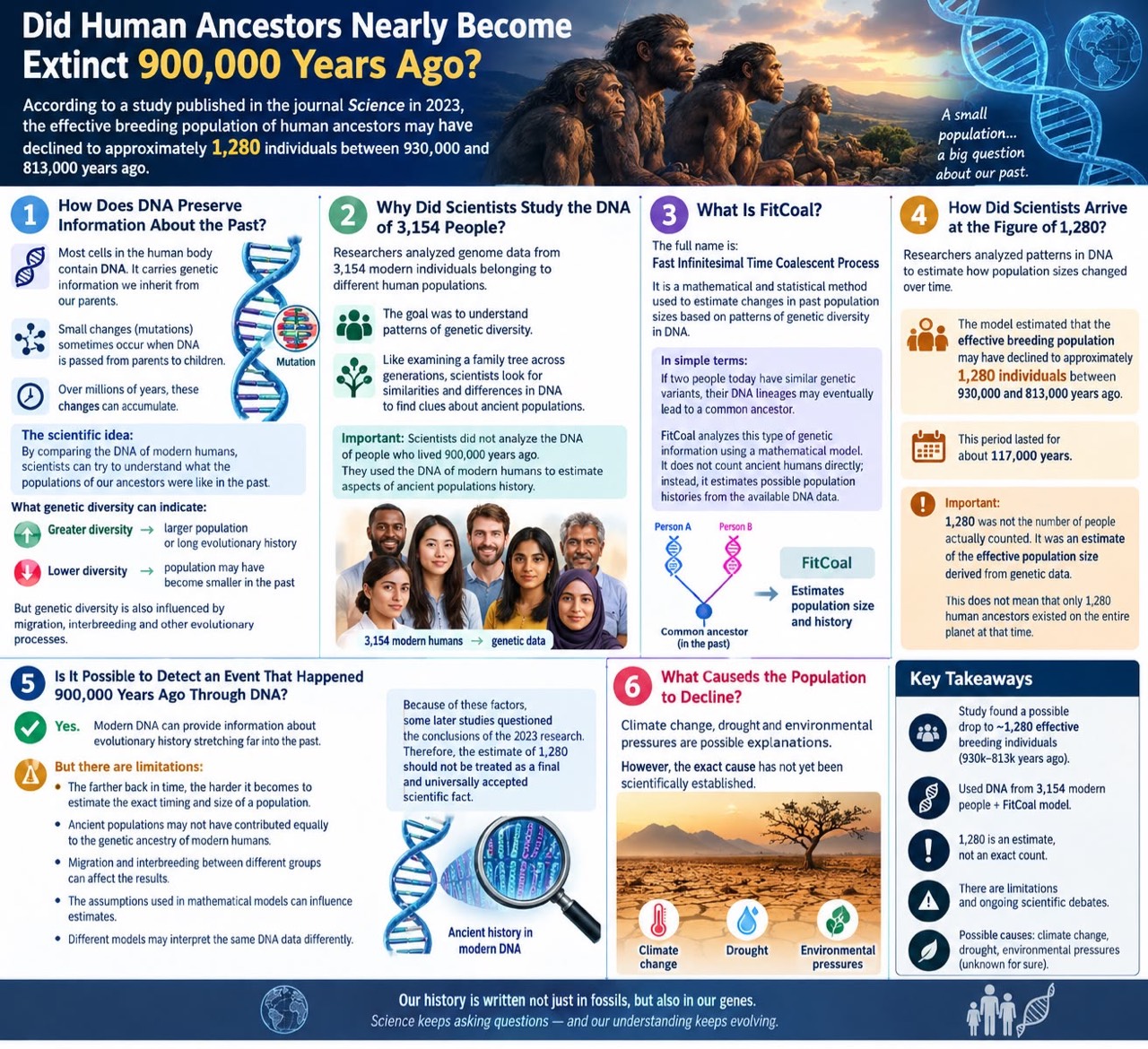
According to a study published in the journal Science in 2023, the effective breeding population of human ancestors may have declined to approximately 1,280 individuals between 930,000 and 813,000 years ago.
🧬 How Did Scientists Estimate the Population of Human Ancestors from DNA Dating Back 900,000 Years?
In a study published in Science in 2023, scientists analyzed the DNA of 3,154 modern humans. They used a mathematical method called FitCoal to estimate the size of ancient human populations.
Let’s understand this process step by step in simple language.
1. How Does DNA Preserve Information About the Past?
Most cells in the human body contain DNA. DNA carries genetic information that we inherit from our parents.
When DNA is passed from parents to children, small changes called mutations sometimes occur.
Over millions of years, these changes can accumulate from one generation to the next.
The scientific idea: By comparing the DNA of modern humans, scientists can try to understand what the populations of our ancestors were like in the past.
For example:
* Greater genetic diversity in a population may indicate a larger population size or a long evolutionary history.
* Lower genetic diversity may indicate that the population became smaller in the past.
However, genetic diversity is also influenced by migration, interbreeding, and other evolutionary processes.
2. Why Did Scientists Study the DNA of 3,154 People?
Researchers analyzed genome data from 3,154 modern individuals belonging to different human populations.
The purpose of studying so many individuals was to understand patterns of genetic diversity.
Imagine examining the records of a family across several generations. You might try to determine how different family members are related and when their ancestral lineages diverged.
Similarly, scientists study similarities and differences in DNA to find clues about the history of ancient populations.
However, one distinction is important: Scientists did not analyze the DNA of people who lived 900,000 years ago. They used the DNA of modern humans to estimate aspects of ancient population history.
3. What Is FitCoal?
The full name of FitCoal is:
Fast Infinitesimal Time Coalescent Process
It is a mathematical and statistical method used to estimate changes in past population sizes based on patterns of genetic diversity in DNA.
Let’s understand it with an example.
Suppose two people today have similar genetic variants in a particular section of their DNA.
If scientists trace their DNA lineages backward through generations, those lineages may eventually lead to a common ancestor or ancestral population.
By studying patterns associated with such shared ancestors, scientists can estimate how large ancestral populations might have been.
FitCoal analyzes this type of genetic information using a mathematical model. It does not count ancient humans directly; instead, it estimates possible population histories from the available DNA data.
4. How Did Scientists Arrive at the Figure of 1,280?
Researchers analyzed patterns in DNA to estimate how population sizes changed over time.
According to their model, the effective breeding population of human ancestors may have declined to approximately 1,280 individuals between 930,000 and 813,000 years ago.
The study also estimated that this period lasted for approximately 117,000 years.
The most important point is that 1,280 was not the number of people actually counted. It was an estimate of the effective population size derived from genetic data.
This does not mean that only 1,280 human ancestors existed on the entire planet at that time.
5. Is It Possible to Detect an Event That Happened 900,000 Years Ago Through DNA?
Yes. Modern DNA can provide information about evolutionary history stretching far into the past. However, this method has limitations.
The farther scientists look back in time, the more difficult it can become to estimate the exact timing of an event and the size of a population.
Other important factors include:
* Ancient populations may not have contributed equally to the genetic ancestry of modern humans.
* Migration and interbreeding between different groups can affect the results.
* The assumptions used in mathematical models can influence estimates.
* Different models may interpret the same DNA data differently.
For these reasons, some later scientific studies questioned the conclusions of the 2023 research. Therefore, the estimate of 1,280 should not be treated as a final and universally accepted scientific fact.
What Caused the Population to Decline?
Climate change, drought, and environmental pressures are possible explanations. However, the exact cause has not yet been scientifically established.


Comments
No comments yet.