

Ownmates Post

Autocatalysis: A Chemical Reaction That Helps Produce More of Itself
Introduction
Autocatalysis is a chemical process in which a product of a chemical reaction acts as a catalyst, helping the same reaction produce more of that product.
In simple words, the reaction produces a substance that helps the reaction continue and generate even more of itself.
1. How Does Autocatalysis Work?
Imagine a chemical reaction in which substance A is converted into substance B.
A simplified representation is:
A B → 2B
In this example, substance B helps convert more of substance A into B.
The process works as follows:
* Initially, only a small amount of B is present.
* As the reaction proceeds, more B is produced.
* The increasing amount of B can accelerate the reaction.
* Eventually, the reaction slows down when the supply of A becomes limited.
This process can lead to rapid growth in the amount of product under suitable conditions.
Note: This equation is a simplified example, not the exact chemical equation for every autocatalytic reaction.
2. What Is the Connection to Kenso Soai’s Research?
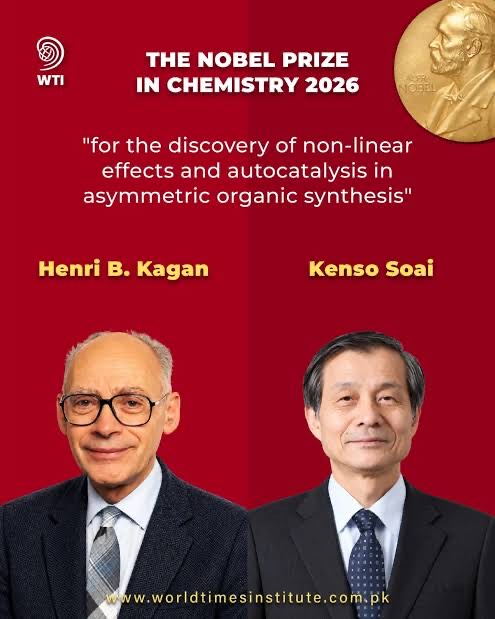
Japanese chemist Kenso Soai is known for the discovery and study of the Soai reaction, a famous example of asymmetric autocatalysis.
This reaction involves two important chemical concepts:
Autocatalysis: A reaction product helps produce more of itself.
Chirality: Some molecules exist in two forms that are mirror images of each other, similar to our left and right hands. These forms are called enantiomers.
In the Soai reaction, a small initial excess of one chiral form can be amplified through the reaction, leading to a much greater predominance of that form.
This makes the reaction important for studying how chemical systems can develop a preference for one molecular form over its mirror image.
3. Why Is Autocatalysis Important for the Origin of Life?
One of the major scientific questions about the origin of life is:
Why does life on Earth predominantly use one particular handedness of certain biological molecules?
For example:
* Proteins in known life are built predominantly from L-amino acids.
* DNA and RNA use sugars with a particular handedness.
* Many biological processes depend on molecules having the correct three-dimensional structure.
Scientists investigate whether autocatalysis and other chemical processes could have contributed to the emergence or amplification of such molecular preferences on early Earth.
However, autocatalysis alone does not explain the origin of life. It is one possible mechanism that helps researchers investigate how chemical complexity and molecular asymmetry may have developed.
4. A Simple Everyday Analogy
Imagine one person sharing a message with five people. Each of those five people shares it with five more people.
As more people spread the message, the number of people receiving it can increase rapidly.
This illustrates the idea of a process that promotes its own expansion.
However, it is only an analogy. Chemical autocatalysis follows specific molecular interactions and chemical laws.
5. Potential Applications
Autocatalysis is important in several areas of scientific research:
* Organic chemistry: Understanding and controlling chemical reactions.
* Pharmaceutical research: Producing molecules with a desired chirality.
* Origin-of-life research: Investigating how complex chemical systems may have developed.
* Chemical systems research: Studying self-amplifying reactions and nonlinear chemical behavior.
Conclusion
Autocatalysis is a remarkable chemical phenomenon in which a reaction product helps accelerate its own formation. The Soai reaction demonstrates how this process can amplify a preference for one molecular handedness over another.
Studying these reactions helps scientists understand chemical self-amplification, molecular chirality, and possible pathways through which early chemical systems developed greater complexity.
Key takeaway: Autocatalysis is a process in which a chemical reaction helps produce more of its own catalyst, potentially allowing a small initial chemical difference to become much larger.


Comments
No comments yet.