

Ownmates Post
🌦️ AI, Drones and the Future of Rain: How Weather Forecasting Is Changing
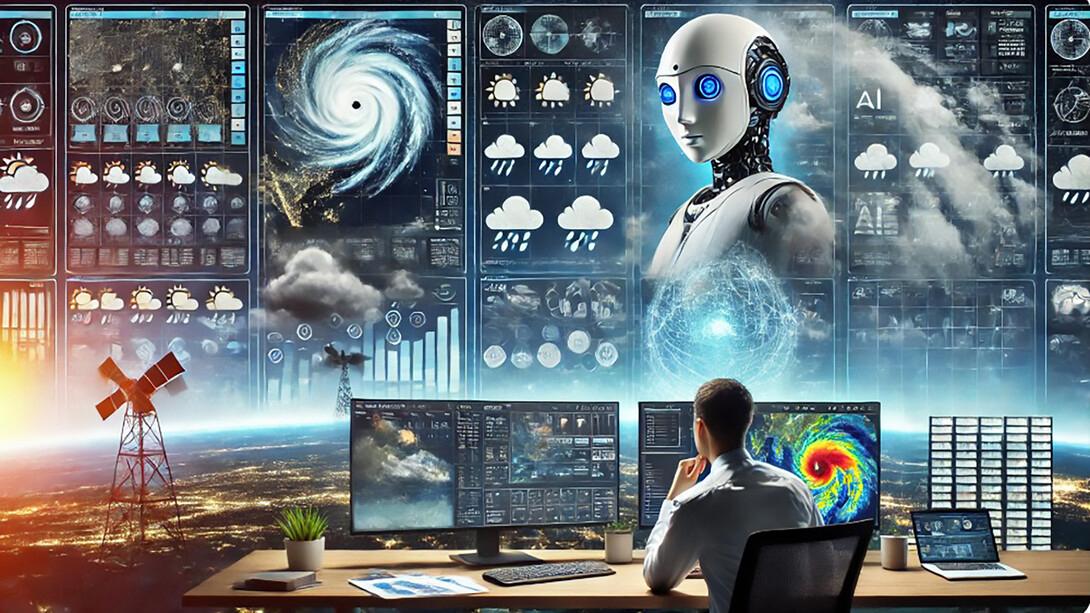
Weather forecasting has traditionally relied on satellites, radar, weather stations, and powerful computer models. Today, Artificial Intelligence (AI), Machine Learning (ML), and drones are bringing major changes to the way weather is monitored and predicted.
AI can process huge amounts of weather data and help predict where rain may occur, when it may begin, how intense it could be, and where severe weather may develop.
But one important point must be clear:
AI does not create rain by itself.
Its main role is to understand atmospheric conditions and improve weather forecasting.
🛰️ 1. Where Does AI Get Weather Data?
AI weather systems can use data from many sources, including:
* 🛰️ Weather satellites* 📡 Doppler weather radars* 🌡️ Automatic weather stations* 🌧️ Rain gauges* 💨 Wind and atmospheric measurements* 📚 Historical weather records
The atmosphere produces enormous amounts of data. AI can analyse millions of data points and identify patterns much faster than humans can.
🧠 2. AI Learns From Historical Weather Patterns
Machine-learning systems can study large amounts of historical weather data.
For example, AI can learn relationships between:
* Temperature and humidity* Cloud movement and rainfall* Atmospheric conditions and thunderstorms* Weather patterns and heatwaves* Pressure, wind and precipitation
The AI then compares current atmospheric conditions with patterns it has learned from previous observations.
🌧️ 3. Can AI Predict Rain?
Yes.
The goal is not simply to answer:
“Will it rain?”
Modern forecasting aims to provide more detailed information such as:
Where → When → How much → How intense?
More localized forecasts can help farmers, cities, emergency services, disaster-management agencies, and the public prepare for severe weather.
🇮🇳 4. AI and Weather Forecasting in India
The India Meteorological Department (IMD) is also incorporating AI and Machine Learning into weather forecasting.
AI-based approaches are being explored and used to improve areas such as rainfall forecasting, monsoon prediction, and high-resolution weather information.
The long-term goal is to provide increasingly localized weather information and warnings, potentially making forecasts more useful at smaller geographical levels.
🤖 5. Will AI Replace Traditional Weather Models?
No.
Weather is governed by physical laws, so traditional physics-based numerical weather prediction remains extremely important.
The emerging approach is:
Physics-Based Weather Models + AI/ML = Hybrid Forecasting
AI can complement traditional numerical models by identifying patterns, improving predictions, processing large datasets, and potentially making certain forecasting tasks faster.
AI weather models such as GraphCast, Pangu Weather, and FourCastNet demonstrate how machine learning is being applied to atmospheric forecasting.
🛩️ 6. What Role Can AI Drones Play?
AI-powered drones could act as flying weather sensors.
Drones can potentially carry cameras and atmospheric sensors capable of collecting information about:
* Temperature* Humidity* Air pressure* Wind* Cloud conditions* Local atmospheric changes
This information can then be analysed by AI.
The basic concept:
Drone → Sensors → Weather Data → AI Analysis → Forecast
This could provide additional local atmospheric information, particularly in areas where conventional weather observations are limited.
☁️ 7. Can AI Drones Make It Rain?
Not directly.
A drone cannot simply fly into the sky and create rain.
There is, however, a separate technology called Cloud Seeding.
Cloud seeding attempts to influence cloud microphysics by introducing suitable particles into certain clouds. Under the right atmospheric conditions, this may increase the likelihood or amount of precipitation.
AI and drones could potentially assist such operations by helping identify suitable clouds and analysing atmospheric conditions.
AI could help determine:
* Which clouds may be suitable* How the cloud system is moving* Whether atmospheric conditions are favourable* When an intervention might be most appropriate
However, cloud seeding is not a guaranteed rain-making technology. It requires suitable clouds and favourable atmospheric conditions.
🌪️ 8. Monitoring Storms and Floods
AI drones could also be useful during:
* Heavy rainfall* Floods* Cyclones* Landslides* Severe storms
Drones can collect aerial images and environmental information from areas that may be dangerous or difficult for humans to access.
AI can then analyse this information to help identify damaged or flooded areas and support emergency response.
🚨 9. What Could Future Weather Forecasting Look Like?
A future weather-monitoring system could combine:
**🛰️ Satellites
* 📡 Radar* 🌡️ Weather Stations* 🌧️ Rain Gauges* 🛩️ AI Drones ↓ 🤖 AI + Machine Learning ↓ 🌦️ High-Resolution Weather Forecast ↓ 🚨 Local Weather Warning ↓ 👨🌾 Farmers + 🏙️ Cities + 🚒 Emergency Services + 👥 Public**
This combination could make weather warnings faster, more localized, and more data-driven.
🔬 The Most Important Point
AI does not control the weather.
Instead:
AI = Prediction and AnalysisDrones = Data CollectionSatellites/Radar = Atmospheric ObservationCloud Seeding = Separate Weather-Modification Technique
Therefore, it would be inaccurate to say:
“AI drones are making rain.”
A more accurate statement is:
AI and drones can help scientists monitor the atmosphere, improve weather forecasts, and potentially support carefully controlled cloud-seeding experiments.
🌍 The Future of Weather Forecasting
The future of weather forecasting may go beyond simply asking:
“What will the weather be tomorrow?”
Advanced systems could increasingly answer questions such as:
“Where could heavy rain occur in the next few hours?”
“How much rainfall is expected in this specific area?”
“Which locations are at increasing risk of flooding?”
And:
“How quickly should a warning be issued?”
The combination of AI + satellites + radar + sensors + drones + scientific weather models could become an important part of the next generation of weather forecasting.


Comments
No comments yet.