

Ownmates Post

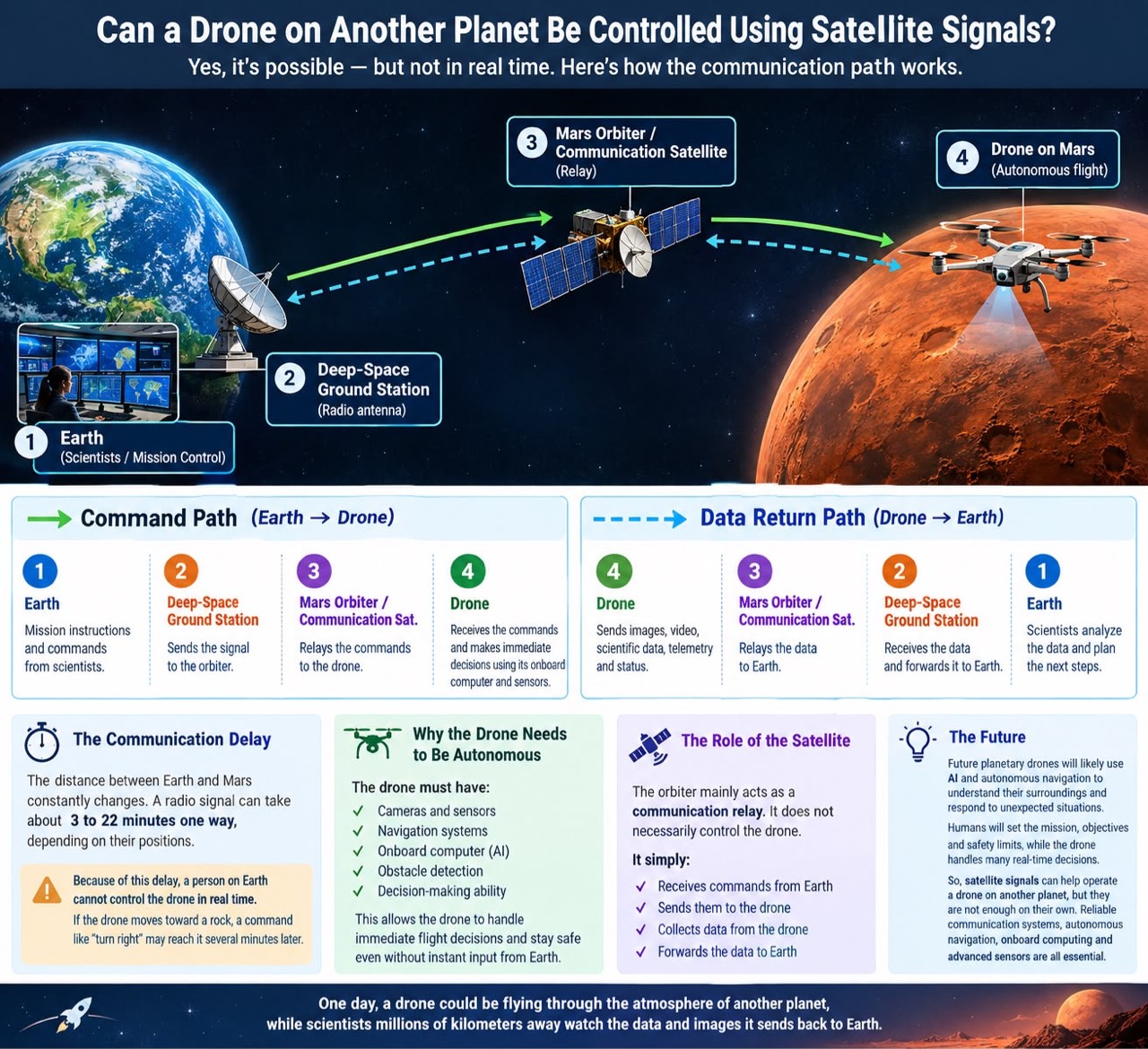
Can a Drone on Another Planet Be Controlled Using Satellite Signals?
Could humans one day control a flying drone on another planet while sitting on Earth? In principle, yes—but it would be much more complicated than controlling a drone on Earth.
Imagine a drone flying on Mars. Radio commands from Earth could be sent directly toward Mars or routed through a communication satellite orbiting Mars. The satellite could act as a relay between Earth and the drone.
The Biggest Challenge: Communication Delay
The biggest problem is the time delay in communication.
The distance between Earth and Mars constantly changes. Depending on their positions, a radio signal can take roughly 3 to 22 minutes to travel one way between the two planets.
That means a person on Earth could not control a Martian drone with a joystick in real time. If the drone suddenly approached a rock, a command such as “turn right” might reach it several minutes later.
How Would the Drone Fly?
The drone would therefore need to be highly autonomous.
It could carry cameras, sensors, navigation systems and an onboard computer. These systems could help it detect obstacles, understand the surrounding terrain and make immediate decisions about its flight.
Scientists on Earth could send high-level instructions such as:
“Fly to this area → take photographs → search for interesting geological features → return to the designated location.”
The drone could then handle many small navigation decisions by itself.
Command path:
Earth → Ground Station → Mars Orbiter → Drone
Data path:
Drone → Mars Orbiter → Ground Station → Earth
The orbiter mainly acts as a communication relay. The drone itself would need onboard computers and autonomous navigation to make immediate flight decisions.
The Role of Satellites
A satellite orbiting another planet could work as a communication relay.
The drone could send images, scientific data, flight information and other telemetry to the orbiter. The orbiter could then transmit this information back to Earth.
Commands from Earth could travel in the opposite direction through the same communication network.
What Could Happen in the Future?
Future planetary drones may not be simple remote-controlled machines. They could use AI and autonomous navigation to understand their surroundings and respond to unexpected situations without waiting for instructions from Earth.
Instead of controlling every movement, humans could define the drone’s mission, objectives and safety limits, while the drone handles many real-time decisions on its own.
So, satellite communication could help operate a drone on another planet, but satellite signals alone would not be enough. Reliable communication systems, autonomous navigation, onboard computing and advanced sensors would all be essential.
One day, a drone could be flying through the atmosphere of another planet while scientists millions of kilometers away watch the data and images it sends back to Earth.


Comments
No comments yet.