

Ownmates Post

When We Put an Artificial Sun Under AI Control
The Next Great Test for Humanity
One day, humanity may create conditions resembling those inside the Sun within a gigantic machine.
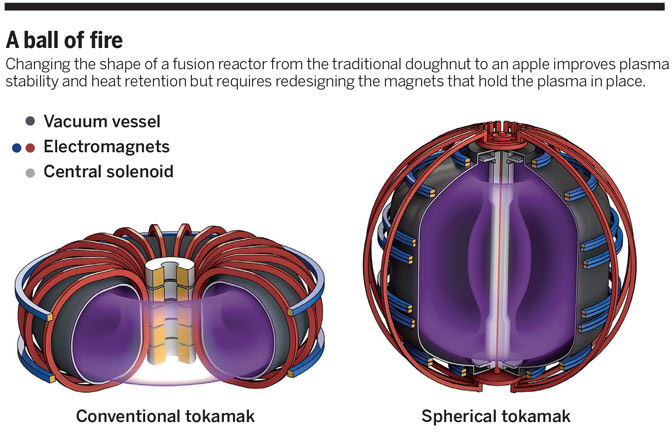
Its shape will look almost like a doughnut.
Inside it, matter will exist as extremely hot plasma, controlled by powerful magnetic fields. Thousands of sensors could monitor the system continuously.
And perhaps the most important part will be this:
Humans may not be the only ones watching it.
AI could analyze enormous amounts of sensor data in real time, identify unusual patterns, assist with plasma control, and help operators respond to changing conditions. Robots could perform inspection and maintenance in environments where direct human access is difficult or hazardous.
This could transform the future of energy.
But it also raises a serious question:
When energy systems become extraordinarily powerful and the technology controlling them becomes extraordinarily complex, how much room will there be for error?
⸻
🍩 A Sun-Like Fire Inside a Doughnut
The doughnut-shaped design of a Tokamak is not simply a matter of appearance.
Its toroidal structure allows magnetic fields to be used to confine and control extremely hot plasma.
The ultimate goal of fusion research is to reproduce, under controlled conditions, the fundamental process that powers the Sun: nuclear fusion.
If fusion becomes technically and economically practical, it could eventually become an important source of low-carbon energy.
But that future has not yet arrived.
Maintaining stable plasma, managing extreme heat, developing suitable materials, achieving useful energy output, and operating a fusion system reliably remain major scientific and engineering challenges.
So the phrase “artificial Sun” is a powerful metaphor—not a literal description of creating a second Sun on Earth.
⸻
🤖 Then AI Enters the Reactor
Operating a fusion system is extraordinarily complex.
This is where AI could become increasingly important.
AI systems can potentially analyze huge volumes of data, recognize changes in plasma behavior, identify anomalies and assist human operators with complex decisions.
Robotic systems could also perform inspection, maintenance and other tasks in difficult environments.
But greater automation creates another kind of dependence.
The more we rely on automated systems, the more important it becomes to know what happens when automation fails.
A sensor can malfunction.
Software can contain an error.
An AI system can misinterpret an unusual situation.
Communication can fail.
A cybersecurity incident could interfere with critical systems.
That is why future high-risk energy infrastructure would require more than intelligent software. It would need human oversight, independent safety systems, redundancy, cybersecurity and reliable fail-safe mechanisms.
⸻
⚡ The Real Transformation May Go Beyond Electricity
Imagine that fusion energy eventually becomes technically and economically viable.
Large amounts of reliable electricity could support the expansion of AI data centers, advanced computing and highly automated industries.
A new technological cycle could emerge:
More Fusion Energy
↓
More Computing
↓
More Capable AI
↓
More Automation and Robotics
↓
Greater Demand for Computing
Such a cycle could provide humanity with extraordinary technological capabilities.
But it could also make the reliability and security of these interconnected systems increasingly important.
⸻
🧠 The Most Important Question May Not Be How Intelligent AI Becomes
Discussions about the future of AI often ask:
“Will AI become more intelligent than humans?”
For critical energy infrastructure, however, another question may be more practical:
“If an AI system makes a wrong decision, can humans take control quickly enough?”
That is why the future of automated energy systems will depend not only on AI capability, but also on questions such as:
Who has ultimate control?
Can humans override the system?
Can the system automatically move into a safe state?
Can AI decisions be tested, audited and understood?
Can a single technical failure be prevented from becoming a larger system failure?
These are not merely science-fiction questions.
They are questions of engineering, cybersecurity, safety and responsible AI deployment.
⸻
🌍 Humanity’s Real Test
Tokamak represents a possible new path toward energy.
AI represents a new way of applying machine intelligence.
Robotics gives machines the ability to act in the physical world.
As these technologies increasingly converge, humanity could gain capabilities unlike anything in its history.
But greater power brings greater responsibility.
We will not only need to build machines that are more powerful.
We will need to build systems that can be understood, tested, monitored, interrupted and safely controlled by humans.
Because the greatest achievement may not be that humanity succeeds in creating an artificial Sun.
It may be that—
we learn how to control that power safely.
And perhaps that will be the real measure of technological progress:
not how much power we can create, but how responsibly we can control the power we create.


Comments
No comments yet.