

🌍 How a Collision Between Two Early Planets Created Earth an

🌍 How a Collision Between Two Early Planets Created Earth and the Moon
Introduction
Approximately 4.5 billion years ago, our Solar System was still developing. Planets were forming from enormous clouds of gas, dust, and rocky material surrounding the young Sun.
During this period, early planetary bodies frequently collided with one another.
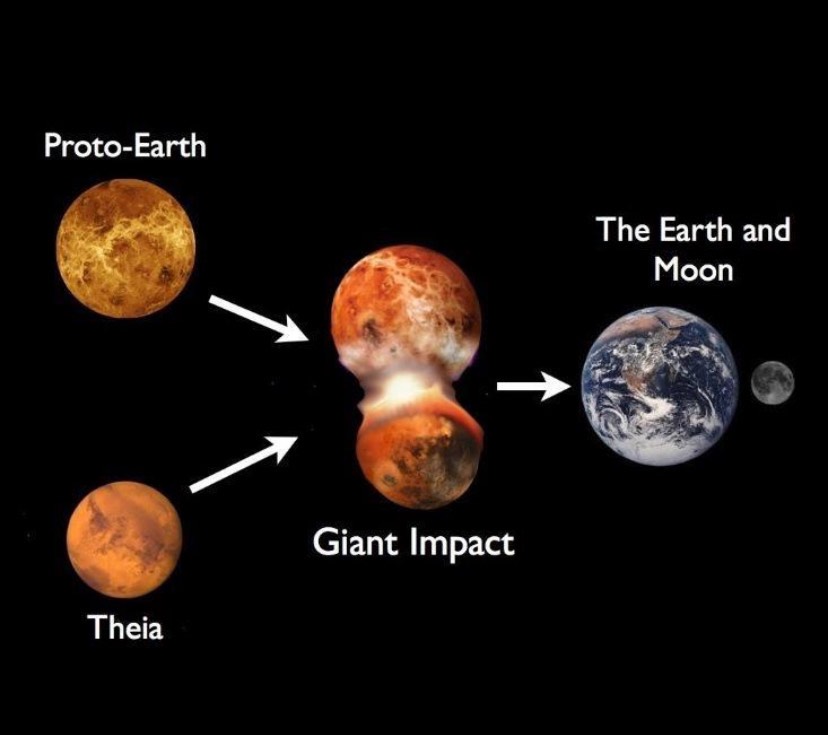
One of the most important events in Earth’s history may have been a massive collision between two planetary bodies: the early Earth, known as Proto-Earth, and another Mars-sized object called Theia.
Scientists call this explanation the Giant Impact Hypothesis.
It is currently the leading scientific explanation for the formation of Earth’s Moon.
1. Proto-Earth: The Early Earth
Around 4.5 billion years ago, Earth was very different from the planet we know today.
It was still developing through the accumulation of rocky material and repeated collisions with other planetary objects.
This early Earth is commonly called Proto-Earth.
At that time:
* Earth’s surface was extremely hot.
* Large regions may have contained molten rock.
* The planet was still gaining mass.
* Its internal structure was gradually developing.
Earth had not yet developed the oceans, atmosphere, and conditions that support modern life.
2. Theia: A Mars-Sized Planetary Body
Scientists propose that another planetary body, approximately the size of Mars, was moving through the early Solar System.
This hypothetical object is called Theia.
Theia may have formed in a nearby region of the Solar System before its orbit eventually brought it into collision with Proto-Earth.
Its estimated size was comparable to Mars, although its exact mass and composition remain uncertain.
3. The Giant Impact: A Massive Collision
According to the Giant Impact Hypothesis, Theia collided with Proto-Earth approximately 4.5 billion years ago.
This was an enormous planetary collision.
The impact released tremendous amounts of energy, melting and vaporizing large quantities of rocky material.
Some material from Earth and Theia was thrown into orbit around the newly formed Earth.
The collision also dramatically changed Earth’s rotation and internal structure.
4. How Was the Moon Formed?
After the collision, enormous amounts of rocky debris remained orbiting Earth.
Over time, gravity caused much of this material to come together.
Gradually, the debris accumulated into a larger body.
Eventually, this process formed the Moon.
The Moon’s composition shares important similarities with Earth’s mantle, which supports the idea that the two bodies were involved in the same giant impact event.
5. How Did Earth Change After the Collision?
The giant impact may have played an important role in Earth’s early evolution.
Some possible consequences include:
* Changes in Earth’s rotation.
* Formation of a debris disk around Earth.
* Creation of the Moon.
* Major changes to Earth’s internal structure.
* Influence on the early evolution of Earth’s orbit and tides.
Over billions of years, Earth continued cooling and developing its atmosphere, oceans, and geological systems.
Much later, conditions suitable for life emerged.
6. Why Is the Moon Important for Earth?
The Moon continues to influence our planet in several important ways.
1. Ocean Tides
The Moon’s gravitational pull is the main driver of Earth’s ocean tides.
2. Earth’s Rotation
The tidal interaction between Earth and the Moon gradually slows Earth’s rotation.
3. Axial Stability
The Moon helps stabilize variations in Earth’s rotational axis over long geological timescales.
4. Scientific Importance
Studying the Moon provides valuable information about Earth’s early history and the formation of the Solar System.
7. How Do Scientists Know About This Event?
Scientists investigate the Giant Impact Hypothesis using several types of evidence:
* Analysis of lunar rock samples collected during Apollo missions.
* Comparison of oxygen and other isotope ratios in Earth and Moon rocks.
* Computer simulations of planetary collisions.
* Studies of the Moon’s density and internal structure.
* Research into the formation and evolution of the early Solar System.
Although the Giant Impact Hypothesis is widely accepted, scientists are still investigating the exact details of the collision and the Moon’s formation.
Conclusion: A Collision That Changed Earth’s History
Approximately 4.5 billion years ago, a massive collision between Proto-Earth and the planetary body known as Theia may have changed the history of our planet forever.
The debris produced by this collision eventually came together to form the Moon.
Today, the Moon influences Earth’s tides, contributes to the long-term evolution of Earth’s rotation, and provides scientists with valuable evidence about our planet’s earliest history.
One of the most important objects in Earth’s sky may have been born from one of the most powerful collisions in our planet’s history.
🌍 The Earth and Moon: Two Worlds, One Extraordinary Beginning.


Comments
No comments yet.