

Ownmates Post

.jpeg)
.jpeg)
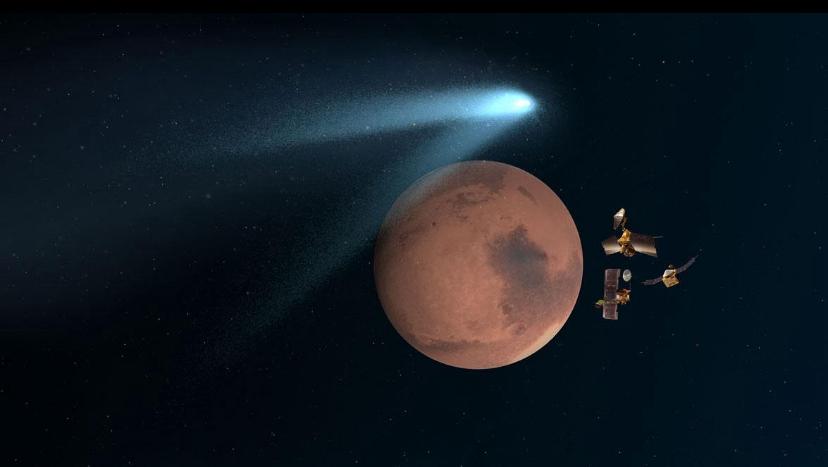
MORPH: Building a Reusable Space Propulsion Hub Around Mars to Redirect Comets and Asteroids
A Future Vision for Space Transportation, Comet Redirection and Planetary Engineering
1. Introduction
Space exploration is entering an era in which humans may not only travel between planets but also develop technologies to control the movement of smaller celestial bodies.
One ambitious concept is to establish a reusable propulsion station in the orbit of Mars. Such a station could support spacecraft missions, asteroid research, comet redirection experiments and future planetary engineering projects.
The proposed concept is called the Mars Orbital Reusable Propulsion Hub (MORPH).
Its primary objective would be to create an orbital infrastructure where different propulsion technologies could be stored, maintained, assembled and reused for multiple space missions.
2. Understanding Comets and Their Composition
Comets are ancient celestial objects that travel around the Sun. They are primarily composed of water ice, frozen gases, dust, rocky materials and organic compounds.
Scientists have identified several chemical elements and compounds in different comets.
Important Elements
Element SymbolHydrogen HOxygen OCarbon CNitrogen NSulfur SIron FeNickel NiSodium NaMagnesium MgSilicon SiCalcium CaPotassium KChromium CrManganese MnCopper CuTitanium Ti
Important Chemical Compounds
* Water (H₂O)* Carbon Dioxide (CO₂)* Carbon Monoxide (CO)* Methane (CH₄)* Ammonia (NH₃)* Methanol (CH₃OH)* Hydrogen Sulfide (H₂S)* Hydrogen Cyanide (HCN)* Ethane (C₂H₆)* Formaldehyde (H₂CO)
These materials make comets scientifically valuable for studying the early Solar System and the chemical ingredients associated with the origins of life.
3. Can We Change the Movement of a Comet?
One interesting possibility is to install propulsion systems on a comet or attach a robotic propulsion module to it.
The objective would be to gradually change its velocity and orbital trajectory.
Different propulsion technologies could potentially contribute to this objective.
Major Propulsion Technologies
Technology Main FunctionChemical Rocket Produces powerful thrustIon Thruster Provides continuous low thrustHall Effect Thruster Accelerates ions using electromagnetic fieldsNuclear Thermal Propulsion Uses nuclear heat to accelerate propellantNuclear Electric Propulsion Uses nuclear-generated electricity to power thrustersPhoton Propulsion Produces thrust using photonsSolar Sail Uses solar radiation pressurePlasma Thruster Accelerates electrically charged plasmaMagnetoplasmadynamic Thruster Uses electromagnetic forces to accelerate plasmaPulsed Plasma Thruster Produces thrust through repeated plasma pulses
Each technology has different advantages, energy requirements and limitations.
For example, photon propulsion produces extremely small thrust, whereas chemical propulsion can generate much greater thrust for shorter periods.
Combining multiple propulsion technologies could provide different levels of control.
4. The Mars Orbital Reusable Propulsion Hub (MORPH)
The central idea is to establish a dedicated propulsion infrastructure around Mars.
Instead of sending a completely new propulsion system for every mission, spacecraft could potentially access reusable propulsion modules from an orbital station.
The proposed station could include:
* Chemical propulsion modules* Ion propulsion systems* Hall Effect thrusters* Nuclear electric propulsion modules* Plasma propulsion systems* Photon propulsion equipment* Solar sail systems* Robotic maintenance facilities* Energy-generation infrastructure* Propellant storage facilities
The station would function as a transportation and maintenance hub for future deep-space missions.
5. How Would the Reusable System Work?
A possible operational model could involve six stages:
Stage 1: Orbital Infrastructure
Establish a propulsion station in a suitable orbit around Mars.
Stage 2: Spacecraft Connection
Attach a reusable propulsion module to a spacecraft designed for a particular mission.
Stage 3: Deep-Space Journey
The spacecraft travels towards a selected comet or asteroid.
Stage 4: Scientific Operations
Robotic equipment studies the object’s composition, mass, rotation and orbital characteristics.
Stage 5: Propulsion Module Recovery
After completing its mission, the reusable propulsion module returns to the orbital station, provided the mission architecture and trajectory allow recovery.
Stage 6: Maintenance and Reuse
Robotic systems inspect, repair and prepare the module for another mission.
This could reduce the need to manufacture and transport entirely new propulsion systems for every expedition.
6. Could a Comet Be Redirected Towards Mars?
In principle, a comet’s trajectory can be changed through controlled thrust.
However, moving a massive comet into a stable Martian orbit would be an extremely difficult engineering challenge.
Scientists would first need to calculate:
1. The comet’s mass and density.2. Its existing orbital trajectory.3. Its velocity and rotational characteristics.4. The required velocity change (Δv).5. The energy and propellant requirements.6. The gravitational influence of Mars and the Sun.7. The final orbital stability.
A comet would not automatically enter a stable Martian orbit simply because it approached Mars.
Its trajectory would require extremely precise control.
7. Could Comets Contribute to Mars’s Future Development?
Comets contain water ice, carbon compounds and other potentially useful materials.
In the distant future, these resources could become interesting targets for scientific investigation and possible resource utilization.
However, deliberately crashing a large comet into Mars would be dangerous.
A collision could release enormous amounts of energy, generate extreme heat and cause widespread geological damage.
Therefore, controlled resource extraction and robotic exploration would be more responsible research directions than deliberately impacting Mars.
It is also important to understand that adding a comet to Mars’s orbit would not significantly increase the planet’s mass or surface gravity. That would require adding the comet’s mass to Mars itself.
8. Major Scientific Challenges
Although MORPH is an interesting future concept, several technological challenges remain:
* Developing high-power and long-life propulsion systems.* Producing sufficient electricity in Martian orbit.* Supplying propellant for electric thrusters.* Developing autonomous robotic maintenance.* Recovering and docking propulsion modules.* Protecting equipment from radiation and micrometeorites.* Maintaining stable orbital infrastructure.* Controlling the movement of massive celestial objects.
Nuclear propulsion would also require careful radiation protection and specialized engineering.
9. Long-Term Vision: A Space Transportation Network
If orbital infrastructure around Mars becomes technologically and economically practical, it could eventually become part of a wider transportation network.
Potential future destinations could include:
* Phobos and Deimos, the moons of Mars.* Near-Earth asteroids.* Main-belt asteroids.* Comets in the Solar System.* Future deep-space research destinations.
Such infrastructure could support scientific exploration, resource studies, spacecraft servicing and planetary defence research.
10. Conclusion
The Mars Orbital Reusable Propulsion Hub (MORPH) represents a futuristic concept for developing reusable space transportation infrastructure.
By combining chemical, electric, nuclear and photon-based propulsion technologies, future space missions could potentially become more flexible and sustainable.
The long-term objective would not simply be to move spacecraft between destinations, but to establish an infrastructure capable of supporting repeated missions, maintaining propulsion equipment and studying the movement of celestial objects.
The future of space exploration may depend not only on building faster spacecraft, but also on building reusable infrastructure that allows humanity to operate throughout the Solar System.
Disclaimer: MORPH is a proposed conceptual architecture, not an existing operational space station or a currently demonstrated method of redirecting massive comets.


Comments
No comments yet.