

Ownmates Post

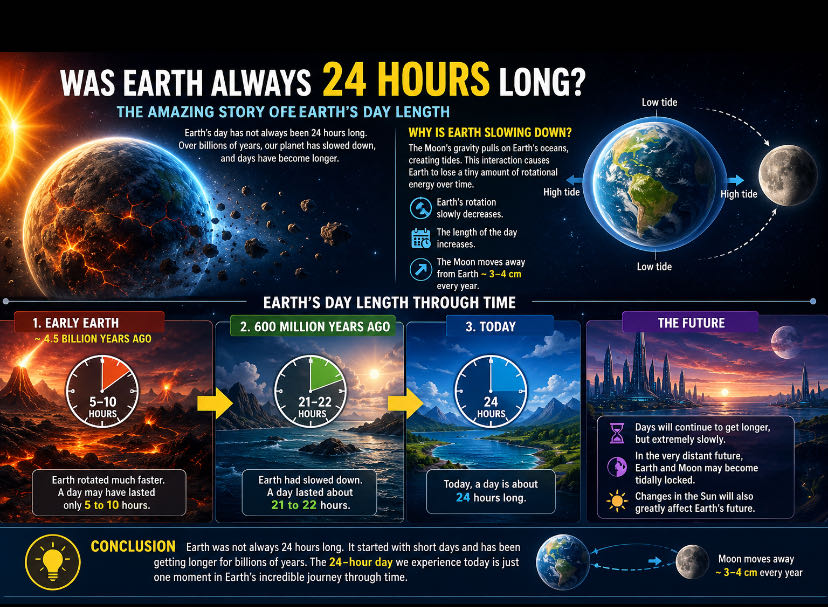
I’ve created a polished English version as an original article:
Was Earth Always 24 Hours Long? Understanding the Evolution of Earth’s Day
Most people assume that Earth has always had a 24-hour day because that is the cycle we experience every day. However, scientific evidence suggests that Earth’s day has not always been 24 hours long. Over billions of years, the planet’s rotation has changed and continues to change even today.
Early Earth Rotated Much Faster
Around 4.5 billion years ago, when Earth first formed, it spun much faster than it does now. Scientists estimate that a single day on early Earth may have lasted only around 5 to 10 hours. This means that sunrise and sunset would have happened much more frequently than they do today.
As Earth evolved over time, its rotation gradually slowed down, resulting in longer days.
Why Is Earth Slowing Down?
The primary reason behind this change is the gravitational interaction between Earth and the Moon, commonly known as tidal effects.
The Moon’s gravity pulls on Earth’s oceans, creating tides. While tides may appear to affect only the seas, they also cause Earth to lose a tiny amount of rotational energy over long periods of time.
This process leads to several effects:
* Earth’s rotation gradually becomes slower.
* The length of a day increases over time.
* The Moon slowly moves farther away from Earth.
Scientists have measured that the Moon is drifting away from Earth by approximately 3–4 centimeters every year.
Earth’s Day Through Time
Based on fossil records, geological evidence, and astronomical calculations, scientists estimate the following timeline:
* Around 4.5 billion years ago: a day may have lasted about 5–10 hours.
* Around 600 million years ago: a day lasted approximately 21–22 hours.
* Today: a day lasts about 24 hours.
This shows that the modern 24-hour day is not a fixed rule of nature but the result of long-term cosmic interactions.
What About the Future?
Earth’s days will continue to become longer in the future. However, the process is extremely slow. Humans will not notice meaningful changes within a normal lifetime because the effects accumulate over millions and billions of years.
In the distant future, Earth and the Moon could theoretically reach a stage called tidal locking, where both bodies always show the same side to each other. However, before that could fully happen, changes in the Sun itself may dramatically alter Earth’s environment.
Conclusion
Earth was not born with a 24-hour day. In its early history, the planet rotated much faster, creating much shorter days. Over billions of years, the Moon’s gravitational influence gradually slowed Earth’s rotation, increasing the length of a day.
The 24-hour day we experience today is therefore not permanent—it is simply a moment in Earth’s long and evolving history.


Comments
No comments yet.