

Ownmates Post
Could the DNA of Buddha or Lord Rama Still Exist Today?
Human history, religion, and science often intersect to create profound questions. One such question is:
Could the DNA of Gautama Buddha or Lord Rama still exist through generations today?
This topic is not only about science, but also about history, tradition, and faith. To understand it properly, we must examine it from three perspectives — historical, religious, and scientific.
⸻
Gautama Buddha and His Lineage
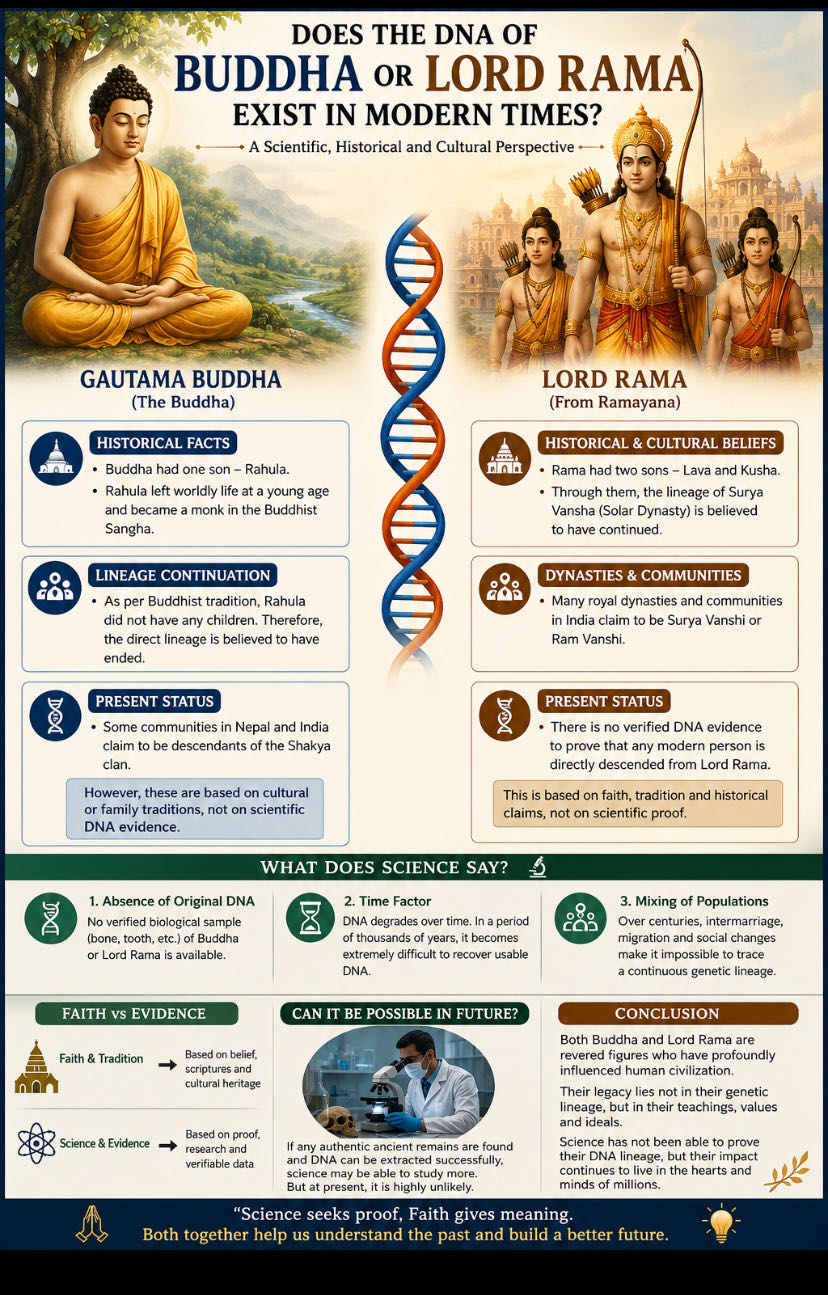
Gautama Buddha, also known as Siddhartha Gautama, is regarded as the founder of Buddhism. Historical texts mention that he had one son — Rahula.
According to Buddhist tradition, Rahula embraced monastic life at a young age. He renounced worldly life, joined the Buddhist Sangha, and devoted himself to spiritual practice. Because of this, most historians and Buddhist scholars believe that Rahula did not have children.
If a person’s descendants do not continue, their direct genetic lineage is generally considered to end. Therefore, there is currently no scientific evidence proving that Buddha’s DNA has certainly continued into modern times.
However, some communities claim to be descendants of the Shakya clan, the clan associated with Buddha. Certain families in Nepal and India culturally identify themselves with this lineage. Yet these claims are based on tradition and family history, not on verified scientific DNA testing.
⸻
Lord Rama and Lineage Tradition
According to Hindu tradition, Lord Rama had two sons — Lava and Kusha. The Ramayana describes how the lineage of the Surya Vansha (Solar Dynasty) continued through them.
Many royal dynasties and communities in India have historically claimed to belong to the Surya Vanshi or Ram Vanshi lineage. Several royal families attempted to connect their ancestry to Lord Rama.
But scientifically, the same challenge remains:
Is there any verified DNA evidence?
To date, no authenticated biological sample has been discovered that can be definitively linked to Lord Rama. Without an original DNA sample, it is scientifically impossible to confirm whether any modern person is genetically descended from him.
⸻
What Does DNA Science Say?
DNA carries hereditary information passed from parents to children. Scientists trace ancestry by:
* Extracting DNA from ancient bones or teeth
* Comparing it with modern DNA samples
* Using continuous genealogical records
However, in the case of individuals who may have lived thousands of years ago, several major difficulties arise.
1. Absence of Original DNA Samples
If no verified biological sample of a historical figure exists, scientific comparison becomes impossible.
2. DNA Degradation Over Time
Heat, humidity, and environmental conditions damage DNA over centuries. In climates such as India’s, preserving usable DNA for thousands of years is extremely rare.
3. Breaks in Lineage
Over long periods, migration, intermarriage, and social changes make it difficult to trace an uninterrupted genetic lineage.
⸻
Difference Between History and Faith
It is important to understand that:
* Science seeks evidence
* Religion and tradition are based on faith
Therefore, a person may culturally or religiously believe they are descendants of Rama or the Shakya clan, but science can only accept such claims when clear DNA evidence exists.
⸻
Could It Become Possible in the Future?
If authenticated ancient remains are discovered in the future and usable DNA can be extracted from them, scientists may be able to conduct deeper research.
But at present:
* There is no scientific proof of Buddha’s DNA lineage
* There is no scientific proof of Lord Rama’s DNA lineage


Comments
No comments yet.