

Ownmates Post

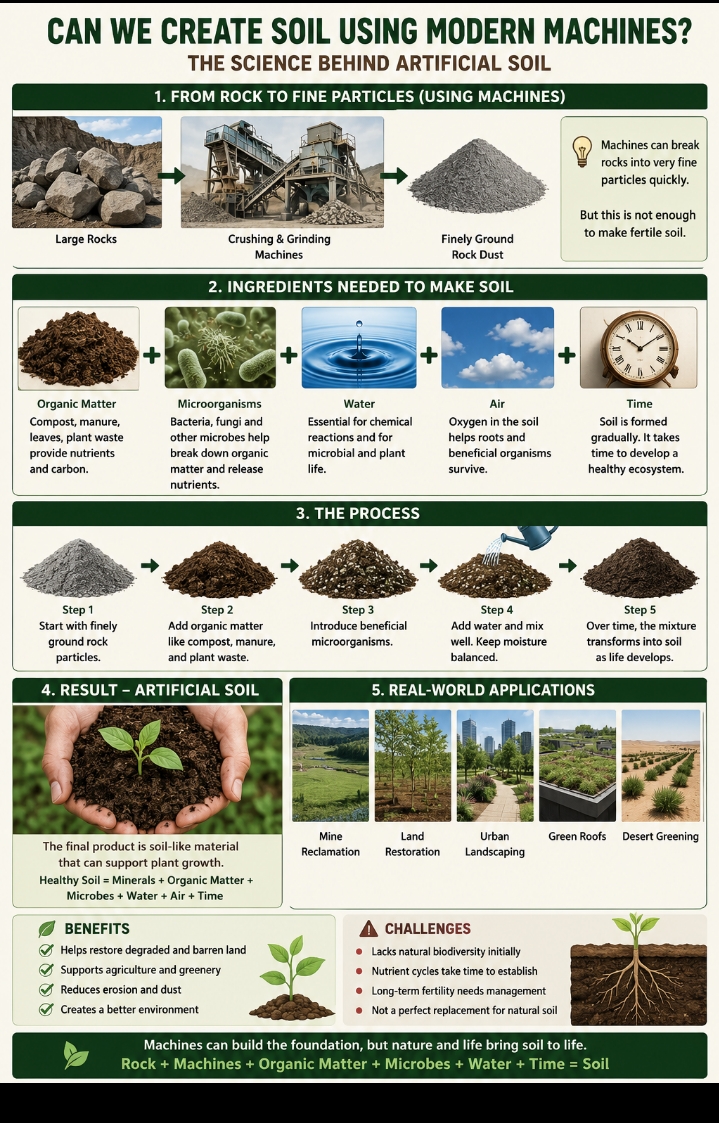
Can We Create Soil Using Modern Machines? The Science Behind Artificial Soil
Introduction
Soil is one of the most valuable natural resources on Earth. It supports agriculture, forests, and nearly all terrestrial life. Traditionally, soil forms naturally over thousands to millions of years through the weathering of rocks and the decomposition of organic matter. But with today's advanced grinding and crushing technologies, an interesting question arises:
Can humans create soil artificially using modern machines?
The answer is yes—but with important limitations.
How Natural Soil Forms
Natural soil is created through a long process involving:
Breakdown of rocks by wind, water, temperature changes, and chemical reactions.
Decomposition of plants, leaves, and animals into organic matter (humus).
Growth of microorganisms such as bacteria and fungi.
Continuous mixing of minerals, water, air, and living organisms.
This process creates fertile soil rich in nutrients and biological activity.
What Modern Machines Can Do
Today, powerful crushers and grinders can turn large rocks into fine particles within minutes. These particles may resemble soil in texture, but they are not yet true fertile soil.
Machines can produce:
Rock dust
Crushed stone particles
Mineral-rich fine material
However, these materials lack the biological components that make soil productive.
Turning Crushed Rock into Soil
To create usable soil, crushed rock must be combined with:
1. Organic Matter
Compost, manure, leaves, and plant waste provide carbon and nutrients.
2. Microorganisms
Beneficial bacteria and fungi help break down organic material and release nutrients.
3. Water and Air
Healthy soil requires proper moisture and oxygen circulation.
4. Time
Biological processes need time to establish a functioning soil ecosystem.
When these elements are added, the material gradually develops into soil capable of supporting plant growth.
Real-World Applications
Artificial soil creation is already used in:
Mine reclamation projects
Land restoration programs
Urban landscaping
Green roofs
Desert greening initiatives
Scientists and engineers often use crushed rock mixed with compost and organic matter to restore degraded land.
Challenges
Despite technological advances, artificial soil still faces challenges:
It may lack biodiversity found in natural soils.
Nutrient cycles take time to develop.
Long-term fertility can be difficult to maintain.
Building a complete soil ecosystem cannot be achieved instantly.
In simple terms:
Rock + Grinding Machine + Compost + Microbes + Water + Time = Artificial Soil Capable of Supporting Life. 🌱🌍


Comments
No comments yet.