

Ownmates Post

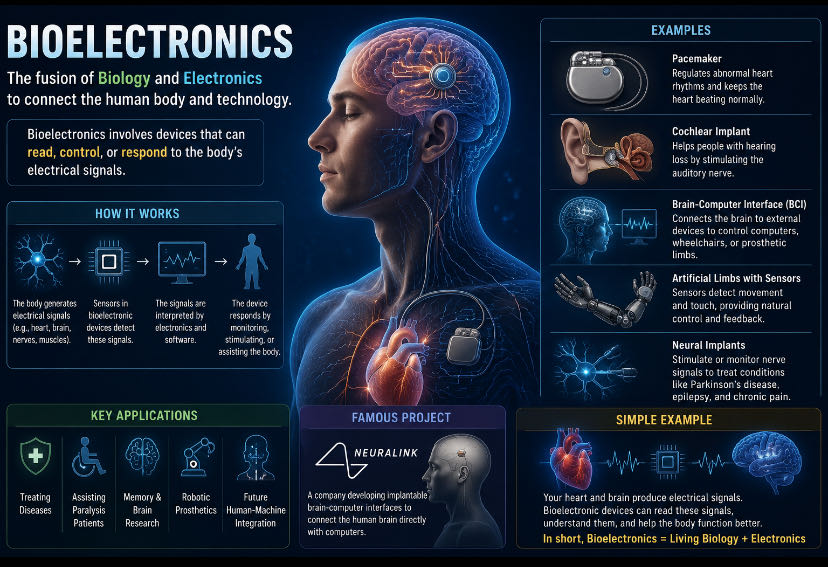
Bioelectronics is a field that combines biology and electronics to develop technologies that can directly interact with the human body. Its main goal is to create communication between living systems and machines.
In simple terms, bioelectronics involves technologies that can read, control, or respond to the body’s electrical signals.
Examples include:
* Pacemakers — devices that regulate heartbeats
* Cochlear implants — devices that help restore hearing
* Brain-computer interfaces (BCI) — systems connecting the brain to computers
* Artificial limbs with sensors — electronic prosthetic arms and legs
* Neural implants — devices that stimulate or monitor nerve signals
This field combines biology, neuroscience, artificial intelligence, and microelectronics.
Major Applications
* Treating diseases
* Assisting paralysis patients
* Brain and memory research
* Robotic prosthetics
* Future human-machine integration
One well-known project in this field is problem to Stephan Hawkins which is developing technology to connect the human brain directly with computers.
Simple Example
Your heart and brain naturally produce electrical signals. Bioelectronic devices can detect and interpret these signals to help the body function better. In short, bioelectronics is the combination of “living biology electronics.”


Comments
No comments yet.