

Ownmates Post

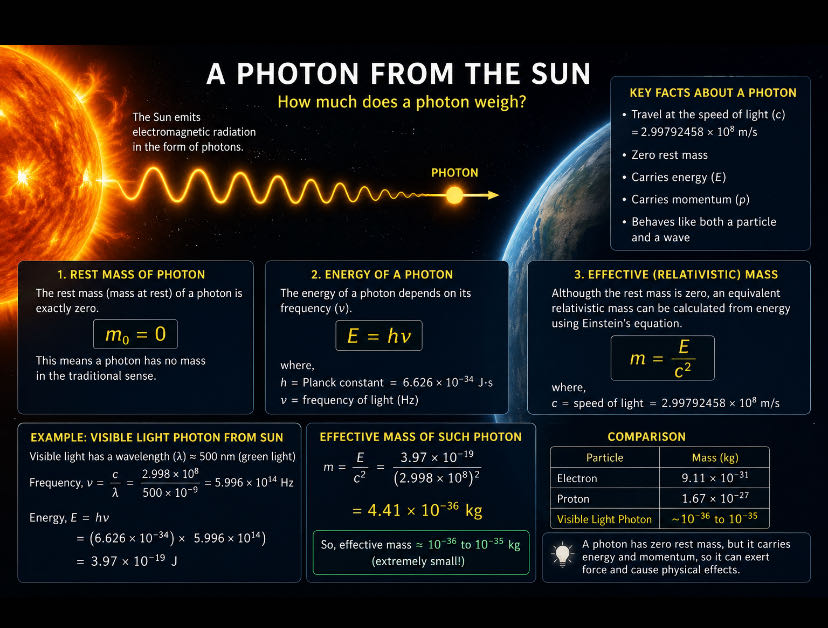
Theoretically, humans can create extremely lightweight materials, but creating something completely “massless” like a photon is not considered possible according to current physics, because a photon is a fundamental particle whose rest mass is exactly zero.
Still, scientists have already developed incredibly light materials such as:
* Aerogel — often called “frozen smoke”
* Graphene — a carbon sheet only one atom thick
* Ultra-thin solar sails
* Advanced nanomaterials
These materials have extremely small mass, but not zero mass.
For example:
Aerogel
Aerogel is so light that it almost feels like air, but it still contains atoms, so it still has mass.
Graphene
Graphene can be just one atom thick, yet its mass is still not zero.
According to physics:
Anything made of atoms or particles will possess mass.
Only certain fundamental particles — such as photons — are considered to have zero rest mass.
That is why:
* Creating “extremely light” materials is possible
* Creating a completely “massless object” is not considered possible under current scientific understanding
⸻
Could It Become Possible in the Future?
Science may advance dramatically in the future, but according to present-day physics, creating a truly massless material would be extremely difficult — and perhaps impossible.
The reason is simple:
* Ordinary matter is made of atoms
* Atoms contain protons, neutrons, and electrons
* All of these particles possess mass
So the moment you create matter, mass appears automatically.
However, some advanced possibilities are being explored:
⸻
1. Ultra-Light Metamaterials
Scientists are developing artificial materials with extremely low effective weight.
These materials can be:
* Very strong
* Extremely lightweight
* Built with nanoscale structures
In the future, they may become important for spacecraft and advanced engineering.
⸻
2. Light-Based Structures
Some researchers study ways to trap and control light using optical fields.
Future technologies might use:
* Light fields
* Plasma
* Electromagnetic confinement
to create temporary structures made mostly of energy rather than traditional matter.
But these would not behave exactly like ordinary solid materials.
⸻
3. Photonic or Energy Objects (Science Fiction Concepts)
Science fiction often imagines concepts such as:
* Hard light
* Holographic matter
* Pure energy constructs
At present, real science does not have technology capable of creating such objects.
⸻
The Most Important Physics Principle
In physics, being “massless” means an object must always move at the speed of light.
According to Albert Einstein’s theory of relativity:
* Massless particles always travel at light speed
* Massive objects cannot reach light speed
So if a “massless solid object” somehow existed, it would not behave like normal matter at all.
⸻
Final Conclusion
In the future:
* Extremely lightweight materials may become far more advanced
* Nano-engineered structures and light-based technologies may improve dramatically
But:
Creating a completely massless material is not considered possible according to current scientific understanding.


Comments
No comments yet.