

Ownmates Post

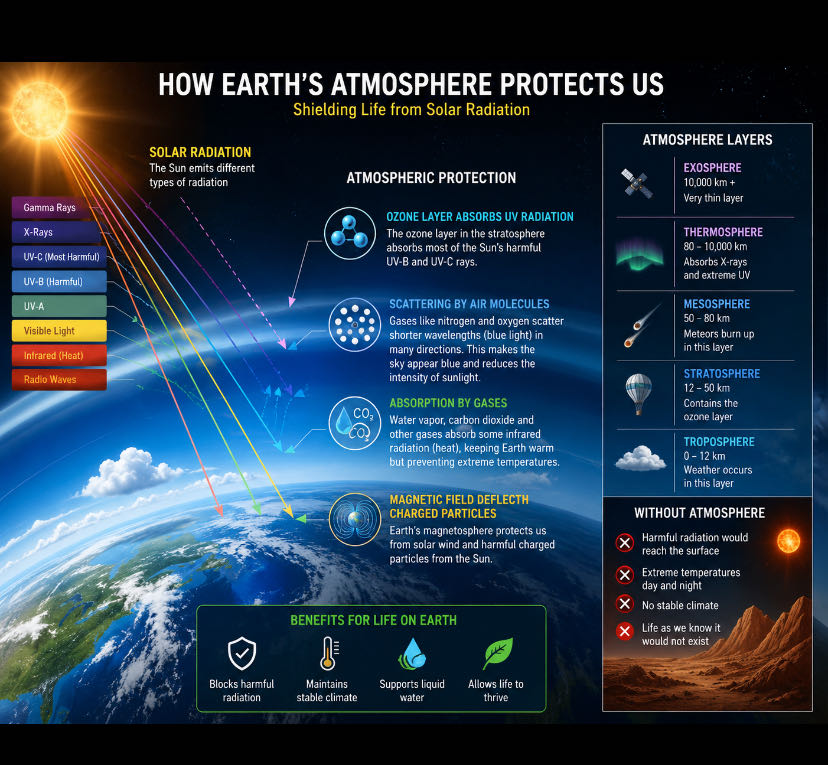
How Earth’s Atmosphere Protects Life from Solar Radiation ☀️🌍
Life on Earth exists under constant exposure to energy from the Sun. Sunlight provides warmth, light, and energy for ecosystems, but the Sun also emits dangerous radiation that could seriously harm living organisms.
Fortunately, Earth possesses a powerful natural defense system: its atmosphere and magnetic field.
Without these protective layers, life as we know it would likely not exist.
⸻
The Sun Emits More Than Visible Light
The Sun produces many types of radiation, including:
* visible light,
* infrared radiation (heat),
* ultraviolet (UV) radiation,
* X-rays,
* and charged solar particles.
Some of this energy is essential for life, while some can damage cells, DNA, and biological systems.
⸻
Does Air Reduce Solar Radiation?
Yes — but not ordinary “air” alone.
Earth’s entire atmosphere works together to reduce harmful solar radiation before it reaches the surface.
The atmosphere contains:
* nitrogen,
* oxygen,
* water vapor,
* dust particles,
* and trace gases.
These components absorb, scatter, and reflect portions of incoming solar energy.
⸻
The Ozone Layer: Earth’s UV Shield 🛡️
One of the most important protective regions is the:
Ozone Layer
The ozone layer absorbs most dangerous ultraviolet radiation from the Sun, especially:
* UV-B
* UV-C
Without ozone protection:
* skin cancer rates would rise dramatically,
* DNA damage would increase,
* and ecosystems could collapse.
⸻
Atmospheric Scattering and the Blue Sky
Air molecules also scatter sunlight.
Shorter blue wavelengths scatter more strongly than red wavelengths, which is why Earth’s sky appears blue.
This scattering process also slightly softens direct sunlight reaching the ground.
⸻
Earth’s Magnetic Shield 🌍
Earth has another major defense system:
Earth’s magnetosphere
The magnetosphere is created by Earth’s magnetic field and protects the planet from charged particles coming from the Sun.
It deflects much of the solar wind and helps prevent harmful radiation from directly striking the atmosphere.
During strong solar storms, this magnetic shield becomes especially important.
⸻
What Would Happen Without the Atmosphere?
Without Earth’s atmosphere:
* harmful radiation would bombard the surface,
* temperatures would become extreme,
* liquid water would struggle to remain stable,
* and most life forms would not survive.
Conditions would become more similar to:
Mars
which has a thin atmosphere and far weaker radiation protection than Earth.
⸻
The Atmosphere Also Controls Heat 🌡️
Earth’s atmosphere does more than block radiation.
It also:
* distributes heat around the planet,
* stabilizes temperatures,
* and supports the greenhouse effect that keeps Earth warm enough for life.
Without atmospheric heat regulation:
* days could become extremely hot,
* nights could become freezing cold.
⸻
Why Earth Is Habitable
Earth’s ability to support life depends on several protective systems working together:
* the atmosphere,
* the ozone layer,
* clouds and water vapor,
* and the magnetic field.
Together, these systems reduce dangerous radiation while allowing enough sunlight to reach the surface for plants, oceans, and ecosystems to thrive.
The balance is delicate — and it is one of the main reasons Earth remains a rare habitable world in the universe. 🌌


Comments
No comments yet.