

Ownmates Post

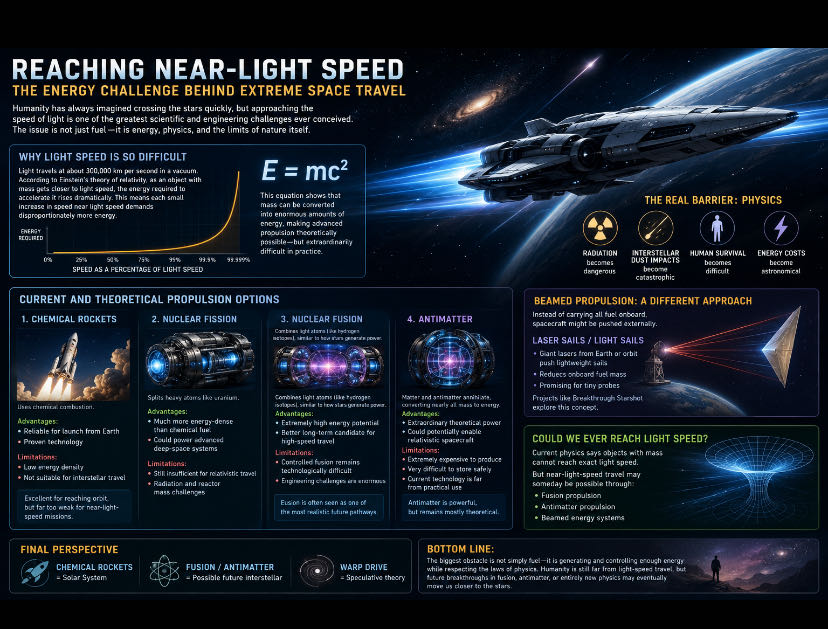
Reaching Near-Light Speed: The Energy Challenge Behind Extreme Space Travel
Humanity has always imagined crossing the stars quickly, but approaching the speed of light is one of the greatest scientific and engineering challenges ever conceived. The issue is not just fuel—it is energy, physics, and the limits of nature itself.
Why Light Speed Is So Difficult
Light travels at about 300,000 km per second in a vacuum. According to Einstein’s theory of relativity, as an object with mass gets closer to light speed, the energy required to accelerate it rises dramatically. This means each small increase in speed near light speed demands disproportionately more energy.
E = mc^2
This equation shows that mass can be converted into enormous amounts of energy, making advanced propulsion theoretically possible—but extraordinarily difficult in practice.
Current and Theoretical Propulsion Options
1. Chemical Rockets
Today’s rockets use chemical combustion.
Advantages:
* Reliable for launch from Earth
* Proven technology
Limitations:
* Low energy density
* Not suitable for interstellar travel
Chemical rockets are excellent for reaching orbit, but far too weak for near-light-speed missions.
⸻
2. Nuclear Fission
Fission splits heavy atoms like uranium.
Advantages:
* Much more energy-dense than chemical fuel
* Could power advanced deep-space systems
Limitations:
* Still insufficient for relativistic travel
* Radiation and reactor mass challenges
⸻
3. Nuclear Fusion
Fusion combines light atoms (like hydrogen isotopes), similar to how stars generate power.
Advantages:
* Extremely high energy potential
* Better long-term candidate for high-speed travel
Limitations:
* Controlled fusion remains technologically difficult
* Engineering challenges are enormous
Fusion is often seen as one of the most realistic future pathways.
⸻
4. Antimatter
Antimatter is the most energy-dense fuel concept known.
When matter and antimatter meet, nearly all mass converts to energy.
Advantages:
* Extraordinary theoretical power
* Could potentially enable relativistic spacecraft
Limitations:
* Extremely expensive to produce
* Very difficult to store safely
* Current technology is far from practical use
Antimatter is powerful, but remains mostly theoretical.
⸻
Beamed Propulsion: A Different Approach
Instead of carrying all fuel onboard, spacecraft might be pushed externally.
Laser Sails / Light Sails
* Giant lasers from Earth or orbit push lightweight sails
* Reduces onboard fuel mass
* Promising for tiny probes
Projects like Breakthrough Starshot explore this concept.
⸻
The Real Barrier: Physics
Even with advanced propulsion:
* Radiation becomes dangerous
* Interstellar dust impacts become catastrophic
* Human survival becomes difficult
* Energy costs become astronomical
Could We Ever Reach Light Speed?
Current physics says objects with mass cannot reach exact light speed.
But near-light-speed travel may someday be possible through:
* Fusion propulsion
* Antimatter propulsion
* Beamed energy systems
Final Perspective
For now:
Chemical rockets = Solar System
Fusion / Antimatter = Possible future interstellar
Warp drive = Speculative theory
Bottom Line:
The biggest obstacle is not simply fuel—it is generating and controlling enough energy while respecting the laws of physics. Humanity is still far from light-speed travel, but future breakthroughs in fusion, antimatter, or entirely new physics may eventually move us closer to the stars.


Comments
No comments yet.