

Ownmates Post
🇨🇳 China’s EAST Tokamak: Where Does the Electricity Come From?
Fusion energy is often described as a potential source of clean and virtually limitless energy. But there is an important question: if a tokamak needs electricity to operate, where does that electricity come from?
China’s EAST (Experimental Advanced Superconducting Tokamak) provides a good example of how modern fusion research works.
⚡ Why Does a Tokamak Need Electricity?
A fusion reaction does not simply start by itself. A tokamak needs large amounts of electrical power to operate its supporting systems and to create and control extremely hot plasma.
Electricity is required for systems such as:
* 🧲 Superconducting magnets — to confine and control the plasma.
* 🔥 Plasma heating systems — to heat the plasma to temperatures of hundreds of millions of degrees Celsius.
* 💨 Vacuum systems — to maintain extremely low pressure inside the reactor chamber.
* ❄️ Cryogenic systems — to keep superconducting magnets at very low temperatures.
* 🖥️ Control, cooling and safety systems — to monitor and operate the facility.
For an experimental tokamak such as EAST, this electricity comes from the external electrical grid.
🔥 How Could Fusion Eventually Produce Electricity?
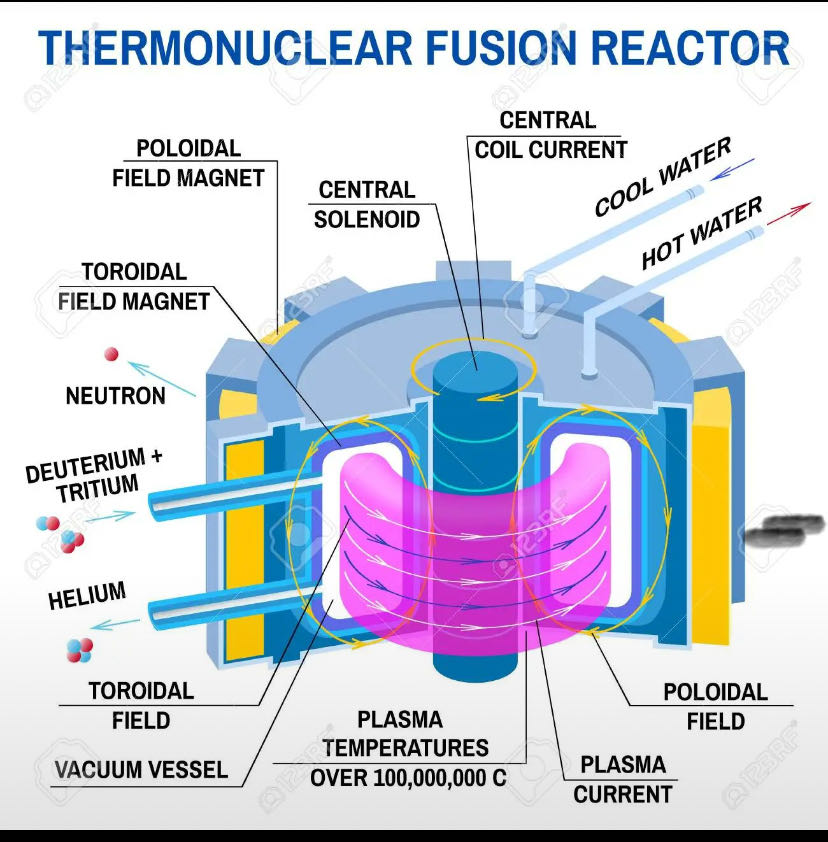
A future commercial fusion reactor is expected to use fuels such as deuterium and tritium.
The basic reaction is:
Deuterium Tritium → Helium Neutron Energy
The high-energy neutron produced by the reaction would enter a surrounding blanket, where its energy would be converted into heat.
That heat could then be used in a conventional power-generation system:
Fusion Energy → Heat → Steam → Turbine → Generator → Electricity ⚡
The electricity could then be supplied to the grid.
🔄 Fusion Gain Is Not the Same as Net Electricity
One of the most important concepts in fusion research is fusion gain, or Q.
Q compares the fusion power produced by the plasma with the external heating power delivered directly to the plasma.
For example:
Q = 1 means the fusion power is approximately equal to the external plasma-heating power.
Q > 1 means the fusion reaction is producing more power than the direct external heating input.
However, Q > 1 does not automatically mean that the entire facility is producing net electricity.
A real fusion power plant would also consume electricity for magnets, cooling, pumps, cryogenics, plasma heating, vacuum systems and other equipment.
Therefore, the ultimate goal is:
Electricity generated by the plant > Electricity consumed by the entire plant
Only then could a commercial fusion plant continuously supply surplus electricity to the grid.
🇨🇳 What About China’s EAST Tokamak?
China’s EAST is an experimental fusion research facility, not a commercial electricity-generating power station.
Its primary purpose is to study how extremely hot plasma can be created, controlled and maintained for long periods. The facility helps scientists and engineers develop technologies that could eventually be used in future fusion power plants.
The basic energy flow today can therefore be simplified as:
China’s Electrical Grid ⚡
↓
EAST Tokamak
↓
Plasma Heating 🔥
↓
Fusion Experiment
↓
Scientific Research and Technology Development
EAST is not currently operating as a commercial plant that converts fusion heat into electricity and continuously sends net electrical power to the grid.
🌍 The Future Goal
A commercial fusion power plant would ideally work like this:
External Electricity ⚡ → Plasma Start-up → Fusion 🔥 → Heat → Turbine → Generator ⚡ → Plant’s Own Electricity Surplus Electricity to the Grid
This is one of the central engineering challenges of fusion energy.
The challenge is not simply creating fusion. Scientists and engineers must ultimately demonstrate that fusion can be sustained safely and economically while producing more useful electricity than the entire facility consumes.
If that can be achieved at commercial scale, fusion could become a fundamentally different type of energy source: a system that initially requires electricity to start and operate, but ultimately generates enough energy to power itself and supply additional electricity to society.


Comments
No comments yet.