

Ownmates Post
What Is Inside a Proton? How Scientists Discovered Quarks
We know that every atom has a tiny central region called the nucleus, which contains protons and neutrons. But scientists once asked a deeper question:
Are protons and neutrons the smallest particles, or are they made of something even smaller?
Experiments in particle physics eventually provided the answer.
The Important Experiments at SLAC
In the late 1960s, scientists at the SLAC National Accelerator Laboratory in California fired high-energy electrons at protons.
They carefully measured how the electrons scattered after hitting the protons, including their direction and energy.
The results showed that the proton was not simply a uniform, indivisible sphere. Instead, it contained extremely small, point-like constituents.
These constituents were later understood as quarks. The experiments became a major milestone in understanding the internal structure of the proton.
The Role of CERN
At CERN, the European particle-physics laboratory, scientists have conducted many high-energy experiments studying quarks, leptons and other elementary particles.
These experiments have provided extensive evidence supporting the Standard Model of Particle Physics, our current framework for describing fundamental particles and their interactions.
DESY and the HERA Collider
Germany’s DESY laboratory operated the HERA electron–proton collider.
HERA allowed scientists to collide electrons and protons at very high energies and study the proton’s internal structure in extraordinary detail.
The experiments provided important information about the distribution and behavior of quarks and gluons inside protons.
Fermilab and Quark Research
The U.S. Fermilab has also played an important role in studying quarks and other elementary particles.
Experiments there contributed significantly to the discovery and measurement of different types of quarks, including very heavy quarks.
Have Scientists Actually Seen a Quark?
Not in the ordinary sense.
Quarks cannot normally be removed from a proton and observed as isolated particles. This is related to a phenomenon called quark confinement.
Instead, scientists study the products of high-energy particle collisions.
They measure:
* the particles produced,
* their energies,
* their directions,
* their momentum, and
* how frequently different collision patterns occur.
Scientists then compare these measurements with theoretical predictions. Repeated experimental results provide strong evidence for the quark structure of matter.
What Is Inside a Proton?
A proton has three valence quarks:
Two up quarks one down quark
However, the complete picture is more complicated. A proton also contains gluons and a dynamic sea of quark–antiquark pairs.
Therefore, it is not accurate to imagine a proton simply as three tiny balls sitting inside it.
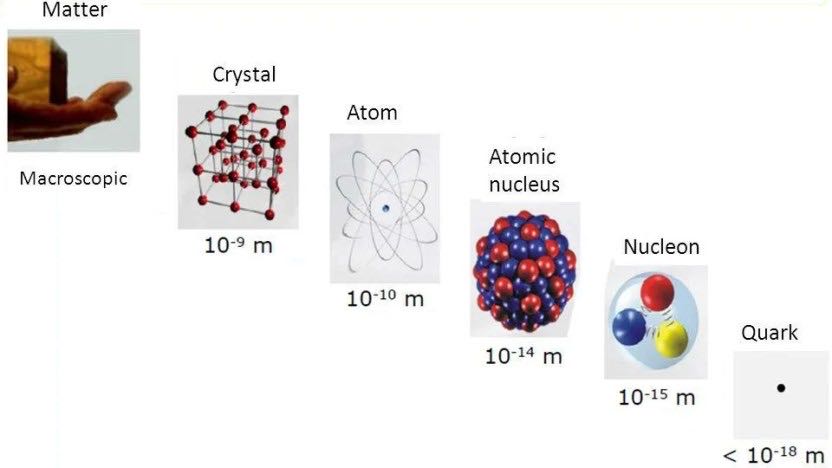
How Small Does Matter Get?
The structure can be viewed as a hierarchy:
Atom → Nucleus → Proton/Neutron → Quarks
Electrons, quarks and several other particles are currently classified as elementary particles, meaning that experiments have not revealed any smaller internal structure inside them.
Scientists continue to perform increasingly precise experiments because an important question remains open:
Are elementary particles truly fundamental, or could they have an even deeper structure that current experiments cannot yet detect?
That question remains one of the fascinating frontiers of modern physics.


Comments
No comments yet.