

Ownmates Post

North Bihar Floods: Hope for a Stronger and Safer Future
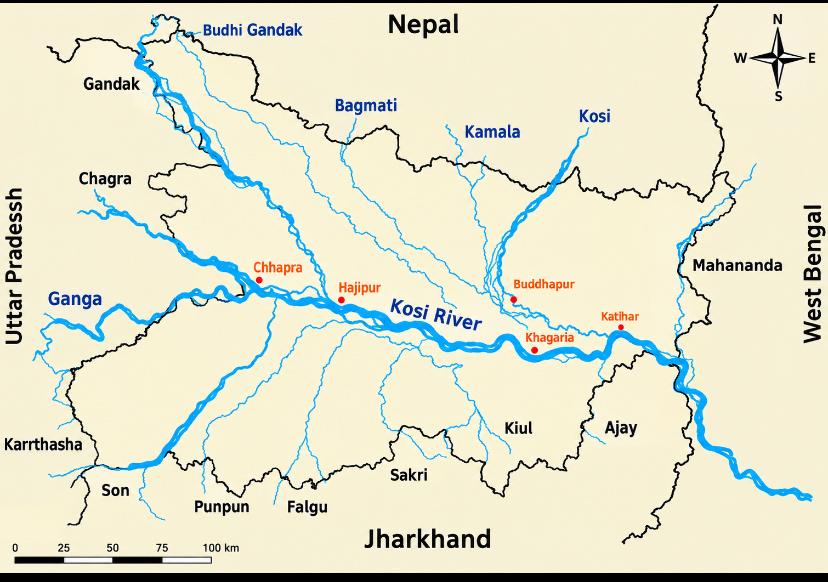
Every year, flooding in North Bihar affects the lives of millions of people, damaging homes, farmland, livelihoods, and the local economy. Rivers such as the Kosi, Gandak, Bagmati, Kamla-Balan, and Mahananda carry enormous volumes of water from the Himalayas and Nepal into Bihar.
But these rivers are not only a challenge for Bihar. They also represent a major long-term opportunity for water security, irrigation, groundwater recharge, and hydropower, if their water is managed scientifically and safely.
A Clear Flood-Control Action Plan
North Bihar needs a 10–15-year phased flood-management strategy. The objective should not be to depend on a single dam or embankment. Instead, the entire river system—from the Himalayan catchments and Nepal to the Ganga—should be managed as an interconnected basin.
Phase 1: Years 1–3 — Water Monitoring and Immediate Protection
1. Establish a real-time water-data sharing system between Nepal and Bihar.2. Install automatic water-level sensors and rain gauges along major rivers, including the Kosi, Gandak, Bagmati, Kamla-Balan, and Mahananda.3. Establish a 24×7 Flood Control Centre to monitor rainfall, river levels, and emerging flood threats.4. Develop an early-warning system capable of reaching villages through mobile alerts, SMS, sirens, and local administration.5. Conduct independent technical audits of old and vulnerable embankments before every monsoon.6. Keep emergency repair materials, equipment, and machinery at strategically important locations in advance.7. Continue technical studies and India–Nepal discussions concerning the proposed Sapta-Kosi High Dam.
The Sapta-Kosi High Dam has not yet been constructed. India and Nepal have been working for years on surveys, studies, and the Detailed Project Report (DPR) associated with the proposed project. The existing major Kosi structure in Bihar is the Kosi Barrage at Birpur, which is much smaller than the proposed high dam and does not provide the same type of massive storage reservoir.
Phase 2: Years 3–7 — Preparing to Manage Large Water Flows
Kosi
Complete detailed technical, environmental, geological, and social studies for the proposed Sapta-Kosi High Dam, and move toward an informed India–Nepal decision based on the findings.
Gandak
Modernize the Valmikinagar Barrage and its associated water-management systems. The feasibility of upstream storage and other flood-management measures should also be scientifically assessed.
Bagmati and Kamla-Balan
Where geographically and environmentally appropriate, develop small- and medium-scale water-storage and flood-storage areas. At the same time, strengthen embankments and improve drainage networks.
Mahananda
Address flooding, drainage, river flow, and local waterlogging through an integrated river-basin-level management plan rather than isolated interventions.
Phase 3: Years 5–10 — Learning to Live Safely With the Rivers
Every river should not simply be confined behind increasingly higher embankments. Instead, authorities should determine scientifically:
Where should water be stored?Where can it safely spread?Where should it be rapidly drained?
This approach could include:
* Implementing floodplain zoning.* Restricting new construction in extremely high-risk flood zones.* Restoring natural wetlands and historical drainage channels.* Increasing the drainage capacity of towns and villages.* Creating temporary flood-storage areas wherever geography and environmental conditions permit.
The objective should be to give floodwater controlled space, rather than allowing it to spread unpredictably into densely populated areas.
Phase 4: Years 10–15 — Turning Water From a Hazard Into a Resource
In the long term, the objective should not be limited to reducing flood damage.
The broader concept could be:
Monsoon excess water → Safe storage → Controlled release → Irrigation + Drinking Water + Groundwater Recharge + Electricity
Where geography, geology, environmental conditions, and social considerations permit, multipurpose reservoirs and other water-storage infrastructure could be developed.
Such systems could potentially provide multiple benefits while reducing uncontrolled downstream flows.
A Joint India–Nepal Flood-Control Framework
Because many of North Bihar’s major rivers are transboundary systems, stronger coordination between India and Nepal could play an important role.
A joint river-basin coordination mechanism could focus on five major areas:
1. Data Sharing
Rapid exchange of rainfall, river-level, reservoir, and hydrological data.
2. Forecasting
Improved scientific forecasting so that communities can receive warnings before dangerous flooding develops.
3. Reservoir Operation
If upstream storage facilities are developed, coordinated reservoir operations and controlled releases could help manage downstream flood risks.
4. Emergency Response
Establish direct communication channels between relevant agencies in India and Nepal for rapid emergency coordination.
5. Long-Term Planning
Develop joint strategies for rivers, sediment management, embankments, drainage, reservoirs, and floodplain management.
China Has Also Raised the Issue
The broader idea of greater upstream water management in the Himalayan river system has also attracted attention from China at different times. However, proposals involving transboundary rivers are complex and require careful consideration of hydrology, engineering feasibility, environmental impacts, downstream effects, international agreements, and the interests of affected communities.
Therefore, any claim about a particular Chinese proposal or demand should be evaluated against official statements and the specific project being discussed.
The Most Important Point
Flood control does not mean completely stopping a river.
Himalayan rivers carry enormous quantities of water and sediment. Their behaviour can also change significantly during extreme rainfall events. Therefore, relying exclusively on one massive dam or continuously raising embankments can create additional engineering and management challenges.
A stronger long-term strategy would combine:
**Upstream storage
* Strong and well-maintained embankments* Improved drainage* Floodplain management* Real-time monitoring* Early-warning systems* India–Nepal cooperation**
In other words:
Not One Dam — A Complete Flood-Control Network
The future of North Bihar’s flood management should be based on an interconnected system rather than a single infrastructure project.
Hope for North Bihar
It would not be realistic to guarantee that flooding in Bihar can be completely eliminated. However, if the above strategy is implemented over the next 10–15 years with scientific studies, adequate funding, modern monitoring technology, effective maintenance, and strong India–Nepal cooperation, it could create a much stronger foundation for reducing flood damage and protecting vulnerable communities.
The water that today becomes a disaster for Bihar could, under carefully managed conditions, become a resource for irrigation, electricity generation, groundwater recharge, drinking-water security, and economic development.
North Bihar’s goal should not be merely to survive the floods.
The goal should be to safely manage the water coming from the Himalayas and transform a recurring challenge into a foundation for long-term development.


Comments
No comments yet.