

Ownmates Post

How Investigators Trace Weapons Recovered from Terrorists
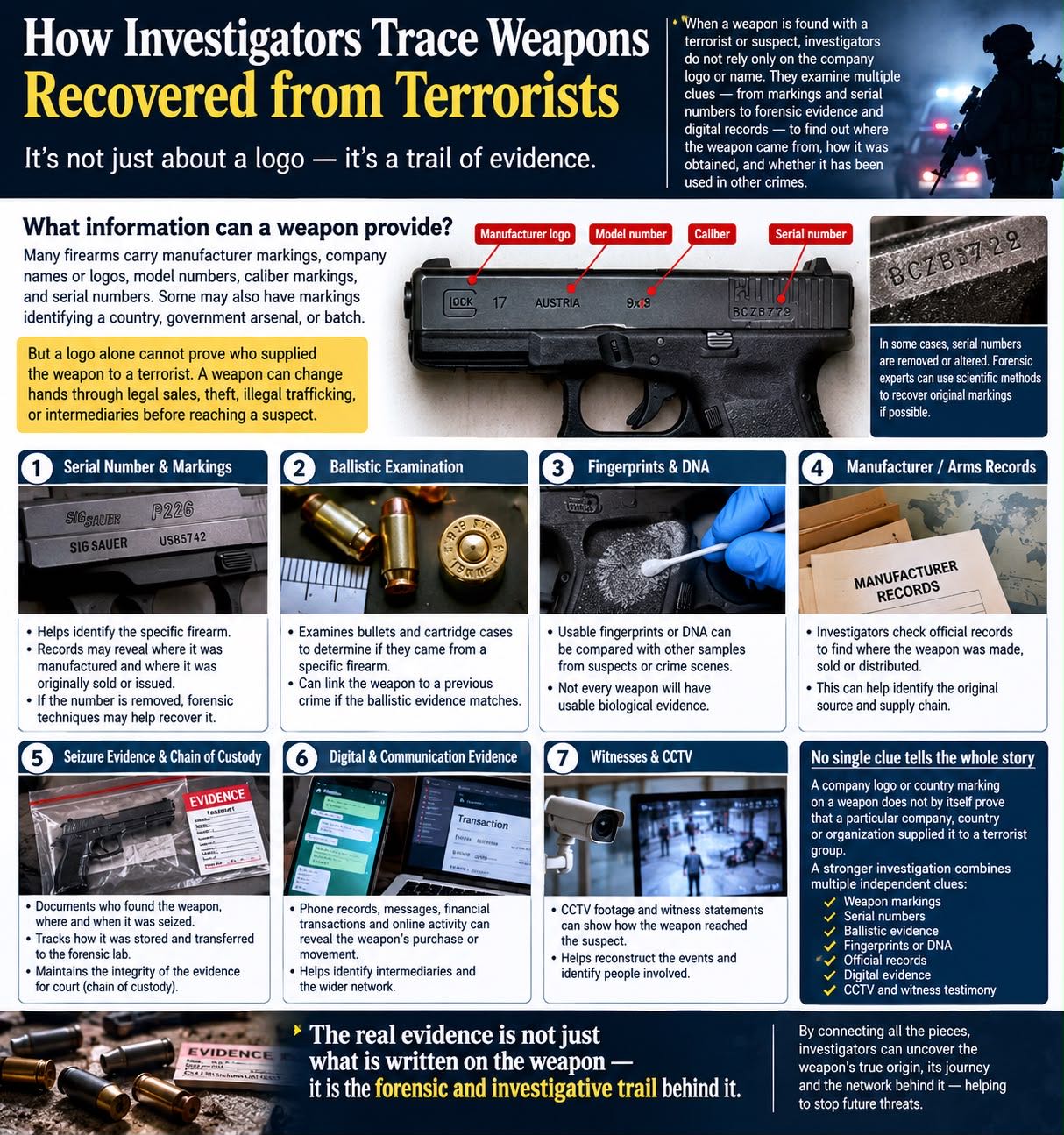
When a weapon is recovered from a terrorist or suspect, investigators do not rely only on the company logo printed on the weapon. Instead, they examine multiple pieces of evidence to determine where the weapon came from, how it was obtained, and whether it was previously used in a crime.
What information can a weapon provide?
Many firearms carry manufacturer markings, company names or logos, model numbers, caliber markings, and serial numbers. Some may also contain markings identifying a country, government arsenal, or manufacturing batch.
However, a logo alone cannot prove who supplied the weapon to a terrorist. A weapon can change hands through legal sales, theft, illegal trafficking, or intermediaries before reaching a suspect.
Why is the serial number important?
A serial number can help investigators identify a particular firearm. Where records are available, authorities may be able to trace its manufacturing history and determine where it was originally distributed or issued.
In some cases, criminals attempt to remove serial numbers. Forensic specialists may then examine the weapon using scientific methods to determine whether the original marking can be recovered.
What does ballistic evidence reveal?
Ballistic examination is another important part of a weapons investigation. Investigators can examine bullets and cartridge cases to determine whether they are associated with a particular firearm.
If evidence from a recovered weapon matches ballistic evidence from an earlier crime, it can provide an important link between the weapon and that incident.
Fingerprints and DNA
A firearm may also contain fingerprints or DNA. If usable forensic material is recovered, investigators can compare it with other legally obtained evidence connected to suspects or crime scenes.
However, not every weapon will contain usable fingerprints or DNA.
How do investigators trace the weapon’s journey?
One of the most important questions is:
“How did this weapon reach the terrorist?”
Investigators may examine weapons records, CCTV footage, witness statements, financial transactions, communication records, and other evidence to reconstruct the weapon’s possible supply chain.
This can help investigators identify intermediaries and determine how the weapon moved from its original source to the person who possessed it.
Why is the chain of custody important?
After a weapon is seized, investigators document where, when, and from whom it was recovered, as well as how it was stored and transferred for forensic examination.
This is known as the chain of custody. Maintaining this record helps establish that the evidence presented in court is the same evidence that was originally seized and that it was properly handled.
No single clue tells the whole story
A company logo or country marking on a weapon does not by itself prove that a particular company, country, or organization supplied it to a terrorist group.
A stronger investigation combines multiple independent clues—weapon markings, serial numbers, ballistic evidence, fingerprints or DNA, official records, digital evidence, CCTV, and witness testimony.
Together, these pieces can help investigators reconstruct the weapon’s history and establish a much clearer picture of its origin and movement.
In terrorism investigations, the real evidence is not just what is written on the weapon—it is the forensic and investigative trail behind it.


Comments
No comments yet.