

Ownmates Post

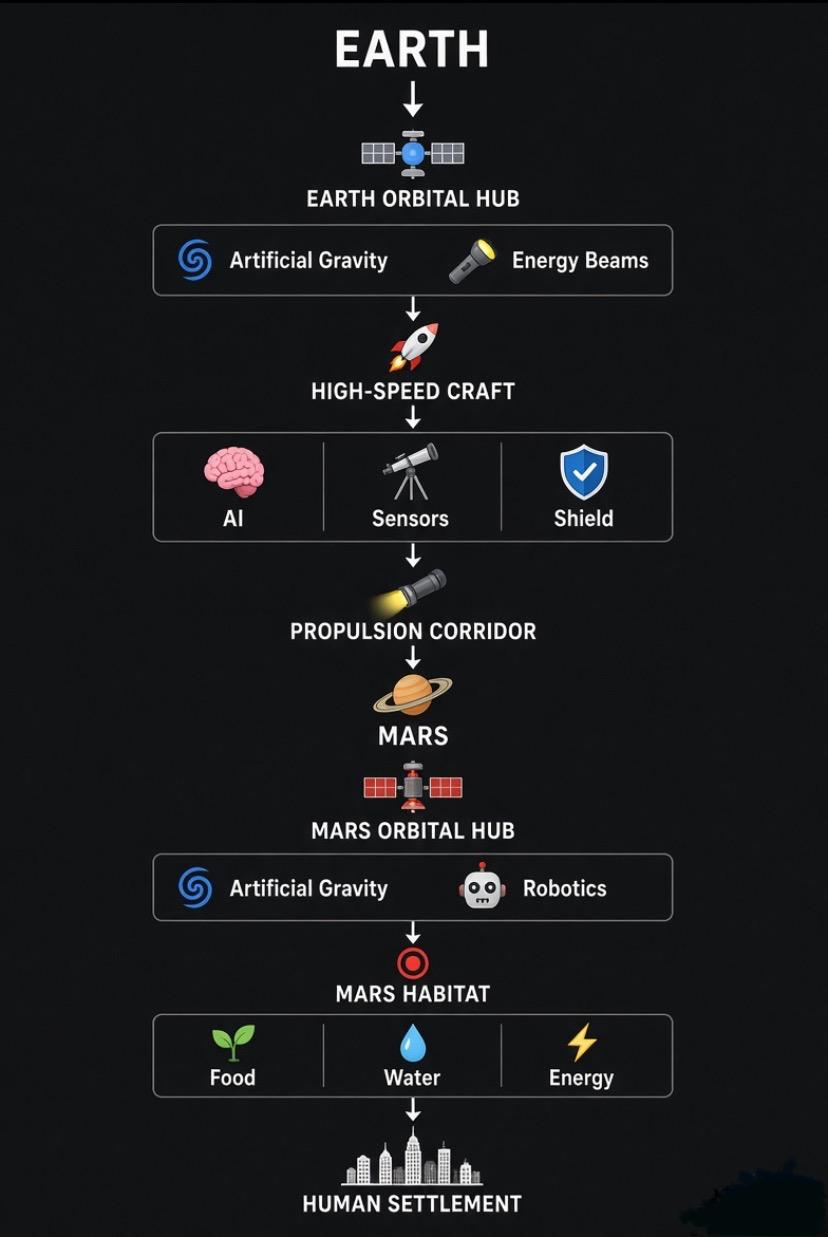
🔴 Mars Habitat of the Future: Artificial Gravity, Magnetic Shielding and a Self-Sustaining Human Colony
Human settlement on Mars will require much more than simply building houses on another planet. Mars has a thin atmosphere, very low temperatures, intense radiation exposure and only about 38% of Earth’s surface gravity. Because of these challenges, future Mars habitats may need advanced systems that create an Earth-like living environment.
One possible concept combines rotational artificial gravity, electromagnetic shielding, radiation protection, life-support systems, greenhouses and renewable or nuclear energy into one integrated Mars habitat.
🌀 1. Rotating Habitat for Artificial Gravity
One of the most interesting concepts for a future Mars habitat is a large rotating circular or ring-shaped structure.
The habitat would continuously rotate around a central axis. People living inside the rotating section would experience an outward apparent force caused by the rotation. This can provide an acceleration that feels similar to gravity.
The basic relationship is:
a = ω²r
Where:
* a = artificial-gravity acceleration* ω = angular rotation speed* r = radius of the rotating habitat
A larger habitat radius allows the structure to rotate more slowly while still producing useful artificial gravity.
A future design could potentially provide approximately Mars-level gravity (0.38 g) or, depending on the engineering design, even approach Earth-like gravity (1 g).
Why is artificial gravity important?
Mars has only about 38% of Earth’s gravity. Humans have evolved under Earth’s stronger gravitational environment, so living for years under significantly lower gravity could create important physiological challenges.
Artificial gravity is therefore being considered as one possible way to reduce the effects associated with long-term low gravity.
However, a large rotating habitat on Mars is still a future engineering concept; no operational rotating Mars habitat currently exists.
⸻
🧲 2. Magnetic Shielding
Artificial gravity and magnetic shielding are two different technologies.
Simply rotating the habitat will not automatically create a useful magnetic field.
A magnetic field can be generated using electrical current flowing through a conductor or, potentially, a large superconducting coil.
The basic principle is:
Electric Current → Coil → Magnetic Field
A future Mars habitat could therefore have a large electromagnetic system surrounding or integrated with the habitat.
The purpose would be to help deflect certain charged particles, particularly particles associated with solar radiation.
However, magnetic shielding would not stop every type of radiation. High-energy cosmic rays are particularly difficult to shield against.
Therefore, magnetic protection would most realistically be combined with physical shielding.
⸻
🪨 3. Mars Regolith as Radiation Shielding
Mars itself provides a valuable resource: regolith, the loose soil and rock covering the planet’s surface.
A habitat could be covered with a substantial layer of Martian regolith.
The basic concept would be:
Radiation ☢️↓Regolith Shield 🪨↓Magnetic Shield 🧲↓Pressurized Habitat 🏠
Physical shielding would provide protection against radiation that magnetic fields cannot effectively deflect.
Water and other hydrogen-rich materials could also potentially contribute to radiation shielding.
⸻
🌬️ 4. Pressurized Living Environment
Mars’s atmosphere is far too thin and unsuitable for humans to breathe normally.
Therefore, the habitat would need to be a sealed and pressurized environment.
Inside the habitat, systems would control:
* Oxygen concentration* Atmospheric pressure* Temperature* Humidity* Carbon dioxide removal* Air circulation
The goal would be to create a stable indoor environment where humans could live without wearing spacesuits.
⸻
🌱 5. Greenhouses and Food Production
A permanent Mars colony would need to produce at least part of its own food.
Special greenhouse modules could use controlled lighting, water recycling and carefully managed atmospheric conditions.
Plants could use carbon dioxide and water while producing oxygen and food.
A simplified representation is:
CO₂ + H₂O + Light → Plant growth + O₂
The system would not be a perfect closed loop, but extensive recycling could greatly reduce the amount of material that must be transported from Earth.
⸻
💧 6. Water Recycling
Water would be one of the most valuable resources in a Mars settlement.
A sophisticated recycling system could recover water from:
* Human waste* Humidity* Hygiene activities* Agricultural systems* Industrial processes
Potential Martian water-ice resources could also be extracted and purified for use.
The objective would be to create a highly efficient water-recycling ecosystem.
⸻
⚡ 7. Energy System
A large Mars habitat would require enormous amounts of energy.
Solar panels could provide electricity, especially during periods of favorable sunlight.
However, Mars experiences dust storms and receives less sunlight than Earth. Therefore, future settlements may also require reliable nuclear power systems.
A hybrid architecture could therefore include:
☀️ Solar Power + ☢️ Nuclear Power + 🔋 Energy Storage
This electricity could operate:
* Life-support systems* Water extraction* Oxygen production* Heating* Agriculture* Communications* Industrial equipment* Electromagnetic shielding
⸻
🚪 8. Airlock and Mars Surface Operations
The habitat could not simply open a door directly to the Martian atmosphere.
Instead, astronauts would use an airlock:
Habitat → Airlock → Spacesuit → Mars Surface
The airlock would isolate the internal atmosphere from the extremely low-pressure Martian environment.
Specialized facilities could also remove Martian dust from spacesuits before astronauts re-enter the habitat.
⸻
🏙️ 9. Central Hub and Rotating Living Ring
A futuristic Mars settlement could use a central non-rotating hub connected to a rotating ring.
The central hub could contain:
* Transportation systems* Communication equipment* Storage* Industrial facilities* Docking areas* Power infrastructure
The rotating ring could contain:
* Bedrooms* Kitchens* Recreation areas* Medical facilities* Offices* Laboratories* Greenhouses
This separation could make engineering and transportation between rotating and stationary sections easier.
⸻
🧲 10. Could the Entire Mars Habitat Create a Magnetic Shield?
In principle, a sufficiently powerful electromagnetic system could generate a magnetic field around a local habitat.
But creating a magnetic field large enough to protect an entire Mars-sized planet would be a completely different engineering challenge.
A habitat-scale magnetic shield is therefore much more realistic than attempting to reproduce Earth’s entire planetary magnetic field.
The most practical future approach may be a layered protection system:
Magnetic field 🧲+Regolith/Water shielding 🪨💧+Pressurized habitat 🏠+Underground structures
Together, these technologies could provide much stronger protection than relying on any single system.
⸻
🌍 11. The Future Mars Habitat — A Miniature Artificial Earth
The ultimate goal would not simply be to build a building on Mars.
It would be to construct a controlled artificial environment capable of supporting human life for years or generations.
A conceptual system could look like this:
☀️ Solar/Nuclear Energy↓⚡ Power Distribution↓🧲 Magnetic Shield + 🪨 Physical Shielding↓🌀 Rotating Habitat↓🌬️ Life Support↓💧 Water Recycling↓🌱 Food Production↓👨🚀 Human Settlement
🔴 The Big Picture
A future Mars colony could therefore combine several independent technologies:
Technology Main Purpose🌀 Rotating structure Artificial gravity🧲 Electromagnetic coils Deflection of some charged radiation🪨 Regolith Physical radiation shielding💧 Water systems Drinking, agriculture and shielding🌬️ Life support Oxygen and atmospheric control🌱 Greenhouses Food production and biological recycling☀️ Solar power Electricity☢️ Nuclear power Reliable energy🚪 Airlocks Safe movement between habitat and Mars
Conclusion
The Mars habitat of the future could essentially become a miniature artificial Earth: a sealed environment protected from Mars’s harsh conditions, with controlled atmosphere, recycled water, food production, artificial gravity and multiple layers of radiation protection.
The most important scientific distinction is that rotation creates artificial gravity, while electrical currents can create magnetic fields. These systems can be integrated into one habitat, but they perform fundamentally different functions.
A fully functional rotating, magnetically shielded Mars city remains a future concept, requiring major advances in materials, energy systems, superconducting technology, radiation protection and large-scale space construction


Comments
No comments yet.