

Ownmates Post

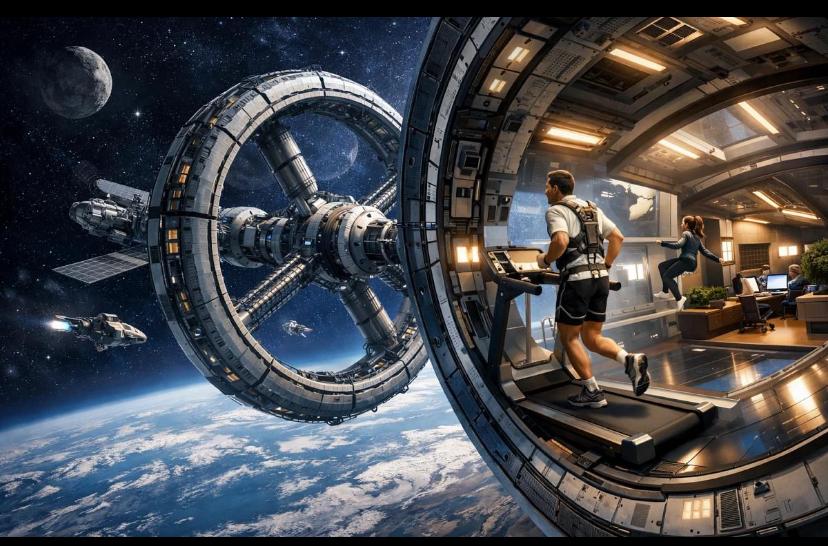
🧠🚀 The Quantum-AI Mars Ark: A Future Architecture for Ultra-Fast Human Civilization
Artificial Gravity, Beamed Propulsion, Advanced Shielding, Quantum AI and the Possibility of a Virtual Human on Mars
Humanity’s dream of reaching Mars is often described as a problem of rockets and fuel. But a truly permanent human presence on Mars would require something far more ambitious: an entire technological ecosystem capable of transporting people or information across interplanetary distances, protecting them from radiation and high-energy impacts, providing artificial gravity, producing energy and resources, and eventually supporting an independent civilization.
One futuristic architecture could combine rotating artificial-gravity habitats, high-power beamed propulsion, electromagnetic particle deflection, multilayer radiation shielding, advanced AI navigation, autonomous robotics and—much more speculatively—digital representations of human consciousness.
Such a system does not exist today. Some individual components have scientific foundations, while others remain theoretical or speculative. Nevertheless, combining them provides an interesting framework for thinking about what an advanced Earth–Mars transportation system might eventually look like.
⸻
🌍 1. From a Mars Mission to a Mars Transportation System
A conventional Mars mission can be imagined as:
Earth → Rocket → Mars
A much more advanced civilization might instead build an infrastructure:
Earth Orbital Station → Propulsion Corridor → High-Speed Spacecraft → Mars Orbital Station → Mars Habitat
The objective would not simply be to send one spacecraft to Mars.
The objective would be to create a reusable transportation network between Earth and Mars.
Such a network could contain:
* 🛰️ Earth orbital infrastructure* 🌀 Rotating artificial-gravity habitats* 🔦 High-power laser or electromagnetic beam systems* 🧠 Advanced autonomous AI* 🔭 High-speed particle detection* 🛡️ Multilayer spacecraft shielding* ⚡ Massive energy-generation systems* 🪐 Mars orbital infrastructure* 🏠 Pressurized Martian habitats* 🤖 Autonomous construction robots
The most important conceptual change is that the spacecraft becomes only one component of a much larger transportation architecture.
⸻
🌀 2. Artificial Gravity: Creating a More Earth-Like Environment
Mars has only about 38% of Earth’s surface gravity.
Long-term exposure to reduced gravity could present serious physiological challenges. For a permanent human settlement, one possible solution would be artificial gravity.
A rotating habitat can create an apparent outward acceleration:
a=\omega^2r
where:
* a = artificial-gravity acceleration* \omega = angular velocity* r = radius of the rotating structure
A larger radius allows the habitat to rotate more slowly while producing the same artificial gravity.
A future Mars orbital station could therefore contain a large rotating ring:
Central hub → rotating structure → living modules
The rotating section could contain:
* sleeping quarters* recreation* medical facilities* agriculture* laboratories* residential areas
The central section could remain non-rotating and contain:
* docking systems* cargo transfer* power equipment* communications* industrial machinery
Important distinction
Rotation creates artificial gravity.
A magnetic field does not create ordinary gravitational acceleration.
This distinction is fundamental to the design.
⸻
🧲 3. Magnetic Shielding: Protection, Not Gravity
A powerful electromagnetic system could potentially deflect some charged particles.
The basic principle is:
Electric current → electromagnetic field → charged-particle deflection
This could potentially provide additional protection against certain solar energetic particles and other charged radiation.
However, magnetic shielding has important limitations.
A magnetic field does not simply stop everything approaching the spacecraft.
In particular:
* neutral dust is not directly deflected by a magnetic field* high-energy cosmic rays are difficult to shield against* secondary radiation can be produced when energetic particles hit material* extremely large magnetic fields require enormous engineering resources
Therefore, magnetic shielding should be considered one layer of protection, not a complete radiation solution.
⸻
🛡️ 4. The Multilayer Relativistic Shield
At ordinary spacecraft velocities, micrometeoroids are already a serious engineering problem.
At relativistic velocities, the problem becomes dramatically more severe.
For a particle approaching at 0.99c:
\gamma=\frac{1}{\sqrt{1-v^2/c^2}}\approx7.09
Its relativistic kinetic energy is:
E_k=(\gamma-1)mc^2
For a hypothetical 1 gram particle:
E_k\approx5.5\times10^{14}\,J
That is an enormous amount of energy.
Consequently, a future ultra-high-speed spacecraft could require a layered protection architecture such as:
Incoming particle
↓
Forward detection system
↓
Sacrificial bumper / Whipple shield
↓
Multiple impact layers
↓
Low-density impact-absorbing material
↓
Water or polyethylene shielding
↓
Dense structural protection
↓
Pressure hull
↓
Crew habitat
The purpose would not simply be to “stop” an incoming particle.
The system would attempt to:
1. detect it,2. avoid it if possible,3. fragment or vaporize it,4. spread its energy,5. absorb secondary particles,6. protect the crew and electronics.
At 0.99c, collision avoidance may be as important as physical shielding.
⸻
🔭 5. The Particle-Detection Problem
A spacecraft travelling at extreme velocity would encounter material that appears almost stationary in the spacecraft’s frame.
Even an extremely small amount of matter can become dangerous because relativistic kinetic energy increases enormously with velocity.
This creates a fundamental design principle:
Do not rely entirely on the shield. Detect and avoid what you can.
A future spacecraft could theoretically combine:
* optical sensors* radar* lidar* particle detectors* electromagnetic sensors* distributed sensor networks* predictive AI
The spacecraft could continuously construct a probabilistic map of hazards ahead.
⸻
🧠 6. Quantum AI as the Navigation Brain
The term “Quantum AI” should be used carefully.
Quantum computing does not automatically create consciousness or violate physical laws.
However, a future combination of advanced AI and quantum computing could potentially assist with difficult optimization problems.
For example, an autonomous Mars transportation system might continuously calculate:
Particle environment → trajectory → propulsion → collision probability → braking → destination position
The AI could optimize:
* trajectory* beam alignment* acceleration* braking* power consumption* collision avoidance* thermal management* Mars orbital insertion* docking
Because Mars and Earth are constantly moving around the Sun, the destination is not a stationary point.
The spacecraft must calculate the future position of Mars rather than simply “point toward Mars.”
⸻
🔦 7. Beamed Propulsion
One of the most interesting parts of this concept is the possibility of using an external energy beam.
Instead of carrying all propulsion energy onboard, a powerful Earth-based or orbital energy system could transmit energy toward the spacecraft.
Possible technologies could include:
* high-power lasers* microwave systems* other directed-energy concepts
A photon beam carries momentum:
p=\frac{E}{c}
For an ideal photon rocket:
F=\frac{P}{c}
where:
* F = thrust* P = photon power* c = speed of light
This immediately shows the scale of the problem.
A power of:
10^{18}\,W
would correspond to an ideal photon thrust of approximately:
3.3\times10^9\,N
if all of that power were converted into directed photon momentum.
That is an extraordinary power level.
⸻
🟣 8. Why Violet Light Is Not Automatically Better
A 420-nanometer violet photon has energy:
E=\frac{hc}{\lambda}
approximately:
4.73\times10^{-19}\,J
Therefore, shorter-wavelength violet photons carry more energy per photon than longer-wavelength red photons.
But there is an important misconception to avoid:
Violet light does not travel faster than red light.
In vacuum:
v=c
for both.
The difference is:
Violet → shorter wavelength → higher frequency → greater energy per photon
Red → longer wavelength → lower frequency → lower energy per photon
For a photon propulsion system operating at a fixed total optical power, the ideal thrust is determined by:
F=\frac{P}{c}
not directly by the color.
Therefore, choosing violet light mainly changes the number and energy of individual photons, not the fundamental maximum speed of the spacecraft.
⸻
⚡ 9. The Enormous Energy Problem
Consider a 10,000 kg spacecraft.
At 0.99c:
\gamma\approx7.09
Its relativistic kinetic energy would be approximately:
E_k=(\gamma-1)mc^2
giving roughly:
\boxed{5.5\times10^{21}\,J}
This is an extraordinary energy scale.
And this is only the spacecraft’s kinetic energy.
A real transportation system would also need energy for:
* propulsion inefficiency* beam generation* beam transmission* cooling* shielding* navigation* acceleration* braking* communications* life-support* infrastructure
Therefore, the real energy requirement would be substantially more complicated.
⸻
🛑 10. Acceleration Is More Important Than Maximum Speed
One of the most important lessons from the concept is that maximum velocity alone does not determine whether humans can make the journey.
A spacecraft could theoretically approach extremely high velocities, but humans cannot tolerate arbitrarily large acceleration.
For comfortable human transportation, acceleration would need to remain within a biologically manageable range.
This creates a trade-off:
Higher acceleration → shorter travel time
but:
Higher acceleration → greater danger to biological humans
At approximately 1g, reaching 0.99c requires an enormous acceleration distance.
This is why a 0.99c Earth–Mars human mission is fundamentally different from a 0.99c robotic mission.
⸻
🤖 11. The Virtual-Human Version Changes the Problem
Now we reach the most speculative part of the concept.
Imagine that instead of transporting a biological human, a future civilization could create a sufficiently accurate digital representation of a person’s brain and mind.
The architecture might become:
Human brain → digital representation → computational system → spacecraft → Mars → robotic embodiment
A virtual entity would not have biological organs.
It would not require:
* blood circulation* lungs* bones* muscles* food* biological oxygen requirements
Therefore, the biological problem of extreme acceleration would disappear.
But this does not mean the spacecraft becomes immune to physics.
The computer hardware would still experience:
* mechanical stress* radiation* particle impacts* heat* power requirements* memory errors* electronic failures
Therefore, the virtual human would still require an extremely robust physical computing platform.
⸻
🧠 12. Can Human Consciousness Actually Be Uploaded?
This is where established science ends and speculation begins.
Today, there is no demonstrated technology capable of:
1. completely mapping a human brain at the necessary functional resolution,2. determining exactly which physical processes are essential for consciousness,3. reproducing the entire relevant brain dynamics,4. transferring a person’s consciousness into another computational substrate,5. proving that the resulting entity is the original conscious person rather than a copy.
Therefore:
Digital human consciousness remains hypothetical.
Quantum computing does not currently solve this problem.
A quantum computer is a computational technology; it is not known to be a machine for transferring human consciousness.
⸻
🪐 13. Mars Orbital Station
A high-speed spacecraft should ideally not enter the Martian atmosphere at extreme velocity.
Instead:
High-speed spacecraft
↓
Long-range braking
↓
Mars orbital insertion
↓
Mars orbital station
↓
Landing vehicle
↓
Mars surface
This separation provides major advantages.
The main interplanetary spacecraft can remain a specialized high-speed vehicle while smaller vehicles handle atmospheric entry and landing.
⸻
🏠 14. The Mars Habitat
The Mars destination could contain a combination of:
Rotating habitat
For artificial gravity.
Underground or regolith-covered structures
For radiation and thermal protection.
Greenhouses
For food production and biological recycling.
Water-processing systems
For drinking, agriculture, industrial use and potentially radiation shielding.
Nuclear and solar power
For reliable energy.
Oxygen production
Using Martian resources and recycling systems.
The settlement would gradually evolve from a transported outpost into an increasingly self-sufficient civilization.
⸻
🌱 15. Closing the Life-Support Loop
A permanent settlement cannot indefinitely depend on Earth for every kilogram of material.
A future Mars habitat would therefore attempt to recycle:
Water → purification → agriculture → human use → recovery → purification
and:
CO₂ → plant systems → oxygen → humans → CO₂
Food production could gradually move from Earth-supplied resources toward locally produced crops.
However, a truly closed ecosystem is extraordinarily difficult.
Losses, contamination, equipment failure and biological instability would always need to be managed.
⸻
☀️ 16. Energy Architecture
A large Mars civilization could use multiple energy sources:
☀️ Solar
Useful but affected by distance from the Sun and dust.
☢️ Nuclear
Potentially important for reliable baseline power.
🔋 Energy storage
Needed to manage fluctuations and emergencies.
🔦 Beamed energy
Potentially useful for high-energy transportation systems.
A mature transportation network might therefore use:
Nuclear + Solar + Storage + Directed Energy
rather than relying on one energy source.
⸻
🌌 17. The “Vacuum Tunnel” Needs a Better Definition
A literal physical pipe stretching from Earth to Mars would be an enormous engineering structure.
There is another problem: Earth and Mars are not fixed relative to each other.
Their distance and orbital geometry continuously change.
Therefore, instead of imagining a permanent rigid tunnel, a more physically meaningful concept would be:
A dynamically controlled propulsion corridor
It could involve:
* Earth orbital infrastructure* Mars orbital infrastructure* directed-energy beams* navigation systems* particle monitoring* communication links
The “corridor” would therefore be an operational region rather than necessarily a gigantic physical pipe.
⸻
🚀 18. 0.99c: Why Mars Is Actually the Wrong Place to Use It
There is a surprising conclusion here.
Earth and Mars are separated by an interplanetary distance, not an interstellar distance.
Even at their relatively large separation, Mars is only hundreds of millions of kilometres away.
A spacecraft does not necessarily need 0.99c to make Mars travel dramatically faster than current missions.
A future civilization might gain enormous benefits from much lower relativistic velocities.
For example:
0.01c
is approximately:
3,000\,km/s
while:
0.1c
is approximately:
30,000\,km/s
These are already extraordinary velocities.
The engineering challenge increases dramatically as velocity approaches c.
Therefore, the most rational progression could be:
Current propulsion → high-performance nuclear/electric systems → advanced beamed propulsion → much higher velocities → eventually relativistic spacecraft
rather than immediately targeting 0.99c.
⸻
🧩 19. The Complete Future Architecture
The entire concept can therefore be represented as:
EARTH │ ▼ 🛰️ EARTH ORBITAL HUB │ ┌───────────┴───────────┐ │ │ 🌀 Artificial Gravity 🔦 Energy Beams │ │ └───────────┬───────────┘ │ ▼ 🚀 HIGH-SPEED CRAFT │ ┌───────────┼───────────┐ │ │ │ 🧠 AI 🔭 Sensors 🛡️ Shield │ │ │ └───────────┼───────────┘ │ ▼ 🔦 PROPULSION CORRIDOR │ ▼ 🪐 MARS │ 🛰️ MARS ORBITAL HUB │ ┌───────────┴───────────┐ │ │ 🌀 Artificial Gravity 🤖 Robotics │ │ └───────────┬───────────┘ │ ▼ 🔴 MARS HABITAT │ ┌──────────────┼──────────────┐ │ │ │ 🌱 Food 💧 Water ⚡ Energy │ │ │ └──────────────┼──────────────┘ │ ▼ 🏙️ HUMAN SETTLEMENT
⸻
🔬 20. What Is Real, What Is Future, and What Is Speculative?
This distinction is essential.
Technology StatusVacuum of space EstablishedPhoton momentum EstablishedRelativistic physics EstablishedRotating artificial gravity Established physics; engineering development neededWhipple shielding Existing technologyWater/hydrogen-rich radiation shielding Established shielding principleAutonomous AI navigation Existing technology, though advanced versions remain future workHigh-power beamed propulsion Research/experimental conceptLarge-scale electromagnetic shielding Research/future technology0.99c spacecraft Theoretically consistent with relativity for massive objects, but extraordinarily impractical10,000 kg spacecraft at 0.99c Far beyond current engineeringEarth–Mars physical vacuum tunnel Extremely speculative infrastructureHuman consciousness upload Speculative; no demonstrated technologyQuantum-AI consciousness SpeculativeInstantaneous consciousness transmission Not established by current physics
⸻
🌍 21. The Ultimate Vision: From Transport to Civilization
The most interesting aspect of this concept is not actually the 0.99c spacecraft.
It is the possibility of building an interplanetary technological ecosystem.
Earth could provide:
* energy* manufacturing* biological resources* computing* advanced components
Mars could gradually develop:
* local mining* manufacturing* agriculture* energy production* autonomous robotics* scientific infrastructure
Eventually, transportation between the planets could become routine rather than exceptional.
The ultimate objective would therefore not be:
“Send humans to Mars.”
It would be:
“Create a technological bridge between two worlds.”
⸻
🔴 Conclusion: The Mars Ark of the Future
A future Mars transportation system could potentially combine:
🌀 Artificial gravity for long-term biological health
🧲 Electromagnetic shielding for certain charged-particle environments
🛡️ Multilayer physical shielding against radiation and high-energy impacts
🔭 Advanced particle detection for collision avoidance
🧠 AI and potentially quantum-assisted computing for navigation and optimization
🔦 Beamed propulsion for transferring enormous amounts of energy without carrying all of it onboard
⚡ Nuclear and solar power for the infrastructure
🌱 Closed-loop life-support and agriculture for long-duration habitation
🪐 Mars orbital stations for safe arrival and transportation
🤖 Robotics for construction and industrial activity
And, far more speculatively:
🧠 Digital representations of human minds that could potentially inhabit robotic systems on another world.
But there is a crucial scientific boundary.
Physics does not currently forbid a massive spacecraft from travelling arbitrarily close to the speed of light.
What prevents us from doing it is the extraordinary combination of:
energy + propulsion + acceleration + braking + shielding + heat management + navigation + infrastructure.
And for biological humans, acceleration adds another fundamental constraint.
Therefore, a 0.99c human Mars mission is not simply a matter of building a more powerful engine. It would require breakthroughs across almost every major technological field.
The more realistic path may be to develop increasingly efficient propulsion systems and progressively higher velocities—while simultaneously building artificial-gravity habitats, autonomous robotics, advanced shielding and permanent Mars infrastructure.
Perhaps the first truly revolutionary Mars vehicle will not be the fastest spacecraft ever built.
It may be the first system capable of making Earth and Mars function as two connected nodes of a single technological civilization.


Comments
No comments yet.