

Ownmates Post

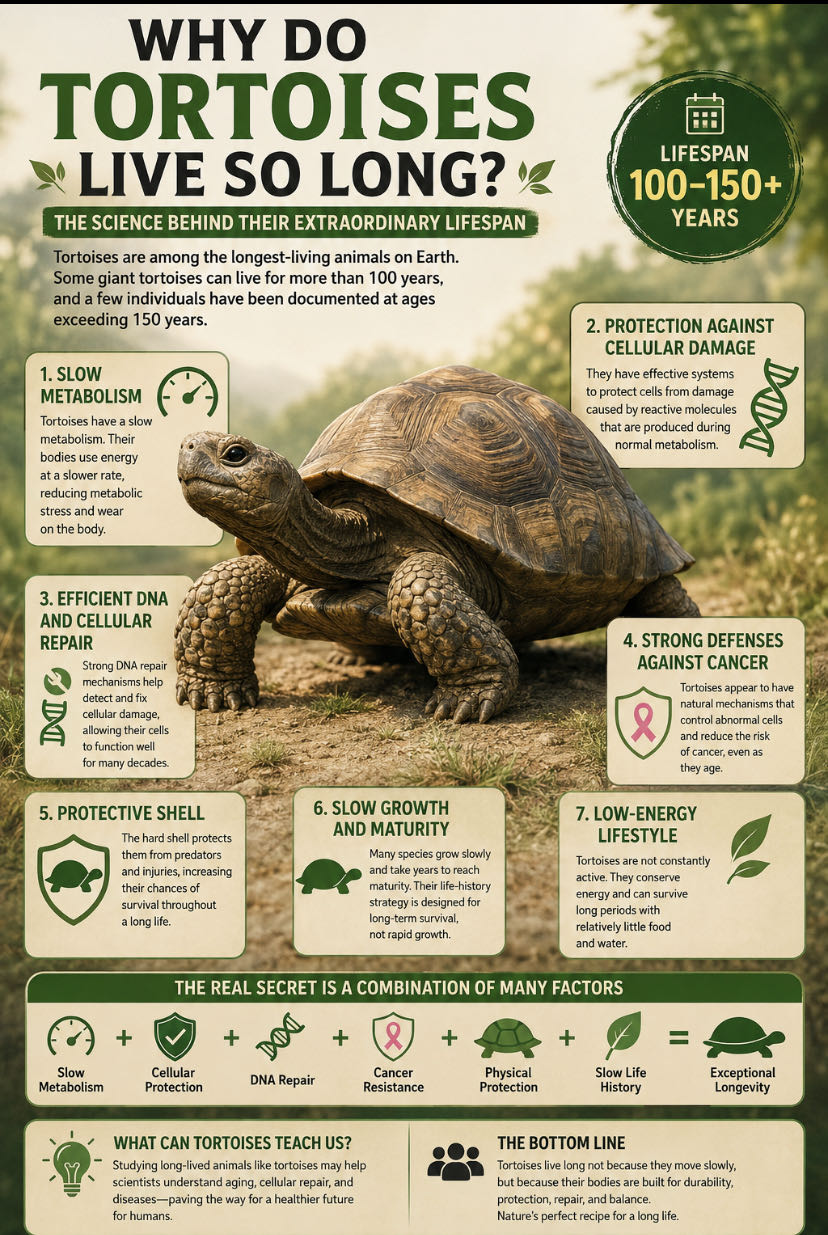
🐢 Why Do Tortoises Live So Long? The Science Behind Their Extraordinary Lifespan
Tortoises are among the longest-living animals on Earth. Some giant tortoises can live for more than 100 years, and a few individuals have been documented at ages exceeding 150 years. But what allows these slow-moving animals to survive for so many decades?
The answer is not simply that tortoises move slowly. Their remarkable lifespan comes from a combination of biological characteristics.
1. Slow Metabolism
Tortoises generally have a relatively slow metabolism compared with many mammals and birds. Their bodies use energy at a slower rate, which can reduce some forms of metabolic stress.
However, slow metabolism alone cannot explain their longevity. It is only one part of a much larger biological system.
2. Protection Against Cellular Damage
As cells use oxygen and produce energy, they can also generate reactive molecules that damage DNA, proteins and other cellular structures.
Long-lived tortoises appear to have effective systems for protecting cells and managing this damage. Their ability to maintain cellular function for many decades may contribute significantly to their long lifespan.
3. Efficient DNA and Cellular Repair
DNA is constantly exposed to damage from normal metabolism and environmental factors.
Long-lived species have evolved mechanisms that help detect and repair cellular damage. In tortoises, these protective systems are an important area of scientific research because they may help explain how their cells remain functional for such a long time.
4. Strong Defenses Against Cancer
Living for more than a century means that an animal’s cells have many opportunities to develop abnormal mutations.
Yet some large, long-lived tortoises appear to have effective biological mechanisms for controlling abnormal cells. This relates to a famous biological question known as Peto’s paradox: why don’t large animals with many more cells and longer lifespans develop cancer at extremely high rates?
Scientists are studying tortoises and other long-lived animals to understand these natural cancer-protection mechanisms.
5. The Protective Shell
A tortoise’s shell is one of nature’s most effective forms of physical protection.
It can protect the animal from predators and many types of physical injury. By reducing the risk of being killed at a young or adult age, the shell contributes indirectly to the possibility of a long life.
6. Slow Growth and Long Life History
Many tortoise species grow slowly and take a long time to reach maturity.
Their bodies are adapted for a relatively slow-paced life rather than rapid growth and reproduction. This life-history strategy can be associated with long-term survival.
7. A Low-Energy Lifestyle
Tortoises generally do not maintain the extremely high levels of physical activity seen in animals such as birds or many mammals.
They conserve energy and can survive for long periods with relatively little food or water, depending on the species and environment.
🧬 The Real Secret Is Not One Factor
There is no single “longevity gene” or one simple reason that makes tortoises live for more than a century.
Their extraordinary lifespan is probably the result of several systems working together:
Slow metabolism cellular protection DNA repair cancer resistance strong physical protection slow life history = exceptional longevity.
🌍 What Can Tortoises Teach Humans?
Scientists are interested in long-lived animals because understanding how their cells resist damage, maintain healthy tissues and control abnormal cells could eventually provide insights into human aging and age-related diseases.
Tortoises have therefore become more than just symbols of patience and longevity. They are also fascinating natural examples of how evolution can produce extremely long-lasting biological systems.
🐢 The Bottom Line
The tortoise does not live a long life simply because it moves slowly.
Its longevity is the result of a complex biological strategy that allows its body to use energy efficiently, protect cells, repair damage and maintain vital functions for many decades.
In nature, the tortoise is a remarkable example of one of life’s most difficult achievements:
not just surviving—but maintaining a healthy body for an extraordinarily long time.


Comments
No comments yet.