

Ownmates Post

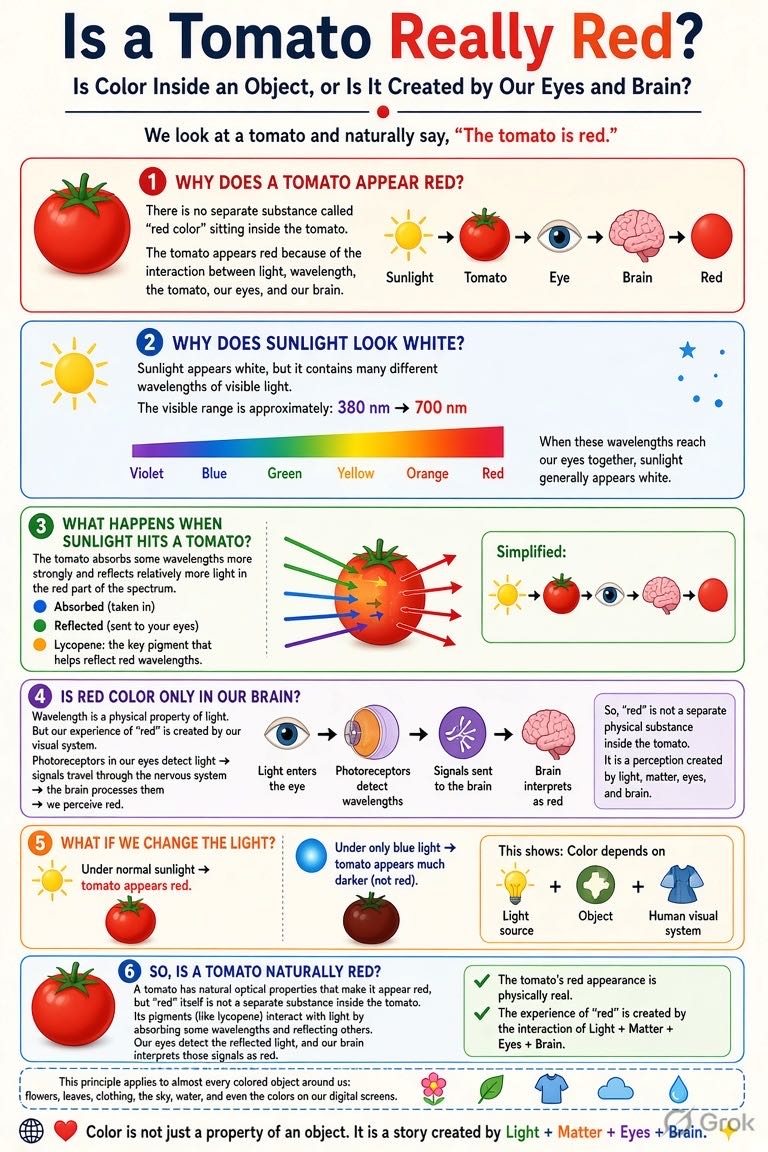
🍅 Is a Tomato Really Red? Is Color Inside an Object, or Is It Created by Our Eyes and Brain? We look at a tomato and naturally say, “The tomato is red.” But science gives us a fascinating perspective: There is no separate substance called “red color” sitting inside the tomato. So why does a tomato appear red? The answer lies in the interaction between light, wavelength, the tomato, our eyes, and our brain. ⸻ ☀️ Why Does Sunlight Look White? Sunlight appears white to us, but it contains many different wavelengths of visible light. The visible range is approximately: 380 nm → 700 nm This range includes violet, blue, green, yellow, orange, and red wavelengths. When these wavelengths reach our eyes together, sunlight generally appears white. ⸻ 🍅 What Happens When Sunlight Hits a Tomato? When sunlight falls on a tomato, the pigments and molecules in the tomato interact with different wavelengths of light. One of the main pigments responsible for the tomato’s characteristic color is lycopene. The tomato absorbs some wavelengths more strongly and reflects relatively more light in the red part of the visible spectrum. That reflected light then reaches our eyes. The process can be simplified as: ☀️ Sunlight → 🍅 Tomato → Absorption/Reflection → 👁️ Eye → 🧠 Brain → 🔴 Red That is why we perceive the tomato as red. ⸻ 🌈 Where Do the Other Colors Go? Sunlight contains many wavelengths, not just red. The tomato absorbs some of them and reflects others. The wavelengths that reach our eyes in sufficient amounts stimulate our visual system in a particular way. Our brain then interprets those signals as a particular color. That is why the tomato appears red. ⸻ 👁️ Is Red Color Only in Our Brain? This is where things become really interesting. Wavelength is a physical property of light. But our experience of “red” is created by our visual system. Specialized photoreceptor cells in our eyes detect light. These cells send signals through the nervous system to the brain. The brain processes those signals and produces our perception of color. So, “red” is not a separate physical substance inside the tomato. However, that does not mean the tomato’s red appearance is imaginary. The tomato has real optical properties and pigments that determine which wavelengths are absorbed and which are reflected. ⸻ 💡 What If We Change the Light? Imagine looking at a tomato under normal sunlight. 🍅 It appears red. Now imagine shining only blue light on the same tomato. The tomato does not have the same broad range of light available to reflect. As a result, it may appear much darker and will not look like the bright red tomato we see under normal white light. This demonstrates something important: The color we see depends on three major factors: Light source Object Human visual system ⸻ 🔬 So, Is a Tomato Naturally Red? The most scientifically accurate answer is: A tomato has natural optical properties that make it appear red, but “red” itself is not a separate substance inside the tomato. Its pigments interact with light by absorbing some wavelengths and reflecting others. Our eyes detect the reflected light, and our brain interprets those signals as red. So: 🍅 The tomato’s red appearance is physically real, but the experience of “red” is created by the interaction of light, matter, our eyes, and our brain. And this principle applies to almost every colored object around us—flowers, leaves, clothing, the sky, water, and even the colors displayed on our digital screens. 🌍 Color is not just a property of an object. It is a story created by Light Matter Eyes Brain.


Comments
😃 tomoto bhi duplicate hota hai kya