

Ownmates Post

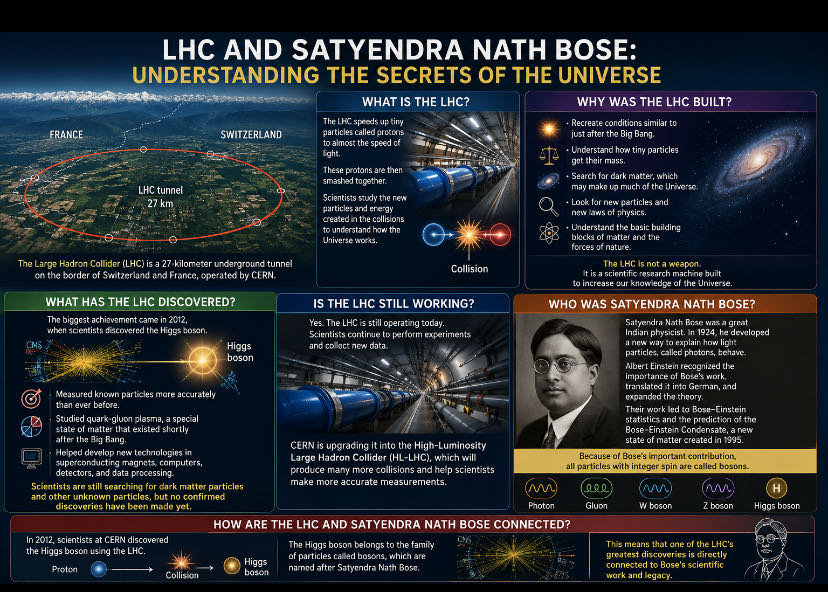
Higgs Boson, Satyendra Nath Bose, Quantum Mechanics, and the LHC
Introduction
Everything in the universe is made of tiny particles. Scientists study these particles using Quantum Mechanics. This branch of science helps us understand how matter, energy, and the universe work. It also led to discoveries such as the Higgs Field, the Higgs Boson, and experiments at the Large Hadron Collider (LHC).
⸻
1. What is Quantum?
A quantum is the smallest fixed amount of something.
At the very tiny level, nature does not always behave like the world we see every day.
For example:
* Light travels as tiny packets called photons.
* Electrons can only have certain energy levels.
This tiny world is called the quantum world.
⸻
2. How Small is the Quantum World?
The quantum world is incredibly small.
Examples:
* An atom is about 0.1 nanometer wide.
* The nucleus of an atom is about 1 femtometer wide.
* A proton is even smaller.
* An electron is so tiny that scientists currently treat it as having no measurable size.
⸻
3. Does Quantum Mechanics Apply to Everything?
Yes.
Everything in the universe is made of atoms, including:
* People
* Animals
* Plants
* Water
* Air
* Earth
* Stars
So everything follows quantum rules.
However, large objects contain trillions of atoms, so they behave according to the familiar laws of everyday physics.
⸻
4. Who Was Satyendra Nath Bose?
Satyendra Nath Bose was a famous Indian physicist.
In 1924, he developed a new way to explain how light particles (photons) behave.
He sent his work to Albert Einstein, who liked it very much.
Einstein translated the paper into German and helped publish it.
Later, scientists named a group of particles Bosons in honor of Bose.
⸻
5. Did Bose Meet Einstein?
Yes.
After exchanging letters, Bose visited Europe in 1925–1926.
He met Albert Einstein in Berlin and discussed physics with him.
⸻
6. What is a Boson?
There are two main types of fundamental particles.
Bosons
Bosons carry the forces of nature.
Examples:
* Photon
* Gluon
* W Boson
* Z Boson
* Higgs Boson
They are named after Satyendra Nath Bose.
Fermions
Fermions make up matter.
Examples:
* Electron
* Quarks
* Neutrinos
They are named after physicist Enrico Fermi.
⸻
7. What is Bose–Einstein Statistics?
It is a rule that explains how Bosons behave.
Unlike electrons, many bosons can exist in the same quantum state at the same time.
This rule helps explain things like lasers and Bose–Einstein Condensates.
⸻
8. What Does “Higgs” Mean?
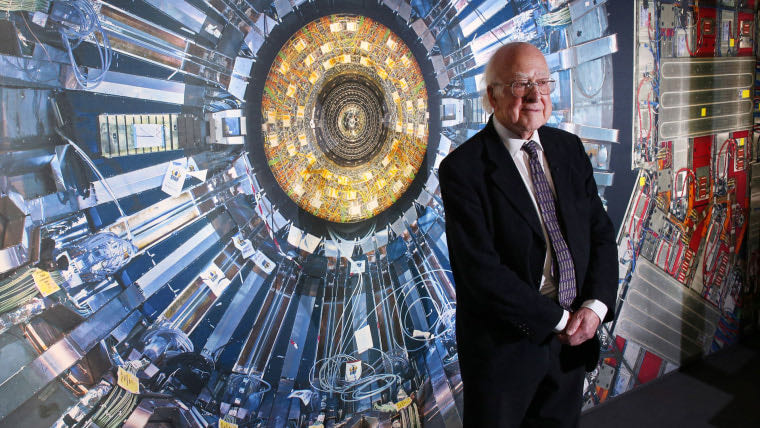
“Higgs” is the surname of physicist Peter Higgs.
In 1964, he proposed that an invisible field fills the entire universe.
This is called the Higgs Field.
⸻
9. What is the Higgs Field?
Imagine the whole universe filled with an invisible substance, like thick honey.
This is the Higgs Field.
* A particle that interacts only a little with the field has low mass.
* A particle that interacts strongly with the field has high mass.
This helps explain why different particles have different masses.
⸻
10. What is the Higgs Boson?
The Higgs Boson is the particle of the Higgs Field.
Think of it like this:
* Ocean = Higgs Field
* Wave = Higgs Boson
Finding the Higgs Boson showed scientists that the Higgs Field really exists.
⸻
11. Why is it Called the Higgs Boson?
The name comes from two scientists:
* Higgs → Peter Higgs
* Boson → Satyendra Nath Bose
So the particle is called the Higgs Boson.
⸻
12. What is the LHC?
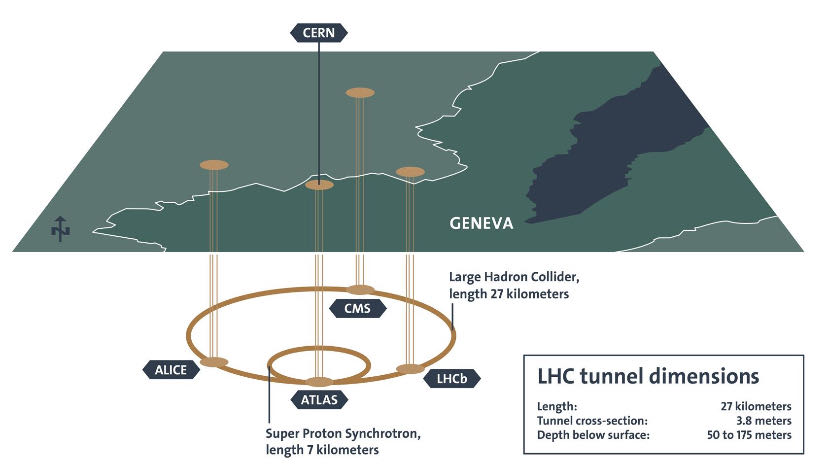
The Large Hadron Collider (LHC) is the world’s largest particle accelerator.
It is a 27-kilometer underground circular machine built by CERN.
Scientists use it to study the smallest particles in the universe.
⸻
13. Why is the LHC So Big?
Protons must reach extremely high speeds before they collide.
A very large circular tunnel gives them enough distance to accelerate.
⸻
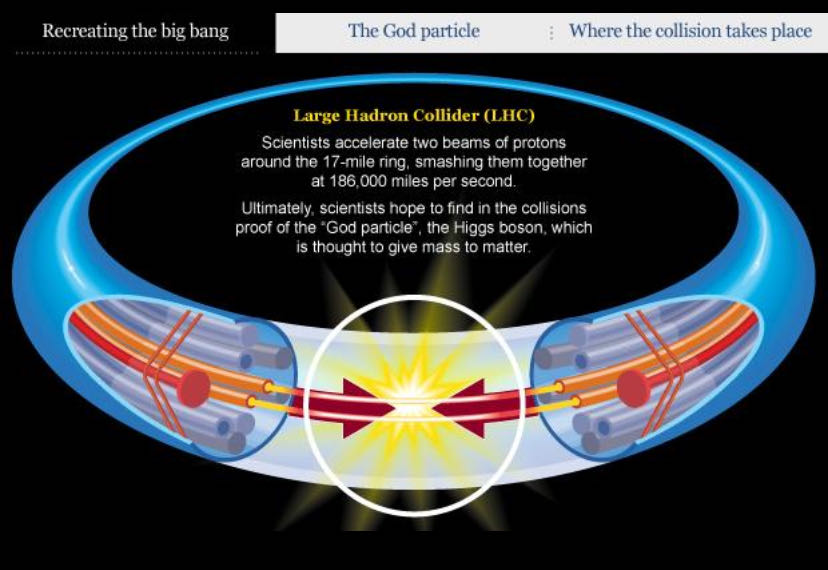
14. How Does the LHC Work?
1. Scientists prepare protons.
2. Powerful magnets speed them up to nearly the speed of light.
3. Two proton beams travel in opposite directions.
4. They collide.
5. The collision creates enormous energy.
6. New particles may be produced.
⸻
15. What Happens When Protons Collide?
The collision can produce many different particles, such as:
* Quarks
* Gluons
* Photons
* Electrons
* Muons
* Neutrinos
* Sometimes a Higgs Boson
The Higgs Boson exists for only a tiny fraction of a second before it breaks into other particles.
Scientists identify it by studying those decay products.
⸻
16. How Do Scientists Detect Quantum Particles?
Quantum particles are too small to see directly.
Instead, scientists:
* Make particles collide.
* Detect the signals left behind.
* Use computers to analyze the data.
* Work out which particles were created.
⸻
17. Why is the LHC Important?
The LHC allows scientists to test ideas about the universe.
Its greatest success was the discovery of the Higgs Boson in 2012, which confirmed the existence of the Higgs Field and strengthened the Standard Model of particle physics.
⸻
Conclusion
Quantum Mechanics explains how the smallest particles in the universe behave.
Satyendra Nath Bose helped explain one important group of particles called Bosons.
Peter Higgs proposed the Higgs Field, and the Large Hadron Collider helped discover the Higgs Boson in 2012.
Together, these discoveries have greatly improved our understanding of how the universe is built and how it works.


Comments
No comments yet.