

Ownmates Post

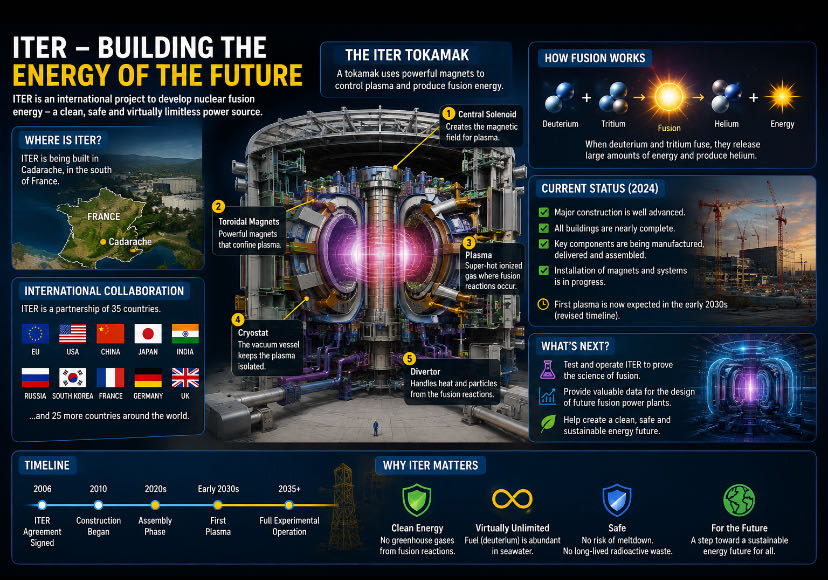
ITER and Tokamak: Building the Future of Fusion Energy ☀️⚛️
ITER is one of the world’s largest international nuclear fusion research projects. It is being built in southern France through cooperation among many countries. The main goal of ITER is to demonstrate that nuclear fusion—the process that powers the Sun—can be controlled on Earth and used as a potential source of future clean energy.
At the center of the project is a huge machine called a Tokamak. A Tokamak is designed to create and control an extremely hot state of matter known as plasma. Scientists hope that this technology will help develop future fusion power plants capable of producing large amounts of low-carbon energy.
What Is a Tokamak Made Of?
A Tokamak is not made from just one material. It is a highly advanced machine containing special metals, powerful magnets, cooling systems, electrical equipment, and protective components.
Some of its main parts include:
Vacuum Vessel:
The vacuum vessel is a large, sealed chamber made mainly from specially engineered stainless steel. It provides the controlled environment where the extremely hot plasma is created and confined.
Superconducting Magnets:
The Tokamak uses powerful superconducting magnets made with advanced materials such as niobium-tin (Nb₃Sn) and niobium-titanium (NbTi). These magnets produce strong magnetic fields that help control and confine the plasma.
First Wall:
The first wall is the inner surface facing the plasma. It is designed to withstand intense heat and energetic particles produced during fusion experiments.
Divertor:
The divertor is one of the most demanding components of the Tokamak. It handles heat and particles leaving the plasma. Important parts of ITER’s divertor use tungsten, a metal with an extremely high melting point.
Blanket:
The blanket surrounds the fusion chamber and is designed to absorb energy carried by fusion neutrons. In future fusion reactors, blanket systems may also help produce tritium fuel.
Cooling Systems:
Advanced cooling systems use water or other coolants to remove heat and protect the machine’s components.
Electrical Systems:
The Tokamak also contains copper conductors, superconducting cables, power supplies, and complex control equipment.
In simple terms, a Tokamak is built using special steel, superconducting materials, copper, tungsten, advanced cooling technology, and powerful electrical systems.
How Will a Tokamak Work?
The Tokamak is designed to reproduce some of the physical conditions found inside the Sun. However, it does not create a literal artificial Sun. Instead, it uses controlled nuclear fusion to study a possible new way of producing energy.
1. Fusion Fuel Is Introduced
The main fuels planned for ITER are deuterium and tritium, which are heavy forms, or isotopes, of hydrogen.
2. The Fuel Is Heated Into Plasma 🔥
The fuel is heated to temperatures of around 150 million°C. At such extreme temperatures, electrons separate from atomic nuclei, creating a hot, electrically charged state of matter called plasma.
3. Powerful Magnets Control the Plasma 🧲
The plasma is far too hot to touch ordinary materials directly. Therefore, powerful superconducting magnets create a magnetic field that helps keep the plasma away from the walls of the vacuum vessel.
The plasma is not held by a physical container. Instead, it is controlled inside a magnetic “cage.”
4. Nuclear Fusion Takes Place ⚛️
When deuterium and tritium nuclei collide with enough energy, they can join together. This process is called nuclear fusion.
The reaction produces helium, high-energy neutrons, and a large amount of energy.
5. Fusion Energy Is Released ⚡
The fast neutrons carry much of the fusion energy out of the plasma. They transfer this energy to the surrounding reactor structures, including the blanket.
6. Future Fusion Plants Could Produce Electricity 🌡️➡️⚡
ITER itself is a research experiment and is not designed to supply electricity to homes.
However, future fusion power plants could use the heat produced by fusion to warm a coolant. The heat could then be used to create steam, which would turn turbines and generate electricity.
The basic process could be summarized as:
Hydrogen fuel → Super-hot plasma → Magnetic control → Nuclear fusion → Heat → Steam → Turbine → Electricity ⚛️🔥🧲⚡
What Is Happening at ITER Today?
ITER is currently focused on assembling and preparing the large Tokamak system. Major work includes:
* Assembling the giant Tokamak machine
* Installing and testing superconducting magnet systems
* Manufacturing and integrating complex reactor components
* Addressing technical and construction challenges
* Following a revised, step-by-step development plan
* Preparing systems for future fusion experiments
Because of the scale and complexity of the project, ITER has experienced technical challenges and schedule changes. The project is being developed in stages, with the aim of gradually testing and demonstrating key fusion technologies.
Why Is ITER Important?
Fusion energy could offer several potential advantages:
* It could produce large amounts of energy with very low operational carbon emissions.
* Fusion fuel sources could be widely available.
* Fusion does not rely on the same chain reaction used in conventional nuclear fission reactors.
* The fusion reaction requires carefully controlled conditions and stops when those conditions are no longer maintained.
* It could contribute to a more sustainable long-term energy system.
However, fusion power is still a developing technology. Scientists and engineers must overcome major challenges involving plasma control, heat management, materials, fuel systems, and the construction of reliable power plants.


Comments
भारत भी इसका हिस्सा है।