

Ownmates Post

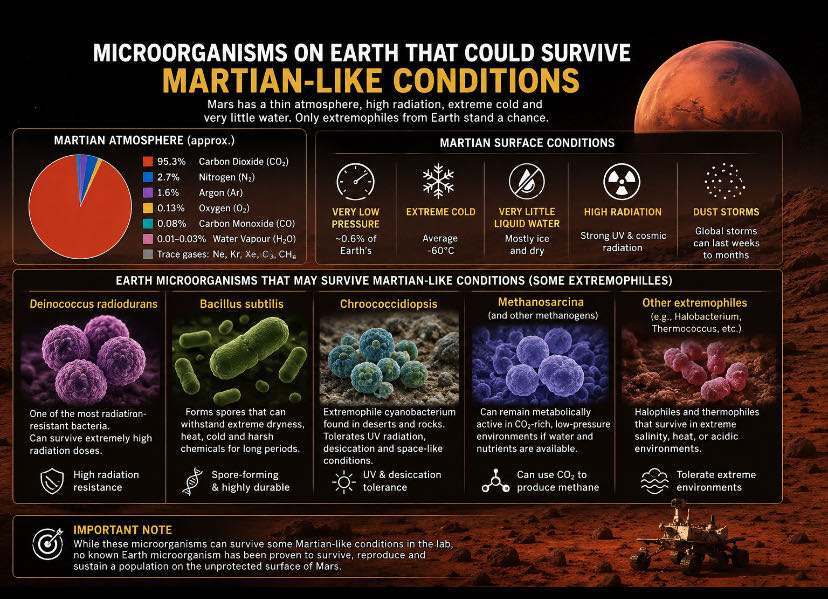
Some microorganisms on Earth can survive certain aspects of the Martian environment, such as low oxygen, a carbon dioxide-rich atmosphere, extreme cold, dryness, and high radiation. However, no known Earth microorganism has been proven to survive and actively grow for long periods on the unprotected surface of Mars.
Examples include:
* 🦠 Deinococcus radiodurans – One of the most radiation-resistant bacteria known. It can survive doses of radiation that would be lethal to most other life forms.
* 🦠 Bacillus subtilis – Produces highly durable spores that can withstand extreme dryness and harsh environmental conditions for long periods.
* 🦠 Chroococcidiopsis – Lives in deserts and inside rocks, tolerates intense UV radiation and desiccation, and has been tested under space-like conditions.
* 🦠 Methanosarcina and other methanogens – Laboratory studies have shown that some can remain metabolically active under Mars-like conditions if water and suitable nutrients are available.
Why Mars is so challenging
The Martian atmosphere is only part of the problem. Mars also has:
* 🌫️ 95% carbon dioxide (CO₂) and almost no oxygen.
* 🌬️ Very low atmospheric pressure (about 0.6% of Earth’s).
* ❄️ Extremely cold temperatures, averaging around −60°C.
* 💧 Very little liquid water on the surface.
* ☢️ High levels of ultraviolet and cosmic radiation due to its thin atmosphere and lack of a global magnetic field.
Conclusion
Although several extremophile microorganisms from Earth can tolerate some Mars-like conditions and survive for limited periods in laboratory experiments, no known Earth microorganism has been demonstrated to permanently survive, reproduce, and establish a self-sustaining population on the exposed surface of Mars without protection.


Comments
No comments yet.