

Ownmates Post

Liquid Metal Robots
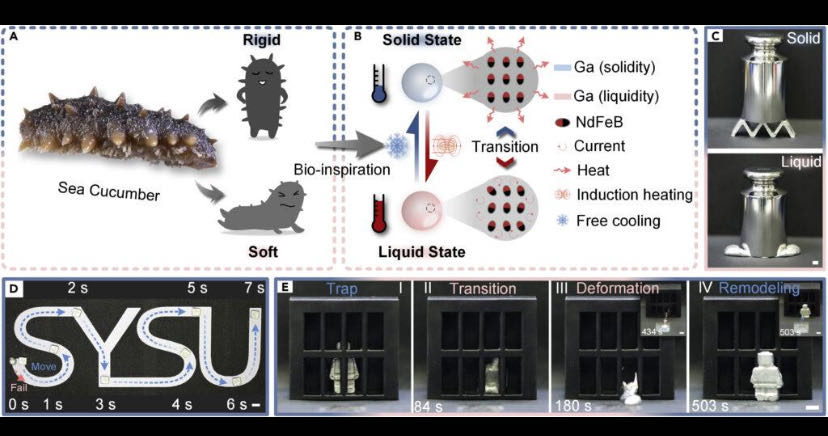
A liquid metal robot is a robot made entirely or partially from a liquid metal, typically a gallium-based alloy, that can change shape and move under controlled conditions. Today, these robots are experimental research prototypes, not science-fiction machines.
How do they work?
* Material: Most use gallium-based liquid metal alloys, which can remain liquid near room temperature.
* Control: They are usually controlled by magnetic fields, electric currents, or changes in temperature.
* Shape-changing: Under specific conditions, they can deform, squeeze through narrow openings, split into smaller droplets, and sometimes merge back together.
Potential applications
* Medical robots for targeted drug delivery or minimally invasive procedures.
* Inspection and repair in confined or hard-to-reach spaces.
* Soft robotics, where flexibility is more important than rigid mechanical parts.
* Micro-robotics for scientific and industrial applications.
Are they like the Terminator T-1000?
No. The liquid metal robots demonstrated in laboratories are far less advanced.
The fictional T-1000 can:
* Instantly transform into almost any shape.
* Repair itself autonomously.
* Move and think independently.
* Mimic people and objects.
Current liquid metal robots:
* Require external control (such as magnetic fields).
* Operate in highly controlled laboratory environments.
* Are typically very small.
* Cannot transform into complex objects or function as autonomous humanoid robots.
Current status
Liquid metal robotics is an active area of research, and scientists continue to improve these systems. However, real liquid metal robots are still limited to specialized laboratory experiments and are nowhere near the capabilities of science-fiction robots like the T-1000.


Comments
No comments yet.