

Ownmates Post

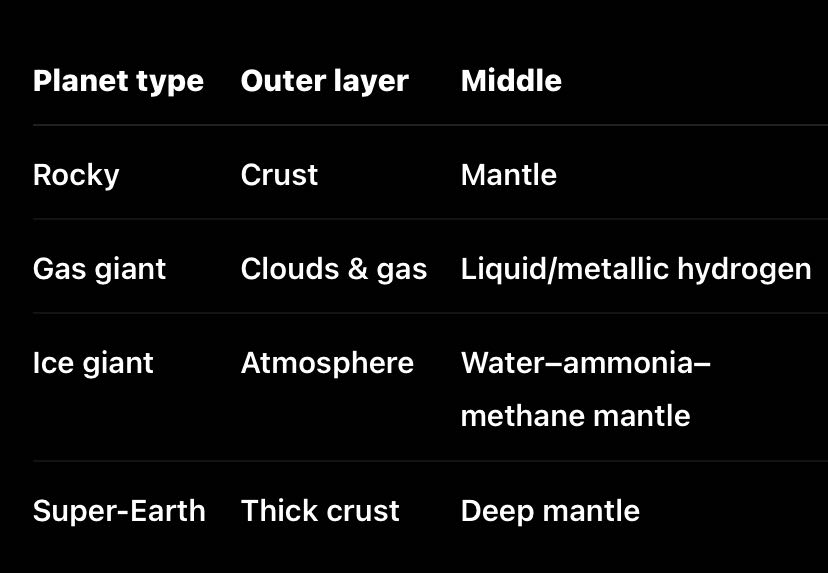
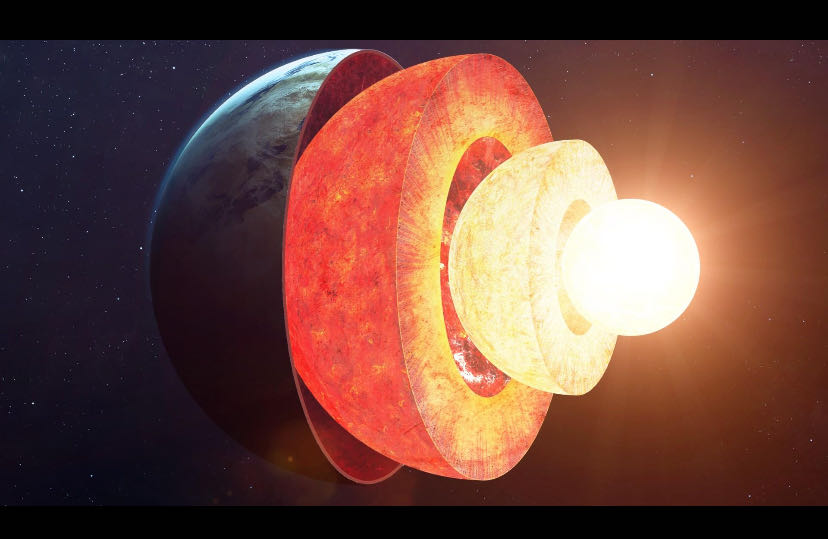
When scientists imagine slicing planets open, they generally find that most planets fall into a few broad interior types. We can’t directly see inside exoplanets, but we infer their interiors from their size, mass, density, and how planets form.
🪨 Rocky planets (like Earth, Venus, Mars, Mercury)
These planets have layered interiors:
* Crust – Thin, solid outer shell of rock.
* Mantle – Thick layer of hot rock that slowly flows over millions of years.
* Outer Core – Usually liquid iron and nickel (Earth’s is liquid).
* Inner Core – Extremely dense solid iron and nickel, compressed by immense pressure.
Earth’s mantle makes up about 84% of its volume, while the core is responsible for generating its magnetic field.
⸻
🪐 Gas giants (like Jupiter and Saturn)
These planets don’t have a solid surface.
From the outside inward:
* Thick clouds of hydrogen and helium.
* Layers of hydrogen compressed into a liquid.
* Metallic hydrogen, where hydrogen behaves like an electrically conducting metal because of enormous pressure.
* A dense central core, likely made of rock, metals, and ice-like materials, though its exact size and composition remain an active area of research.
⸻
❄️ Ice giants (like Uranus and Neptune)
Their interiors differ from gas giants:
* Hydrogen-helium atmosphere.
* A deep mantle rich in water, ammonia, and methane under extreme pressure (often called an “icy” mantle, though it isn’t frozen like household ice).
* A rocky and metallic core.
These unusual interiors may explain their complex magnetic fields.
⸻
🌌 Exoplanets
Across the universe, astronomers think many worlds have even stranger interiors:
* Super-Earths – Larger rocky planets with thicker mantles and bigger cores.
* Ocean worlds – Global oceans hundreds of kilometers deep over high-pressure ice.
* Carbon planets (hypothetical) – Interiors rich in carbon compounds, possibly including diamond layers.
* Iron-rich planets – Massive iron cores with relatively thin rocky mantles.
Because we cannot directly drill into these planets, these models are based on physics, observations, and computer simulations.
The deeper you go inside almost any planet, pressure and temperature increase dramatically. While the exact composition varies, many planets are thought to have a layered structure with lighter materials near the surface and denser materials concentrated toward the center due to gravity.


Comments
No comments yet.