

Ownmates Post

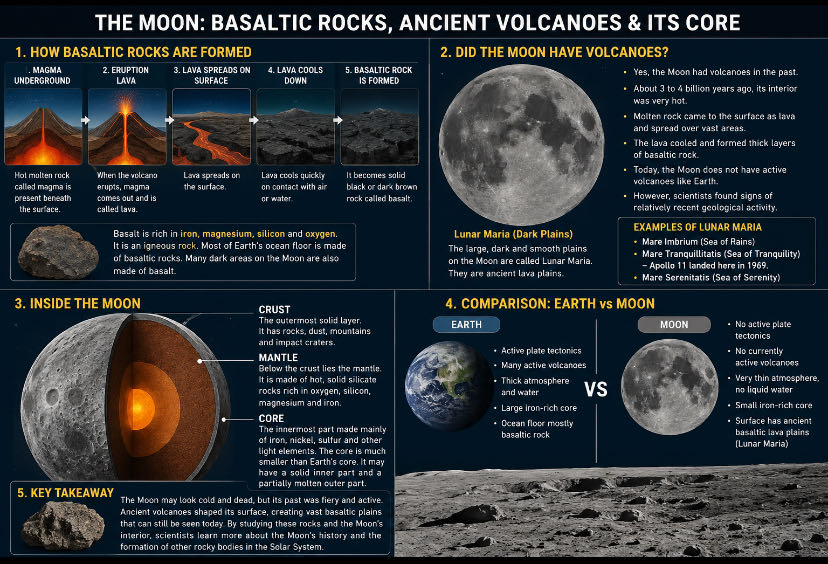
Basaltic Rocks, Ancient Volcanoes, and the Moon’s Core
The Moon may look cold, quiet, and lifeless today, but billions of years ago, it was much more geologically active. Ancient volcanic eruptions released large amounts of molten rock onto its surface. This lava cooled and formed dark basaltic rocks, which can still be seen across many areas of the Moon.
How Are Basaltic Rocks Formed?
Basalt is a type of igneous rock. It forms when hot molten rock cools and becomes solid.
The process takes place in the following way:
1. Deep inside a planet or moon, extremely hot melted rock is called magma.
2. When magma reaches the surface, it is called lava.
3. The lava spreads across the surface and begins to cool.
4. As it cools, it becomes solid and forms a dark volcanic rock called basalt.
Basalt is usually black or dark gray. It contains minerals rich in iron, magnesium, silicon, oxygen, and calcium.
On Earth, much of the ocean floor is made of basaltic rock. Basalt is also found in many dark regions on the Moon.
Did the Moon Have Volcanoes?
Yes. The Moon experienced major volcanic activity in the distant past. Around 3 to 4 billion years ago, the Moon’s interior was much hotter than it is today.
Molten rock from inside the Moon rose to the surface and flowed across large areas. This lava later cooled and formed thick layers of basaltic rock.
The Moon does not have active volcanoes like those found on Earth today. There is no confirmed evidence of large, currently erupting lunar volcanoes. However, scientists have found signs of relatively recent geological activity, suggesting that the Moon may not be completely geologically inactive.
What Are Lunar Maria?
The large, dark, and relatively smooth plains on the Moon are called Lunar Maria. The word “Maria” comes from Latin and means “seas.”
Early astronomers thought these dark areas were oceans or seas because they looked smooth and flat. However, they do not contain water. They are vast plains formed by ancient volcanic lava.
Some famous lunar maria include:
* Mare Imbrium — Sea of Rains
* Mare Tranquillitatis — Sea of Tranquility
* Mare Serenitatis — Sea of Serenity
The Apollo 11 spacecraft landed in the Mare Tranquillitatis region. In 1969, humans walked on the Moon for the first time there.
What Is Inside the Moon?
The Moon has several main internal layers.
1. Crust
The crust is the Moon’s outermost solid layer. It contains rocks, dust, mountains, and many impact craters.
Because the Moon has an extremely thin atmosphere and no strong weather system like Earth’s, many craters remain visible for billions of years.
2. Mantle
Below the crust is the mantle. It is made mainly of hot, solid silicate rocks containing elements such as:
* Oxygen
* Silicon
* Magnesium
* Iron
In the Moon’s early history, parts of the mantle were much hotter and could melt to produce magma. Some of this magma reached the surface and became lava.
3. Core
The core is the Moon’s innermost region. Scientists believe it contains mainly:
* Iron
* Nickel
* Sulfur
* Other light elements
The Moon’s core is much smaller than Earth’s core. It is thought to have a solid inner region and a partially molten or liquid outer region.
Conclusion
The Moon appears cold and inactive today, but its ancient history was shaped by volcanic activity. Billions of years ago, molten rock rose from inside the Moon, flowed across its surface as lava, and cooled to form basaltic rocks.
These ancient lava flows created the large, dark plains known as Lunar Maria. By studying basaltic rocks, volcanic regions, and the Moon’s internal structure, scientists can better understand how the Moon formed and how it changed over billions of years.


Comments
No comments yet.