

Ownmates Post

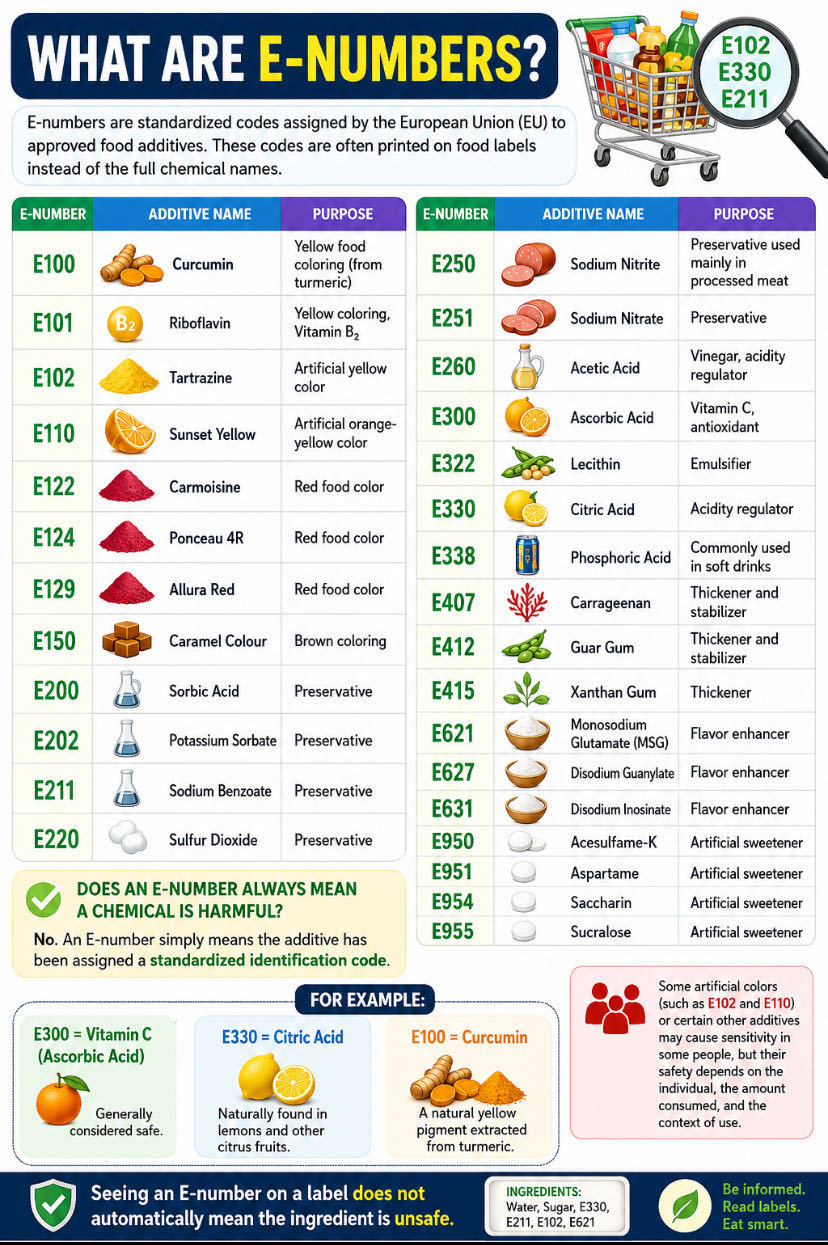
E-numbers are standardized codes assigned by the European Union (EU) to approved food additives. These codes are often printed on food labels instead of the full chemical names.
Here are some common E-numbers and their names:
E-number Additive Name Purpose
E100 Curcumin Yellow food coloring (from turmeric)
E101 Riboflavin Yellow coloring, Vitamin B₂
E102 Tartrazine Artificial yellow color
E110 Sunset Yellow Artificial orange-yellow color
E122 Carmoisine Red food color
E124 Ponceau 4R Red food color
E129 Allura Red Red food color
E150 Caramel Colour Brown coloring
E200 Sorbic Acid Preservative
E202 Potassium Sorbate Preservative
E211 Sodium Benzoate Preservative
E220 Sulfur Dioxide Preservative
E250 Sodium Nitrite Preservative used mainly in processed meat
E251 Sodium Nitrate Preservative
E260 Acetic Acid Vinegar, acidity regulator
E300 Ascorbic Acid Vitamin C, antioxidant
E322 Lecithin Emulsifier
E330 Citric Acid Acidity regulator
E338 Phosphoric Acid Commonly used in soft drinks
E407 Carrageenan Thickener and stabilizer
E412 Guar Gum Thickener and stabilizer
E415 Xanthan Gum Thickener
E621 Monosodium Glutamate (MSG) Flavor enhancer
E627 Disodium Guanylate Flavor enhancer
E631 Disodium Inosinate Flavor enhancer
E950 Acesulfame-K Artificial sweetener
E951 Aspartame Artificial sweetener
E954 Saccharin Artificial sweetener
E955 Sucralose Artificial sweetener
Does an E-number always mean a chemical is harmful?
No. An E-number simply means the additive has been assigned a standardized identification code.
For example:
* E300 = Vitamin C (Ascorbic Acid) – Generally considered safe.
* E330 = Citric Acid – Naturally found in lemons and other citrus fruits.
* E100 = Curcumin – A natural yellow pigment extracted from turmeric.
Some artificial colors (such as E102 and E110) or certain other additives may cause sensitivity in some people, but their safety depends on the individual, the amount consumed, and the context of use. Seeing an E-number on a label does not automatically mean the ingredient is unsafe.


Comments
No comments yet.